 Customer Service Software Guides & AI Agent Blogs | Udesk
Why a Global Customer Service System is Critical for Manufacturing Overseas Expansion
article summary:Manufacturing overseas shouldn't mean drowning in scattered WhatsApps and soaring support costs. Our latest guide explores how a global customer service system can slash after-sales overhead by 60%. Learn to bridge the "translation gap" with AI, unify omnichannel customer service, and master field dispatching. We highlight how Udesk turns complex global support into a lean, scalable engine. Stop firefighting and start growing!



Table of contents for this article
- 1. Challenges of Post-Sale Support in Global Manufacturing
- 1.1 Fragmented Communication Channels and Data Silos
- 1.2 High Operational Costs of Multilingual Technical Support
- 1.3 Managing Complex Warranty and Spare Parts Logistics
- 2. Architecture of an Effective Global Customer Service System
- 2.1 Omnichannel Integration for Seamless Global Reach
- 2.2 Automated Ticketing and Intelligent Routing
- 2.3 Centralized Knowledge Base and Self-Service Portals
- 3. Optimizing the "Ticketing + Dispatch + Field Service" Workflow
- 3.1 Streamlining the Transition from Digital Ticket to Physical Repair
- 3.2 Real-Time Dispatching and Resource Optimization
- 3.3 Feedback Loops and Continuous Improvement
- 4. Udesk: The Leading Global Customer Service Solution for Manufacturers
- 4.1 Unified Omnichannel Platform
- 4.2 Intelligent Field Service Management (FSM)
- 4.3 AI-Powered Multilingual Support
- 4.4 Data-Driven Insights and Reporting
- 5. FAQ
- 》》Click to start your free trial of Omnichannel Systems, and experience the advantages firsthand.
Expanding into international markets requires more than just high-quality products; it demands a robust global customer service system to handle complex after-sales needs. For manufacturers, transitioning from local sales to a global footprint often reveals deep-seated inefficiencies in technical support and spare parts management.
By implementing an overseas customer support solution, companies can bridge the gap between regional headquarters and local end-users. This article explores how an omnichannel customer service approach—integrating WhatsApp customer service, automated ticketing, and field service management—can reduce operational costs by up to 60% while maintaining brand loyalty across borders.

1. Challenges of Post-Sale Support in Global Manufacturing
1.1 Fragmented Communication Channels and Data Silos
In the context of global manufacturing, communication often happens across a chaotic mix of emails, phone calls, and local messaging apps. Without a unified global customer service system, customer inquiries and technical issues are scattered across different platforms, making it nearly impossible for managers to track the history of a specific piece of equipment or a client's previous complaints.
The challenge lies in the "information black hole" created when regional offices use separate tools. A distributor in Europe might use email, while a client in Southeast Asia prefers WhatsApp customer service. When data isn't centralized, the home office loses visibility into product failure rates or common user errors, leading to slow response times and repetitive troubleshooting. For a SaaS-driven manufacturer, this lack of transparency prevents the optimization of the entire supply chain.
For example, a construction machinery manufacturer might find that their Brazilian team is resolving the same hydraulic issue that the Indonesian team solved months ago. Because the data wasn't shared through a central overseas customer support solution, the company wastes hundreds of hours in redundant engineering work. This inefficiency directly inflates labor costs and frustrates high-value B2B clients who expect rapid, expert intervention.
A centralized system resolves this by aggregating every interaction into a single customer profile, ensuring that data serves as a strategic asset rather than a buried liability. Centralizing communication is the first step toward turning after-sales from a cost center into a value driver.
1.2 High Operational Costs of Multilingual Technical Support
Manufacturing products are inherently technical, requiring specialized knowledge to troubleshoot. When expanding globally, the cost of hiring native-speaking technical experts in every target market is often prohibitive. Companies struggle to balance the need for high-quality, localized support with the reality of limited budgets and the difficulty of finding qualified personnel who understand both the language and the machinery.
Real-world scenarios often involve "translation lag." A customer in Vietnam reports a turbine malfunction; the local agent translates it into English to send to the head office in China or Europe; the engineer responds in English, which is then translated back. This manual process is slow, prone to technical inaccuracies, and incredibly expensive due to the high headcount required to manage the flow. Without a multilingual knowledge base, the cost per ticket remains unsustainably high.
Consider a consumer electronics manufacturer launching a new smart appliance line. Without an automated global customer service system, they would need a 24/7 localized call center to handle basic setup questions. By utilizing AI-powered translation and localized self-service portals, they can deflect 70% of these queries, allowing their expensive technical staff to focus on high-level engineering problems rather than basic "how-to" questions.
The solution lies in leveraging technology that provides instant translation and intelligent routing, ensuring that the right expert is matched with the right problem regardless of language barriers. Efficient global support relies on replacing manual translation with integrated, AI-enhanced communication tools.
1.3 Managing Complex Warranty and Spare Parts Logistics
After-sales in manufacturing isn't just about talking; it’s about doing. Managing warranties and the logistics of spare parts across borders involves navigating different legal regulations, shipping times, and inventory levels. Without an integrated global customer service system, the disconnect between the support desk and the warehouse leads to shipping delays, incorrect parts being sent, and expired warranties being honored by mistake.
Businesses often face the "parts mismatch" problem. A field engineer arrives at a site in Mexico only to realize the support ticket didn't specify the correct model revision, and the spare part in their truck doesn't fit. This results in "second-trip" costs, which are a major drain on profitability. Without a system that links the customer's purchase history (installed base) to the inventory management system, these errors are inevitable.
For instance, an industrial pump manufacturer might have a five-year warranty policy that varies by region due to local consumer laws. If the agent in Turkey doesn't have immediate access to the digitized warranty contract, they may offer a free repair for a product that is out of scope, or worse, deny a legitimate claim and damage the brand's reputation. An overseas customer support solution tracks these variables automatically.
By integrating ticketing with asset management, manufacturers ensure that every service request is validated against actual warranty data and linked to real-time inventory. Automating the link between support tickets and logistics is essential for controlling the high costs of physical after-sales service.
2. Architecture of an Effective Global Customer Service System
2.1 Omnichannel Integration for Seamless Global Reach
An effective global customer service system must meet customers where they are. In the modern landscape, this means moving beyond the "contact us" form on a website. Omnichannel customer service integrates email, live chat, voice, and social messaging into a single interface for the agent, while providing a consistent experience for the user regardless of their chosen platform.
The problem many manufacturers face is "channel sprawl." They try to be everywhere but end up being slow everywhere. An agent has to check five different tabs to see if a customer has replied, leading to missed messages and duplicated efforts. In a global context, this is exacerbated by regional preferences, such as the dominance of WhatsApp customer service in Latin America and Europe, or Line in Japan.
Take a global solar panel manufacturer as an example. Their B2B installers might prefer a professional email thread for documentation, while the end-user (homeowner) wants a quick update via WhatsApp. An omnichannel customer service platform allows the support team to manage both interactions from one dashboard, ensuring that the history is preserved and the response is rapid.
By unifying these channels, companies can implement a "follow-the-sun" support model, where tickets are handed off between global offices as time zones shift, without losing any context. True omnichannel capability ensures that the brand remains accessible and responsive across all global digital touchpoints.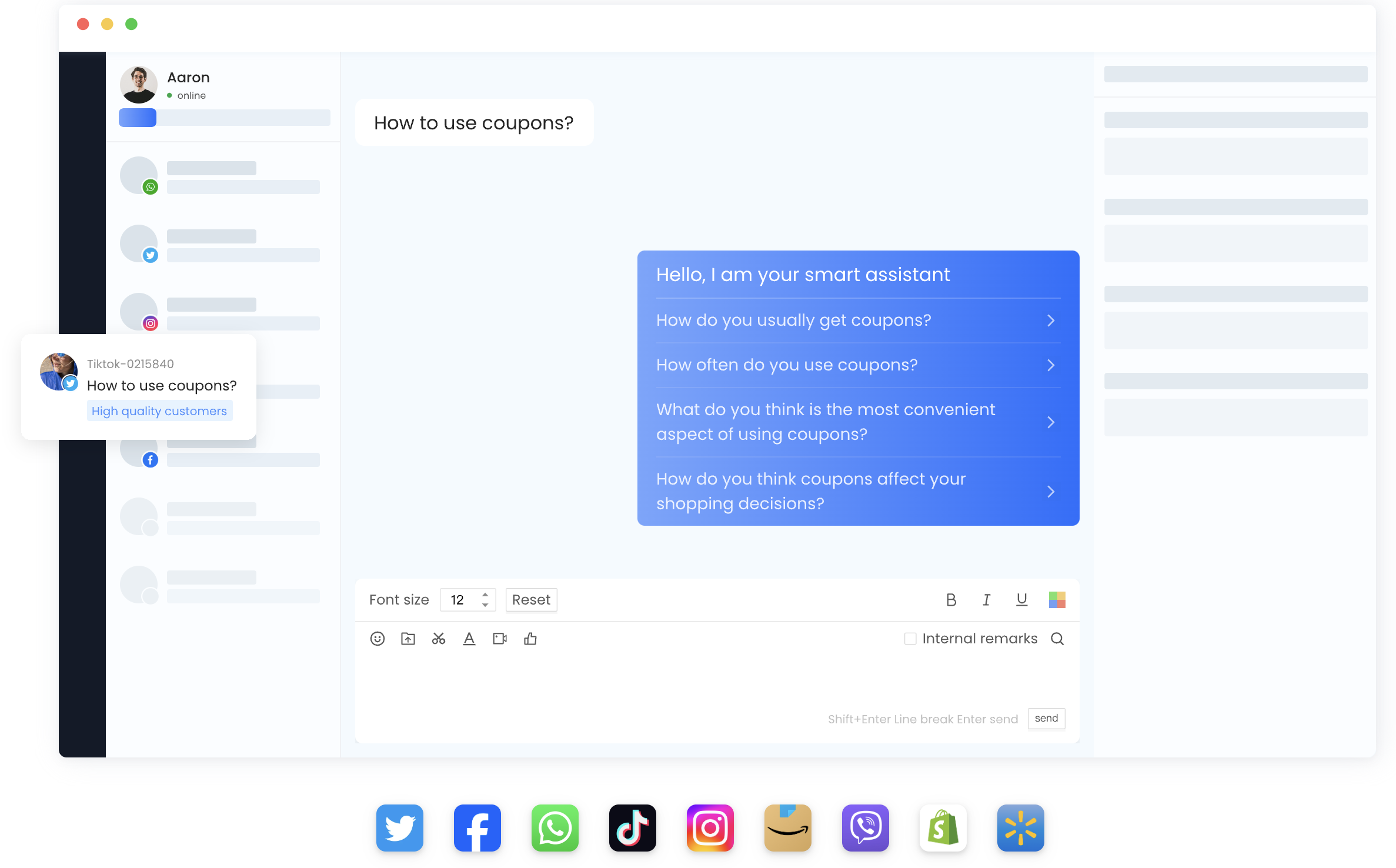
2.2 Automated Ticketing and Intelligent Routing
The heart of any overseas customer support solution is the ticketing engine. It’s not enough to just receive messages; the system must understand the priority, the product type, and the required expertise to route the task to the most capable agent. Manual sorting of hundreds of global emails daily is a recipe for delayed high-priority issues and overwhelmed staff.
In global manufacturing, a "critical failure" at a factory is far more urgent than a "manual request" from a hobbyist. Without intelligent routing, these two tickets might sit in the same queue. The challenge is identifying keywords, customer tiers (SLA levels), and geographic origins to ensure that a "Tier 1" client in Germany is answered within 30 minutes, as per their contract.
Imagine an automotive component supplier. When a production line stop is reported, the global customer service system uses AI to detect keywords like "line down" or "emergency." It immediately bypasses general support and pings the senior technical engineer on duty in that specific time zone. This automation ensures that the most critical issues receive the fastest response, protecting the manufacturer from costly SLA penalties.
This level of automation removes human error from the initial sorting process and ensures that no ticket falls through the cracks. Intelligent routing transforms a reactive support desk into a proactive, SLA-driven service department.
2.3 Centralized Knowledge Base and Self-Service Portals
A multilingual knowledge base is the most effective tool for reducing support volume and empowering global customers. In manufacturing, where many issues are related to installation or basic maintenance, providing high-quality, searchable documentation in the customer's native language can solve problems before they ever become a ticket.
The primary issue is that technical documentation is often stored in static PDFs that are hard to search and rarely updated across all languages simultaneously. When a customer can't find an answer, they call or email, driving up the company's "cost per contact." This is a significant burden for manufacturers with thousands of SKUs and complex technical specifications.
For a SaaS-integrated hardware company, a self-service portal can include video tutorials, troubleshooting trees, and FAQ sections. If a customer in France encounters an error code on their 3D printer, they can type the code into the global customer service system portal and receive an instant, localized solution. This "zero-touch" resolution is the gold standard for modern customer support.
By investing in a robust knowledge management strategy, companies can scale their support capabilities without linearly increasing their headcount. A well-maintained, multilingual self-service portal is the foundation of a cost-effective global support strategy.
3. Optimizing the "Ticketing + Dispatch + Field Service" Workflow
3.1 Streamlining the Transition from Digital Ticket to Physical Repair
In the manufacturing sector, a digital ticket is often just the beginning. The real work frequently happens on-site. The critical challenge is the "handoff" between the digital global customer service system and the field service team. If these two systems don't talk to each other, information is lost, and the customer experience suffers.
Many companies struggle with a "broken chain" where the support agent promises a repair, but the dispatch team has no record of the specific technical requirements or the parts needed. This leads to wasted trips and extended downtime for the customer. For global operations, where a field technician might be a third-party contractor, this lack of coordination is even more dangerous for brand reputation.
Consider an industrial HVAC company. A sensor fault is reported via the overseas customer support solution. The system should automatically generate a work order that includes the sensor's part number, the unit's service history, and the site's access requirements. When the technician arrives, they have all this info on a mobile app, allowing them to complete the repair on the first visit.
This seamless integration ensures that everyone from the call center agent to the technician on the roof is looking at the same "single source of truth." Closing the loop between digital support and physical field service is vital for operational efficiency.
3.2 Real-Time Dispatching and Resource Optimization
Efficiently managing a global fleet of technicians requires real-time visibility. A global customer service system must include or integrate with a Dispatch Management System (DMS) to track technician locations, skill sets, and current workloads. Without this, dispatchers are "flying blind," often sending technicians who are too far away or lack the specific certification for a task.
The problem is particularly acute in large-scale manufacturing where specialized skills (like high-voltage electrical work) are required. If the system doesn't track "skill tags," a general technician might be sent to a job they aren't qualified to perform, necessitating a second dispatch and doubling the service cost.
Using a modern overseas customer support solution, a dispatcher can see a map of all active tickets and available technicians. If an emergency arises in Chicago, the system can identify the nearest technician who has the "Precision Calibration" certification and reroute them instantly. This dynamic scheduling maximizes the "wrench time" of every employee.
This level of optimization directly impacts the bottom line by reducing travel expenses and increasing the number of jobs completed per day. Intelligent dispatching ensures that the right person reaches the right place at the right time, every time.
3.3 Feedback Loops and Continuous Improvement
The final stage of the field service workflow is data capture. Once a repair is finished, the data collected on-site must flow back into the global customer service system to inform future product development and support strategies. Often, this data is lost in paper notebooks or disparate spreadsheets, leaving the company with no way to track long-term product reliability.
In a global business case, a manufacturer of medical devices might notice through their ticketing data that a specific component is failing prematurely in humid climates. Without a system that aggregates field service reports into a central database, this pattern might go unnoticed for years, leading to massive recall costs later.
By mandating digital "close-out" reports in the overseas customer support solution, technicians can upload photos, note the parts used, and record the time spent. This data is then analyzed by the HQ engineering team to improve product design. It also allows the customer service team to follow up with a satisfaction survey, closing the loop on the customer experience.
Turning field data into actionable intelligence is what separates market leaders from their competitors. A continuous feedback loop ensures that today's service calls prevent tomorrow's product failures.
4. Udesk: The Leading Global Customer Service Solution for Manufacturers
Udesk provides a comprehensive, AI-driven global customer service system specifically designed to handle the complexities of overseas expansion and industrial after-sales. Rather than offering a generic chat tool, Udesk focuses on the entire lifecycle of a customer inquiry, from the first "hello" to the final field repair.
4.1 Unified Omnichannel Platform
Udesk integrates WhatsApp customer service, Facebook Messenger, Email, Voice, and Live Chat into a single "Agent Desktop."
- Use Case: A global machinery company can manage Brazilian customers on WhatsApp and North American clients via phone, all within the same Udesk interface.
- Business Value: This unification reduces agent training time and ensures that no customer message is ever lost, leading to a 30% increase in agent productivity.
4.2 Intelligent Field Service Management (FSM)
Udesk's system goes beyond digital tickets by offering integrated dispatch and field service modules.
- Use Case: When a heavy equipment manufacturer receives a repair request, Udesk automatically converts it into a work order, assigns it to the nearest qualified technician, and tracks the spare parts used.
- Business Value: This minimizes "second-trip" costs and ensures high First-Time Fix Rates (FTFR), which are critical for maintaining industrial uptime.
4.3 AI-Powered Multilingual Support
Udesk leverages advanced AI to provide real-time translation and a robust multilingual knowledge base.
- Use Case: A customer in Italy can interact with a support center in Asia; the system translates the Italian query to the agent's language and the agent's response back to Italian instantly.
- Business Value: This allows manufacturers to centralize their support hubs, drastically reducing the need for expensive localized call centers and saving up to 50% on global labor costs.
4.4 Data-Driven Insights and Reporting
Udesk provides deep analytics into ticket volume, response times, and product failure patterns.
- Use Case: Management can generate reports on which global regions have the highest warranty claims and why, allowing for data-backed decisions on regional pricing or product adjustments.
- Business Value: This visibility transforms customer service from a cost center into a strategic advisor for the entire organization, driving long-term product-market fit.

5. FAQ
Q: How does a global customer service system help reduce after-sales costs? A global customer service system reduces costs by automating routine inquiries through a multilingual knowledge base, optimizing technician dispatching to prevent wasted trips, and centralizing data to reduce the need for large, localized support teams. By increasing efficiency and self-service, companies often see a 40–60% reduction in operational overhead.
Q: Is WhatsApp customer service necessary for manufacturing support? Yes, in many regions like Europe, Latin America, and Southeast Asia, WhatsApp customer service is the preferred method of communication for B2B and B2C clients. Integrating WhatsApp into your omnichannel customer service strategy ensures higher engagement rates and faster response times compared to traditional email.
Q: How does Udesk handle security for global manufacturing data? Udesk adheres to global security standards, including GDPR compliance, ensuring that sensitive customer and technical data is protected across borders. This is vital for manufacturers who deal with proprietary technical specifications and high-value client information in a global customer service system.
Implementing a robust global customer service system is no longer an option—it is a necessity for any manufacturer looking to succeed in the international arena. By addressing the challenges of fragmented communication, high technical support costs, and complex logistics, companies can build a foundation for sustainable growth.
The integration of an overseas customer support solution like Udesk allows businesses to scale efficiently, maintaining high service standards without a corresponding explosion in costs. From WhatsApp customer service to advanced field service dispatching, the right system ensures that your brand remains synonymous with reliability, no matter where your products are installed.
Ready to optimize your global after-sales operations? Explore Udesk’s Global Solutions today and see how our integrated platform can transform your customer service into a competitive advantage. Book a demo to start your journey toward a 60% reduction in service costs.
》》Click to start your free trial of Omnichannel Systems, and experience the advantages firsthand.

The article is original by Udesk, and when reprinted, the source must be indicated:https://www.udeskglobal.com/blog/why-a-global-customer-service-system-is-critical-for-manufacturing-overseas-expansion.html