For enterprise leaders, the contact center is no longer just a cost center—it is the strategic nexus of customer experience (CX). However, scaling this function is fraught with risk. Traditional on-premise infrastructure forces you to forecast demand months in advance, leading to either stranded capacity or catastrophic service failures during traffic spikes.
The shift to Cloud Contact Center Solutions (CCaaS) has matured. Yet, not all clouds are equal. A solution that works for 10 agents often collapses under the governance, latency, and compliance weight of 10,000 agents.
This guide provides a framework for selecting a cloud contact center solution that scales linearly with your business. We analyze deployment models (Public, Private, Hybrid), global expansion logistics, and the non-negotiable regulatory landscape—highlighting how Udesk’s microservices architecture and global multi-node infrastructure solve the "Impossible Trinity" of scale, cost, and reliability .
Part 1: The Scaling Paradox – Why 10 Agents is Different from 10,000
The technical debt incurred by a bad buying decision at 10 agents will break the bank at 10,000.
The Architecture Litmus Test
When evaluating CCaaS providers, look beyond the feature checklist. You need an architecture that supports elasticity. In a modern cloud-native system, concurrency should be a matter of configuration, not hardware procurement.
-
The SMB Reality (10–50 Agents): Focus is on simplicity and up-time. Basic queueing and CRM integration suffice.
-
The Enterprise Reality (1,000–10,000+ Agents): Focus shifts to throughput, AI governance, and disaster recovery. You need a system that can handle 352,000 API calls per hour without manual intervention .
Key Insight: Udesk’s containerized architecture leverages auto-scaling groups. During Black Friday traffic surges, the system autonomously spins up new instances to handle the load, and scales down when traffic normalizes—optimizing for both customer experience and cloud spend .
Part 2: Choosing Your Deployment Model (Public vs. Private vs. Hybrid)
The debate is no longer "Cloud vs. On-Prem." It is "Which Cloud?" Your choice dictates your data sovereignty, integration depth, and total cost of ownership (TCO).
We have broken down the three archetypes to help you align your deployment with your risk tolerance and growth curve .
When to choose what?
-
Go Public if you are a B2C brand facing seasonal spikes (e.g., retail, travel). You need the "infinite ceiling" of Udesk’s public cloud to handle volume without buying servers.
-
Go Private if you are a bank or healthcare provider where data cannot leave a specific VPC (Virtual Private Cloud). Udesk offers dedicated instances that meet stringent security audits.
-
Go Hybrid if you are a manufacturer with legacy IVR systems but want modern AI chat. Udesk’s APIs allow you to keep the old PBX for voice while deploying AI bots on the cloud edge .
Part 3: The Global Imperative – Multi-Node Architecture
Latency is the enemy of customer satisfaction. If your contact center platform is hosted only in the US, your agents in Singapore or London will suffer from lag of 200ms+, leading to "talk-over" and dropped calls.
Udesk’s Global Multi-Node Strategy
To solve this, Udesk has deployed a global network of data centers and edge nodes. This is not just server hosting; it is intelligent traffic routing .
-
Geographic Distribution: Nodes in North America, East Asia, Southeast Asia, and Europe ensure that a call from a customer in Tokyo is processed by a server in Tokyo, not one routed back to Virginia.
-
Local Dial Tone: Udesk provides local DID numbers (Phone numbers) in over 225 countries and 1,600+ telecom networks. This increases answer rates and reduces cross-border telecom fees .
-
AI-Powered Translation: In a global center, an English-speaking agent can service a Spanish or Japanese customer. Udesk integrates real-time AI translation into the agent desktop, removing language as a barrier to scaling .
Case in Point
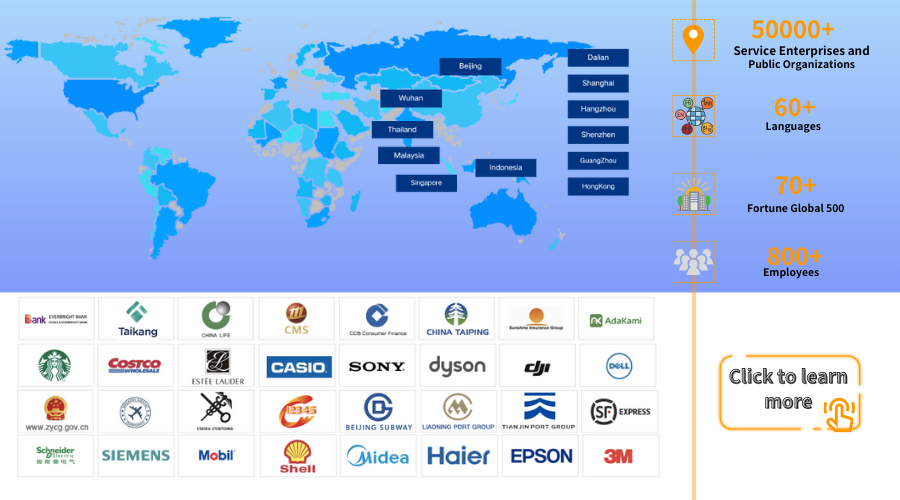
When scaling globally, major electronics retailers and EV manufacturers (like BYD and Huawei) use Udesk to connect their global offices. A customer in the US speaks to a local IVR, but if necessary, the call routes seamlessly to a specialist in China via the Udesk cloud fabric, with no perceived latency .
Part 4: Compliance Without Borders (GDPR, CCPA, & Beyond)
Scaling to 10,000 agents often means operating across 50 jurisdictions. Compliance is the biggest blocker to scale. You cannot simply "copy" customer data from Europe to the US without violating GDPR .
Navigating the "Data Trilemma"
You must balance Data Residency (Where data sleeps), Processing (Where it is analyzed), and Access (Who sees it).
How Udesk operationalizes compliance:
-
Data Residency by Design: For a global bank, Udesk can deploy a private instance in AWS Frankfurt for EU traffic and a separate instance in AWS Singapore for APAC traffic. Data never crosses borders unintentionally .
-
PCI DSS & HIPAA Ready: The platform supports redaction of payment card information (PCI) from call recordings. If an agent says a credit card number, the Udesk system automatically blanks that audio segment and transcript before it hits the storage logs .
-
Consent Management: The platform integrates directly with DNC (Do Not Call) lists and consent management platforms (CMPs). Outbound dialing campaigns automatically scrub numbers against global blacklists to avoid TCPA violations .
Part 5: The Enterprise Buyer’s Checklist
To ensure you do not get "burned" by a platform that cannot scale, use this RFP checklist for your cloud contact center evaluation .
-
Is the architecture truly "headless"? Can you use the same microservices for voice, chat, and WhatsApp? (Udesk supports unified routing across 20+ channels).
-
Is the AI deterministic? When the AI fails, does it default to a human? Does it support "Agent Assist" (giving agents info) rather than just "Bot Replace"?
-
Can we fail over? Does the provider support Active-Active data centers? If one cloud node goes down, does traffic route instantly to another without dropping the call?
-
Is pricing linear? Beware of vendors who charge "per feature." Udesk’s model scales with agents, not hidden API overage fees.
Conclusion
Scaling a contact center from 10 to 10,000 agents is a test of your infrastructure's elasticity and your partner's global reach. You need a solution that offers the security of a private cloud, the intelligence of AI, and the reach of a global telecom carrier.
Udesk provides the blueprint for this scale. With its global multi-node architecture, support for 30+ languages, and hyper-scalable containerized core, Udesk ensures that whether you have 10 agents or 10,000, every customer interaction feels local, secure, and instant .
Frequently Asked Questions (FAQ)
1. What is the typical time-to-value for deploying Udesk across a global team (e.g., US and Europe)?
Most deployments complete in under 4 weeks. Because Udesk is cloud-native and offers pre-built integrations for major CRMs (Salesforce, SAP, Zendesk), you can set up a multi-node environment (e.g., EU data residency + US data residency) in a matter of days. The primary time investment is configuring your specific routing logic (IVR) .
2. How does Udesk handle high-volume outbound marketing campaigns without violating TCPA compliance?
Udesk’s outbound dialer includes compliance guardrails. It supports "Right Party Connect" (RPC) to ensure agents only speak to live answers, not answering machines. Furthermore, the system automatically enforces time-of-day restrictions (e.g., no calls before 8 AM local time) and syncs with DNC lists, scrubbing numbers in real-time to prevent fines .
3. If we choose a Private Cloud deployment now, can we switch to Public Cloud later without re-provisioning agents?
Yes. Udesk operates on a unified platform codebase. The difference between Public and Private is the deployment environment (shared vs. dedicated hardware), not the software logic. You can migrate your configuration, historical data, and even licenses via a managed migration service without retraining agents on a new interface .
 Customer Service Software Guides & AI Agent Blogs | Udesk