 Customer Service Software Guides & AI Agent Blogs | Udesk
Global Customer Service System Guide: Comparing Top 5 Overseas Support Channels
article summary:Scaling globally requires more than just a great product; it demands a seamless global customer service system that speaks the local language—literally and culturally. From WhatsApp dominance in LATAM to the self-service habits of North America, managing an overseas customer support solution is a complex balancing act. This guide breaks down the top five support channels, comparing cost, speed, and regional impact. Discover how an omnichannel customer service strategy, powered by Udesk’s AI and unified desktop, can eliminate data silos and provide 24/7 support. Learn to turn global support into a competitive advantage.




Table of contents for this article
- 1. Comparative Analysis of the 5 Major Global Support Channels
- 1.1 WhatsApp and LINE: The Dominance of Instant Messaging
- 1.2 Email: The Gold Standard for Formal Documentation
- 1.3 Voice and VoIP: Solving High-Emotion Complexity
- 1.4 Social Media (SNS): Managing Public Brand Reputation
- 2. Regional Channel Preferences: Navigating Local Markets
- 2.1 Southeast Asia: The Mobile-First Messaging Culture
- 2.2 North America: The High Demand for Self-Service
- 3. Technical Framework for Multi-Channel Integration
- 3.1 The API Economy and Seamless Connectivity
- 3.2 AI and Automation: Managing the 24/7 Global Load
- 4. Udesk: The All-in-One Global Customer Service Solution
- 4.1 Unified Omnichannel Desktop
- 4.2 AI-Powered Intelligence
- 4.3 Global Infrastructure and Compliance
- 5. FAQ
- 》》Click to start your free trial of Omnichannel Systems, and experience the advantages firsthand.
In the era of rapid digital expansion, selecting the right global customer service system is the difference between seamless scaling and operational friction. For enterprises venturing into international markets, managing an overseas customer support solution requires a deep understanding of regional channel preferences and technical integration. Whether your customers prefer the real-time nature of WhatsApp or the formal documentation of Email, your infrastructure must be agile enough to meet them where they are.
1. Comparative Analysis of the 5 Major Global Support Channels
1.1 WhatsApp and LINE: The Dominance of Instant Messaging
Instant messaging has become the backbone of modern global commerce, with WhatsApp boasting over 2 billion users and LINE dominating key Asian markets.
The primary challenge businesses face is the fragmentation of messaging apps. Relying on a single app limits reach, while managing multiple apps manually leads to missed messages and slow response times. For example, an e-commerce brand selling in both Brazil and Thailand cannot use the same communication strategy; one relies on WhatsApp while the other is dominated by LINE. Without a unified system, agents waste 30% of their time just switching between platforms.
A global customer service system bridges this gap by integrating WhatsApp Business API and LINE into a unified interface. This allows agents to handle high-velocity inquiries without switching tabs. By centralizing these chats, companies can use automated routing to ensure the right agent handles the right language, significantly reducing the "waiting anxiety" that leads to cart abandonment in global retail.
1.2 Email: The Gold Standard for Formal Documentation
Despite the rise of chat, Email remains the primary channel for complex inquiries, legal documentation, and B2B global communication.
The difficulty with global Email support is volume management and categorization. Without a robust omnichannel customer service tool, support inboxes often become black holes where tickets are lost. A global SaaS company, for instance, might receive technical bug reports alongside billing inquiries; if these aren't automatically tagged and routed, the "Time to Resolution" (TTR) skyrockets, damaging brand trust and renewal rates.
Advanced systems solve this by converting every incoming email into a structured ticket. These tickets are subjected to AI-driven sentiment analysis and keyword extraction. This means a "Critical Payment Failure" email is automatically escalated to a senior agent, while a "Feature Request" is moved to a product queue. This systematic approach ensures that no customer is left unheard, regardless of time zone differences.
1.3 Voice and VoIP: Solving High-Emotion Complexity
Voice support is often the "last mile" of customer service, providing a human connection that digital channels sometimes lack for critical issues.
Global enterprises struggle with the high cost of traditional telephony and the latency issues associated with poor VoIP setups. If a customer in the Middle East calls a support center and experiences a 3-second lag, the experience is immediately compromised. Businesses need an overseas customer support solution that offers local toll-free numbers and high-quality cloud telephony to maintain a professional global image.
A modern cloud call center provides features like Interactive Voice Response (IVR) and call recording. For a global travel agency, this means a stranded traveler can call a local number, navigate an IVR in their native language, and be connected to an agent who already has their booking details on-screen. This "contextual calling" transforms a stressful situation into a loyalty-building moment through immediate human empathy.
1.4 Social Media (SNS): Managing Public Brand Reputation
Social media channels like Facebook, Instagram, and Twitter (X) are unique because they are both marketing platforms and public-facing support desks.
The core challenge with social media is its public nature. Unlike a private email, a customer’s complaint on an Instagram comment is visible to thousands of potential buyers. If a brand fails to respond publicly and quickly, a single negative comment can snowball into a PR crisis. This "Public Service" dynamic requires a level of transparency and speed that traditional private channels do not.
A global customer service system handles this by treating every social interaction—whether it’s a DM, a comment, or a @mention—as a trackable ticket. For a global consumer electronics brand, the system alerts the agent immediately to a public post; the agent can reply publicly to show the brand cares, then move the conversation to DMs to collect personal details. This protects the brand's public image while solving the individual's problem.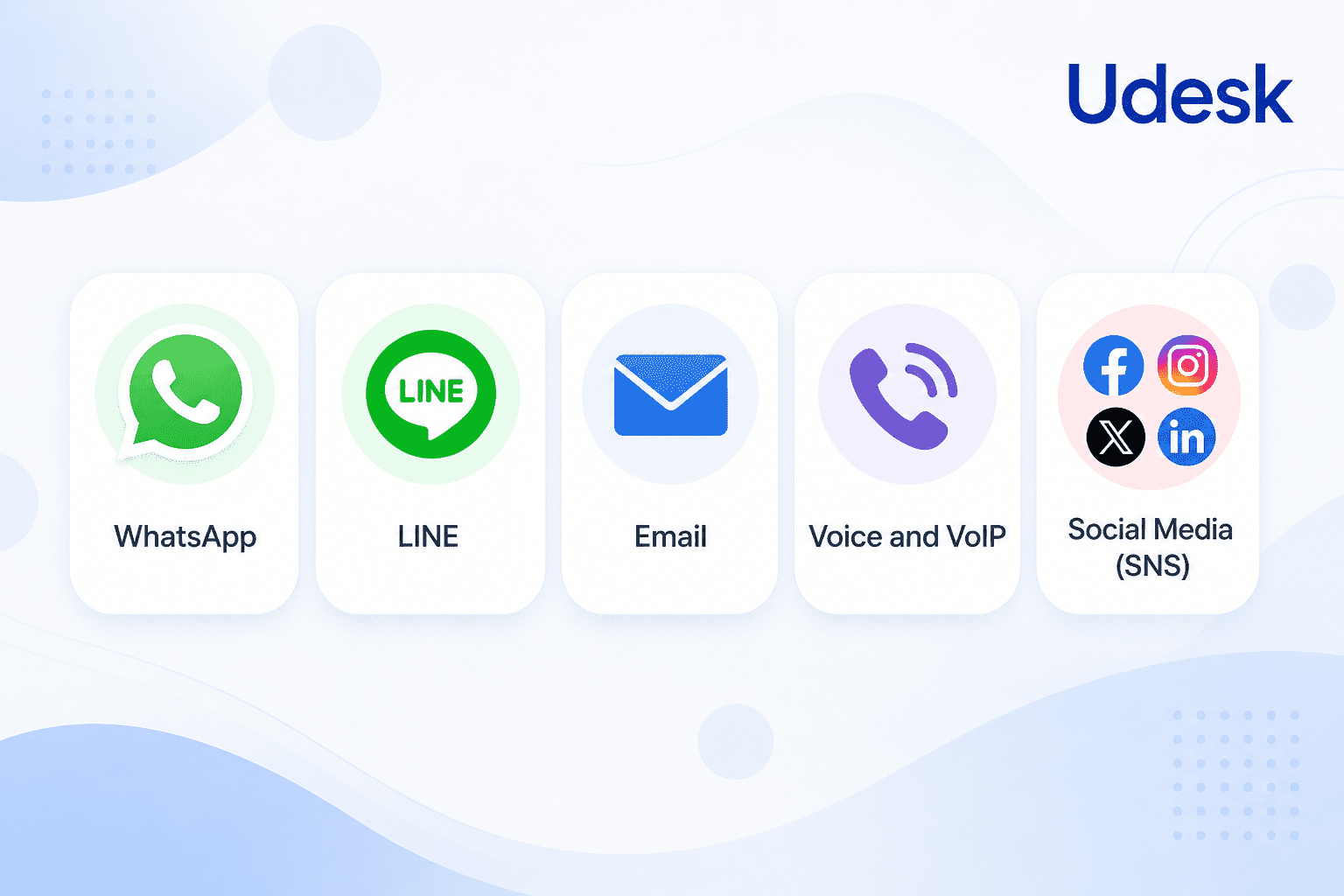
2. Regional Channel Preferences: Navigating Local Markets
2.1 Southeast Asia: The Mobile-First Messaging Culture
Southeast Asia is a mobile-first region where "Social Commerce" is the primary driver of digital growth and customer interaction.
Businesses entering markets like Indonesia or Vietnam often find that traditional web forms are ignored. The challenge is the "always-on" expectation. A customer browsing Facebook expects to click a "Message" button and get a reply within minutes. If a brand forces these users to send an email, they simply find a competitor who is available on their preferred social platform.
By using a global customer service system, companies can unify Facebook Messenger, Instagram DMs, and WhatsApp into one stream. For a fashion retailer, this means an agent can see a customer's Instagram comment, respond via DM, and send a product link directly in the chat. This mimics the fluidity of social interaction, converting passive scrollers into active buyers through real-time engagement.
2.2 North America: The High Demand for Self-Service
North American consumers are increasingly self-sufficient, often preferring to find answers themselves rather than speaking to an agent.
The challenge here is the "Content Gap." When a business doesn't provide a comprehensive Help Center or an intelligent chatbot, ticket volumes swell with repetitive questions (e.g., "Where is my order?"). This overwhelms agents and slows down response times for customers with genuine, complex problems.
Integrating an AI-powered Knowledge Base allows North American users to find answers 24/7. When a user starts typing a query into a search bar, the system suggests relevant articles instantly. If the self-service fails, a seamless hand-off to a live agent ensures the user doesn't have to repeat their problem, maintaining the high CSAT scores expected in the US and Canadian markets.
3. Technical Framework for Multi-Channel Integration
3.1 The API Economy and Seamless Connectivity
The biggest technical hurdle for global brands is the "Data Silo" problem, where information from one channel doesn't sync with others.
When a customer emails on Monday and chats on Tuesday, they expect the agent to know the history. Without a unified global customer service system, the agent is "blind," leading to redundant questions. For a SaaS company, this technical debt results in a fragmented customer journey that feels disjointed.
A robust technical solution utilizes Open APIs to sync data across all touchpoints. This creates a "Single Source of Truth." Whether the data comes from a WhatsApp message or a CRM entry, it is all funneled into a single customer profile. This allows for "Continuous Conversation," where the medium may change, but the context remains intact.
3.2 AI and Automation: Managing the 24/7 Global Load
Global support requires 24/7 availability, but staffing human agents across every time zone is prohibitively expensive for most firms.
The problem is the "After-Hours Gap." When a business in Beijing is closed, a customer in New York is just starting their day. Without automation, that customer waits 12 hours for a reply. This delay is a major churn factor in the competitive global market.
AI-driven chatbots serve as the "First Line of Defense." These bots can handle up to 85% of routine inquiries, such as tracking shipments. When the bot encounters a complex issue, it intelligently routes the ticket to the next available human agent in the appropriate time zone. This hybrid model ensures that the brand is "always open," maximizing efficiency.
4. Udesk: The All-in-One Global Customer Service Solution
Udesk provides a world-class global customer service system specifically engineered for the complexities of cross-border business. Trusted by over 50,000 global customers, Udesk offers a unified ecosystem that scales with your international growth.
4.1 Unified Omnichannel Desktop
Udesk consolidates WhatsApp, LINE, Email, Voice, and Social Media into a single, intuitive workstation.
- Use Case: A global logistics provider like J&T Express uses Udesk to manage massive inquiry volumes across multiple countries in one view.
- Business Value: Centralization increases agent productivity and ensures no message is overlooked, directly improving NPS and customer retention.
4.2 AI-Powered Intelligence
Leveraging advanced NLP, Udesk’s AI bots support over 80 languages and handle complex workflows with ease.
- Use Case: Retailers like Watsons deploy Udesk AI chatbots to handle 85% of common issues, freeing human agents for high-value tasks.
- Business Value: Automation reduces operational costs by up to 30% while maintaining a personalized, 24/7 user experience.
4.3 Global Infrastructure and Compliance
Udesk is built on a global server network, ensuring low latency and enterprise-grade security compliance, including GDPR and ISO certifications.
- Use Case: Financial services firms can deploy Udesk knowing that customer interactions are encrypted and compliant with international data laws.
- Business Value: Provides a "Global-Ready" foundation that allows enterprises to expand into regulated markets without technical or legal friction.
5. FAQ
Q: What is the best channel for customer service in Southeast Asia? In Southeast Asia, WhatsApp and LINE are the most effective channels. Most consumers prefer instant messaging over traditional email for both pre-sales and post-sales support.
Q: How does a global customer service system improve agent efficiency? It centralizes all channels into one interface, eliminating "app-switching." It also uses AI to automate repetitive tasks, allowing agents to focus on complex issues.
Q: Is WhatsApp Business API necessary for overseas support? Yes. The API allows for multiple agent logins, automated replies, and full integration with your global customer service system to track performance and manage high volumes.
Q: Can Udesk manage multiple languages? Yes, Udesk offers AI translation and multilingual bots, enabling seamless communication across different regions without requiring native-speaking agents for every language.
Choosing the right global customer service system is a strategic decision that affects your international expansion. By understanding the nuances between channels like WhatsApp, Email, and Social Media, and recognizing regional preferences, businesses can build a support infrastructure that truly resonates with their users. Transitioning to an omnichannel customer service model is no longer a luxury—it is a requirement for any brand that wishes to remain competitive on the global stage.
Ready to scale your global support? Explore how Udesk can transform your international customer experience with our suite of AI-powered tools.
Contact Udesk today for a personalized choice and see our global customer service system in action.
》》Click to start your free trial of Omnichannel Systems, and experience the advantages firsthand.

The article is original by Udesk, and when reprinted, the source must be indicated:https://www.udeskglobal.com/blog/global-customer-service-system-guide-comparing-top-5-overseas-support-channels.html
