 Customer Service Software Guides & AI Agent Blogs | Udesk
Video Chat Customer Service: When to Use It and How to Deploy
article summary:Customer expectations have reached unprecedented levels. 82% of service professionals report that customers expect more than ever before, and 79% of customers demand consistent interactions across departments—yet 56% still find themselves repeating information to different agents. In this demanding landscape, text-based support and traditional voice channels are no longer sufficient.



Table of contents for this article
- Key Market Statistics at a Glance
- Part I: When to Use Video Chat Customer Service — Three High-Impact Use Cases
- Use Case 1: Financial Services — Identity Verification and Trust-Building
- Use Case 2: Healthcare — Remote Diagnosis and Patient Support
- Use Case 3: Luxury Retail — The Hybrid AI + Live Video Model
- Part II: Why Video Chat Customer Service Works — The Value Framework
- Part III: Udesk Video Customer Service — Capabilities and Deployment Framework
- Core capabilities
- Deployment in three steps
- Part IV: Practical Guidelines for Implementation
- Conclusion
- Frequently Asked Questions (FAQ)
- 》》Click to start your free trial of voice chatbot, and experience the advantages firsthand.
Customer expectations have reached unprecedented levels. 82% of service professionals report that customers expect more than ever before, and 79% of customers demand consistent interactions across departments—yet 56% still find themselves repeating information to different agents. In this demanding landscape, text-based support and traditional voice channels are no longer sufficient.
Enter video chat customer service.
While only 24% of consumers have used live video support to date, 54% would consider it for problem resolution, and 50% for refund interactions. More tellingly, Metrigy research reveals that more than 90% of consumers want to visually engage with businesses—particularly for troubleshooting, consultative calls, online shopping, and orientations. The gap between demand and availability presents a significant opportunity. Forty percent of consumers say companies don‘t make video communication easy, and 29% would use video if offered.
Organizations that bridge this gap are seeing measurable returns. According to Metrigy‘s CX Optimization study, 74% of companies providing visual capabilities achieved a 41% improvement in customer satisfaction, 67% increased resolution speed by 40%, and 43% increased sales by 33%. Video support channels resolve issues 40% faster than text-based alternatives.
This article examines where video chat customer service delivers the greatest value—focusing on finance, healthcare, and luxury retail—and provides a structured approach to deployment using Udesk‘s video customer service solution.
Key Market Statistics at a Glance
| Metric | Value |
|---|---|
| Live chat software market size (2025) | $6.96 billion |
| Projected market size (2034) | $51.22 billion |
| Market CAGR (2026–2034) | 24.83% |
| Consumers who would consider live video for issue resolution | 54% |
| CSAT improvement from visual capabilities | 41% (74% of adopters) |
| Resolution speed increase | 40% |
| Sales lift from video support | 33% |
Sources: Fortune Business Insights, Apizee, Metrigy
Part I: When to Use Video Chat Customer Service — Three High-Impact Use Cases
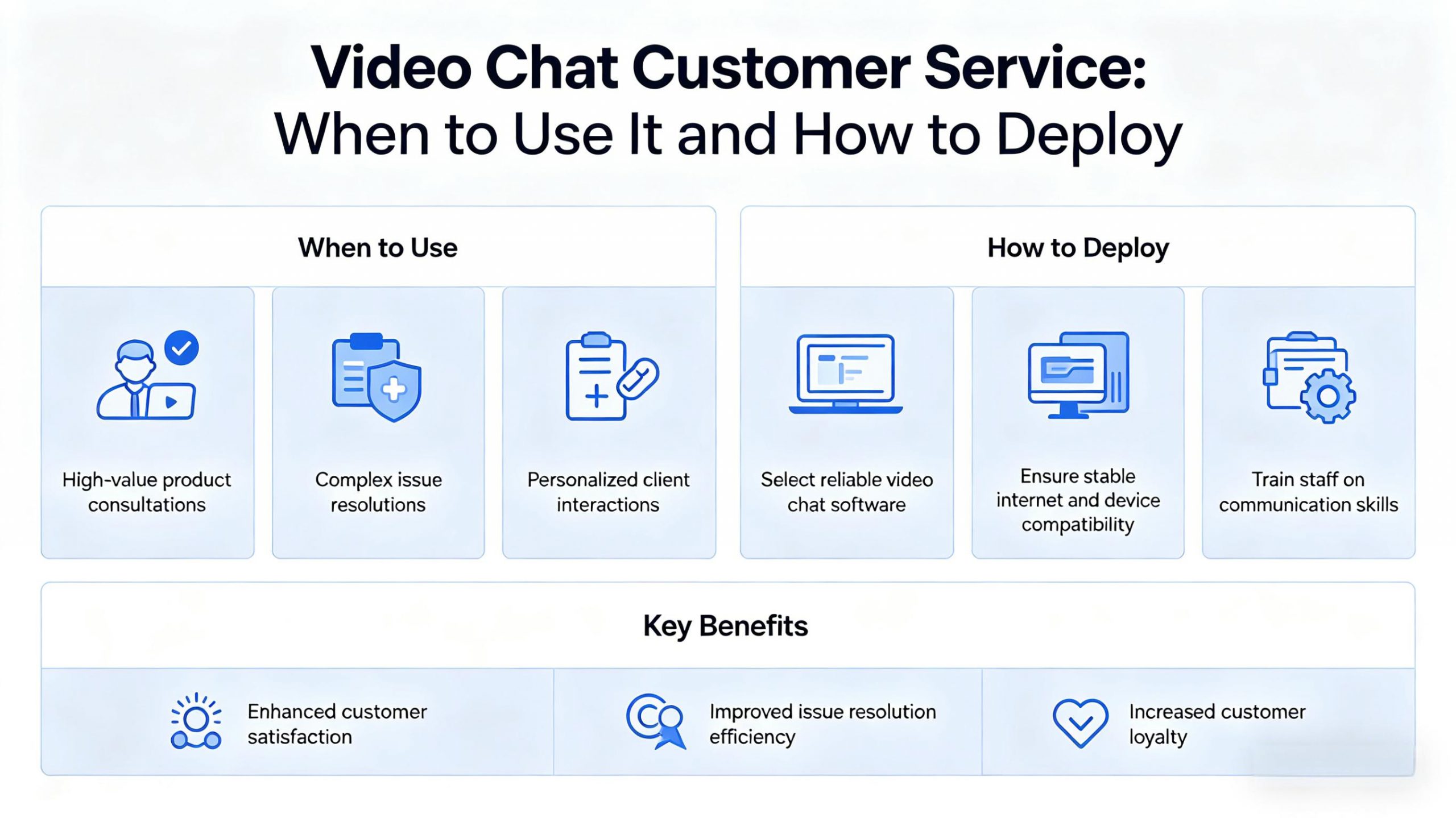
Not every customer interaction requires video. The key is identifying moments where visual context, emotional connection, or regulatory requirements demand more than text or voice can provide. Three industries illustrate this principle most clearly.
Use Case 1: Financial Services — Identity Verification and Trust-Building
Financial institutions face a dual mandate: deliver seamless digital onboarding while maintaining strict regulatory compliance. Video chat addresses both imperatives.
The value of video KYC. Traditional Know Your Customer (KYC) processes often require in-person branch visits, creating friction that drives abandonment. Video KYC solutions compress account opening from days to hours while adding critical compliance layers. “Video KYC adds two layers of protection—live customer consent and centralized, auditable verification—which makes impersonation, identity renting, and mule-account creation far more difficult than eKYC alone,” explains Ankit Ratan, CEO of a digital lending platform. Video creates a defensible compliance posture, satisfying full customer due diligence while providing auditable evidence for regulatory review.
Beyond onboarding. Video chat also powers remote wealth advisory consultations, loan application reviews, insurance claims verification, and fraud investigation interviews. For high-net-worth clients expecting premium service, video bridges the gap between digital convenience and personalized attention.
Measurable impact. Financial institutions implementing AI-powered Video KYC have reported boosting user conversions by up to 80% while reducing fraud and eliminating branch dependency for verification.
Use Case 2: Healthcare — Remote Diagnosis and Patient Support
Healthcare providers have rapidly adopted telemedicine, but video customer service extends beyond clinical consultations into patient engagement and device support.
Expanding access. Video enables patients in rural or distant areas to connect with specialists anywhere, receiving real-time diagnoses and treatment prescriptions without travel. For follow-up care, routine check-ins via video reduce hospital readmission rates and improve chronic condition management.
Medical device support. Using live HD video and AR-enhanced support, clinicians can visually assist patients through unboxing, assembling, and calibrating medical devices step by step, eliminating the need for in-home technician visits.
Patient satisfaction. The ability to see a clinician’s face and receive personalized guidance builds trust that phone calls alone cannot achieve. For palliative care and long-term treatment plans, video fosters the human connection essential to patient adherence and satisfaction.
Use Case 3: Luxury Retail — The Hybrid AI + Live Video Model
In luxury retail, static product pages and chatbots cannot replicate the in-store experience—and consumers know it. According to Immerss research, 68% of luxury shoppers abandon online purchases because they could not see product details adequately or feel confident making a large purchase online. This dissatisfaction translates directly to revenue loss. Luxury apparel converts at just 0.7–0.8%, handbags at 0.3–0.4%, while physical retail achieves 20–40%.
Why AI chat alone falls short. AI chatbots excel at answering factual questions and checking inventory, but they cannot show how a diamond catches light, demonstrate watch movement, or build the trust necessary for five-figure purchases. For high-value items, customers need expert guidance, not generic responses.
The hybrid solution: AI qualification + live video consultation. The winning approach combines AI efficiency with live video consultation, achieving 58% conversion and 2,400% ROI. AI handles initial qualification—gathering budget, preferences, and intent—before seamlessly escalating to a live video expert who provides personalized, white-glove service. One-to-one consultation live shopping achieves 40–70% conversion on $1,000–$50,000+ products, delivering 53x higher customer lifetime value compared to broadcast live shopping models.
Part II: Why Video Chat Customer Service Works — The Value Framework
Beyond specific use cases, video chat customer service delivers value across four interconnected dimensions.
1. First-contact resolution. Video eliminates the back-and-forth of text-based troubleshooting. When agents can see the problem, resolution happens in a single interaction. Companies report FCR improvements of 40% or more.
2. Customer satisfaction (CSAT). According to Apizee, 41% of consumers report being extremely satisfied with video chat-based service interactions. Research from Unbounce shows that incorporating personalized video into support workflows raises retention from 70% to 88%.
3. Operational efficiency. While video interactions may take longer per session than text, they dramatically reduce repeat contacts. One study found that 85% of customers served via video call with effective resolution give a satisfaction score of 9 or 10 out of 10. Lower repeat contact rates reduce overall support volume and cost per resolution.
4. Revenue generation. Video customer service is not merely a cost center—it drives sales. Beyond the 33% sales lift documented by Metrigy, luxury retailers report average order values of $1,000–$10,000+ for video consultation purchases. For financial services, higher onboarding conversion rates translate directly to new customer acquisition.
Part III: Udesk Video Customer Service — Capabilities and Deployment Framework
Udesk provides a comprehensive enterprise-grade video customer service platform designed for rapid implementation and seamless integration with existing customer service infrastructure.
Core capabilities
Capability
Description
Real-time video chat
One-to-one and one-to-many video communication with HD quality (480p/720p/1080p)
Screen sharing
Visual troubleshooting and remote guidance for complex issues
Multi-channel messaging
Simultaneous text, image, rich media, and file transfer during video calls
Omnichannel routing
Unified inbox for video, chat, email, phone, and social media
AI chatbot pre-screening
Handles 85% of common inquiries before human escalation
Video recording & playback
Cloud-based automatic recording with searchable transcripts
Smart routing & queuing
Skills-based assignment, load balancing, and callback options
Multi-device support
Works across web, H5, iOS, Android, WeChat mini-program, and app
Real-time analytics dashboard
Call volume, duration, connect rate, satisfaction metrics
Enterprise security & compliance
SSL encryption, data sovereignty, auditable logs
| Capability | Description |
|---|---|
| Real-time video chat | One-to-one and one-to-many video communication with HD quality (480p/720p/1080p) |
| Screen sharing | Visual troubleshooting and remote guidance for complex issues |
| Multi-channel messaging | Simultaneous text, image, rich media, and file transfer during video calls |
| Omnichannel routing | Unified inbox for video, chat, email, phone, and social media |
| AI chatbot pre-screening | Handles 85% of common inquiries before human escalation |
| Video recording & playback | Cloud-based automatic recording with searchable transcripts |
| Smart routing & queuing | Skills-based assignment, load balancing, and callback options |
| Multi-device support | Works across web, H5, iOS, Android, WeChat mini-program, and app |
| Real-time analytics dashboard | Call volume, duration, connect rate, satisfaction metrics |
| Enterprise security & compliance | SSL encryption, data sovereignty, auditable logs |
Sources: Udesk product documentation
Deployment in three steps
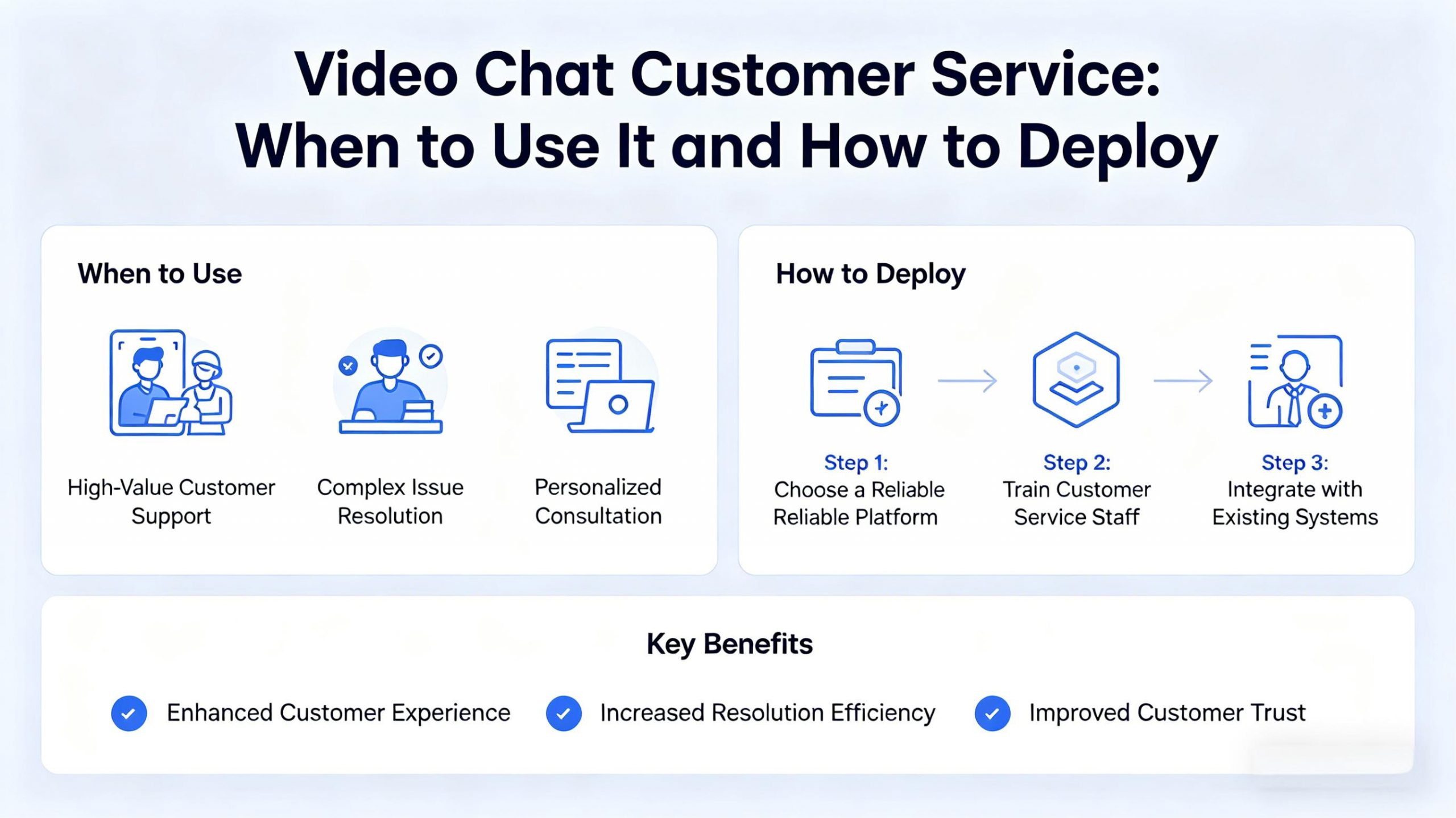
Udesk‘s flexible integration options enable businesses to launch video chat customer service within days, not months.
Step 1: Choose your integration path
| Integration Method | Best For | Time to Deploy |
|---|---|---|
| H5 web plugin | Adding video chat to existing website pages via embed code | < 1 hour |
| SDK integration | Native video capability in iOS/Android apps | 1–3 days |
| API integration | Custom workflows, CRM/data synchronization | 3–7 days |
The H5 plugin requires only three mandatory parameters: sdkAppId (provided by Udesk), code (unique user identifier), and optional parameters for agent routing and custom data fields.
Step 2: Configure omnichannel routing
Video chat does not operate in isolation. Udesk integrates video with existing IM, ticketing, call center, and email platforms. The platform supports flexible routing rules—including round-robin distribution, load balancing, and skills-based assignment—to ensure video requests reach the most qualified available agent.
Step 3: Launch, monitor, and optimize
Deployment cycles typically range from 3 to 7 days, with 7×24 cross-border operational support available. Post-launch, the Insight dashboard provides real-time monitoring of call volume, connect rates, satisfaction scores, and other KPIs. Video recordings automatically sync to the ticketing system, enabling quality assurance and agent coaching based on actual interactions.
Part IV: Practical Guidelines for Implementation
Before launching video chat customer service, organizations should address the following considerations.
1. Use video as an escalation channel, not a first touchpoint. AI chatbots and self-service portals handle routine inquiries efficiently. Reserve live video for moments when visual context, emotional nuance, or verification is essential. This hybrid approach maximizes agent efficiency while preserving the human touch when it matters most.
2. Respect privacy boundaries. In healthcare and finance especially, customers must explicitly consent before video starts. Provide clear opt-in mechanisms and transparent explanations of how video data will be stored and used.
3. Train agents for video communication. Video requires different skills than phone or chat—eye contact, body language awareness, camera positioning, active listening, and the ability to guide customers through screen sharing and visual troubleshooting. Provide structured training and ongoing coaching based on recorded session reviews.
4. Measure what matters. Track CSAT scores (target 75–85%), first-contact resolution rates (target 75–85%), average handle time reduction (typically 35–46%), cost per interaction, customer retention rates, and Net Promoter Score (NPS).
5. Start with high-value, high-friction use cases. Instead of deploying video across all support channels simultaneously, identify the 20% of interaction types that cause 80% of customer effort. For most organizations, this includes product setup and troubleshooting, account verification, complex claims, and high-value sales consultations.
Conclusion
Video chat customer service is no longer a futuristic concept—it is a proven channel delivering measurable improvements in customer satisfaction, resolution speed, and revenue. Financial institutions use it to verify identities and close loans remotely. Healthcare providers leverage it to reach patients anywhere and support medical device users. Luxury retailers combine AI efficiency with live video to achieve conversion rates physical stores envy.
Udesk provides a deployment-ready platform that integrates video seamlessly with omnichannel customer service infrastructure, enabling organizations to launch within days rather than months. For businesses ready to meet rising customer expectations, the question is no longer whether to adopt video chat—but how quickly.
Frequently Asked Questions (FAQ)
Q1: What are the technical requirements for implementing Udesk video chat customer service?
A: Udesk supports three primary integration methods. For web-based video chat deployment, adding an H5 video plugin to your website requires only a few lines of embed code with three mandatory parameters (sdkAppId, code, and optional agentId). For mobile apps, SDK integration for iOS and Android is available with complete API documentation and code samples. The platform also provides open API interfaces for custom CRM and database synchronization. Deployments can be completed within 7 days, with 7×24 operational support. End users do not need to download any specialized applications—video chat works directly within their web browser, H5 page, or existing mobile app.
Q2: Which industries benefit most from video chat customer service?
A: Video chat delivers exceptional value in three industry categories: (1) Financial services—for KYC identity verification, remote advisory consultations, loan processing, and fraud investigations, where compliance and trust are paramount; (2) Healthcare—for telemedicine consultations, medical device setup and calibration support, and chronic disease management follow-ups, where visual assessment improves diagnostic accuracy; and (3) Luxury retail—for high-value purchase consultations where product demonstration and personalized guidance drive conversion from sub-1% passive browsing rates to 40–70% live consultation rates. More broadly, any business handling complex troubleshooting, claims processing, or high-trust customer interactions should evaluate video chat as a strategic channel.
Q3: How is video chat customer service performance measured against other channels?
A: Key metrics for evaluating video chat customer service include CSAT (customer satisfaction score), with research showing 41% of consumers extremely satisfied with video interactions; first-contact resolution (FCR) rate, where Metrigy found 67% of adopters increased resolution speed by 40%; average handle time (AHT), with video typically delivering 35–46% reduction in overall resolution time when accounting for repeat contact avoidance; Net Promoter Score (NPS), where personalized video support workflows increase customer retention from 70% to 88%; and cost per interaction, balancing higher per-session agent costs against reduced repeat contacts and improved revenue conversion. The most sophisticated approach measures Return on Video Investment (ROVI), tracking incremental revenue from video-assisted sales against deployment and operational costs.
》》Click to start your free trial of voice chatbot, and experience the advantages firsthand.

The article is original by Udesk, and when reprinted, the source must be indicated:https://www.udeskglobal.com/blog/video-chat-customer-service-when-to-use-it-and-how-to-deploy-2.html
Video Chatvideo chat customer service