 Customer Service Software Guides & AI Agent Blogs | Udesk
Multilingual Customer Support Software: Serve Global Customers
article summary:When a customer from Berlin reaches out in German, a shopper from São Paulo texts in Portuguese, and a user from Seoul submits a ticket in Korean—and your support team only speaks English—you are not just inconveniencing your customers. You are losing them.



Table of contents for this article
- 1. The Market Reality: Why Multilingual Support Is No Longer Optional
- 2. Core Challenges of Global Customer Support
- 3. Key Solutions Powering Multilingual Customer Support
- 3.1 AI Real-Time Translation: The End of the “Hold for Interpreter” Era
- 3.2 Multilingual AI Chatbots: Self-Service at Scale
- 3.3 Udesk: A Comprehensive International Customer Support Platform
- 4. Key Selection Criteria for Multilingual Customer Support Software
- 5. Comparing Leading Multilingual Customer Support Platforms
- 6. ROI and Business Impact of Multilingual Support
- 7. Implementation Best Practices
- FAQ
- Q1: How does multilingual customer support software differ from using Google Translate for customer service?
- Q2: Can I deploy multilingual support without replacing my existing customer support platform?
- Q3: What is the typical ROI timeline for implementing multilingual customer support software?
- Conclusion
- 》》Click to start your free trial of Udesk customer service solution, and experience the advantages firsthand.
When a customer from Berlin reaches out in German, a shopper from São Paulo texts in Portuguese, and a user from Seoul submits a ticket in Korean—and your support team only speaks English—you are not just inconveniencing your customers. You are losing them.
The data is unambiguous. Research from CSA shows that 76% of consumers prefer buying products with information in their native language, and 68% prefer speaking with a company in their native language. Equally striking, Intercom reports that 29% of businesses have already lost customers due to poor multilingual support. Forrester data further reveals that 47% of overseas customers abandon purchases due to subpar service experiences—and implementing the right cross-border customer support system can boost repurchase rates by 62%.
In 2026, language access is no longer a nice-to-have. It is a core operational requirement for any business aiming to compete globally. This article explores how multilingual customer support software—powered by AI real-time translation, multilingual chatbots, and comprehensive international platforms like Udesk—enables brands to break down language barriers and deliver seamless, culturally appropriate service to customers in every corner of the world.
1. The Market Reality: Why Multilingual Support Is No Longer Optional
The numbers speak for themselves. According to Global Info Research, the global Multilingual Customer Support Software market was valued at US$ 312 million in 2024, with projections reaching US$ 496 million by 2031 at a CAGR of 6.9%. The broader AI solutions for multilingual customer support market is even larger, estimated at USD 20.47 billion in 2025 and projected to hit USD 30.58 billion by 2032. Meanwhile, the overall customer service software market is expanding rapidly, expected to grow from USD 28.45 billion in 2025 to USD 164.39 billion by 2034 at a CAGR of 21.52%.
The growth is not accidental. As businesses expand across borders, the traditional approach—hiring native-speaking agents for every language—breaks down both economically and operationally. Supporting customers in five languages via human agents can cost hundreds of thousands of dollars annually. By contrast, an AI chatbot can cover 85+ languages for a fraction of that cost, delivering faster responses and consistent quality.
Key market drivers:
| Driver | Impact |
|---|---|
| Cross-border e-commerce expansion | Independent store market set to exceed $7 trillion |
| Rising customer expectations | 75% of consumers more likely to be repeat buyers with native-language support |
| 24/7 global operations | Demand for round-the-clock support across all time zones |
| Multilingual compliance requirements | GDPR, CCPA, PDPA and 38+ regulations require native-language retention |
2. Core Challenges of Global Customer Support
To understand why businesses are turning to multilingual customer support software, it is essential to examine the core obstacles of serving a global customer base.
2.1 Language Diversity. A business may need to serve customers in dozens of languages. For smaller markets or lower-volume languages, the economics rarely justify full-time native-speaking hires. Traditional solutions default either to expensive parallel staffing—or to asking customers to communicate in English, introducing friction that erodes trust and conversions.
2.2 Demand Volatility. Language support rarely arrives in predictable, consistent volumes. Some weeks bring zero tickets in a given language; other weeks bring surges of 96 inquiries. This unpredictability leads to either overstaffing or being underprepared—sometimes both simultaneously.
2.3 Cultural and Regulatory Complexity. Beyond translation, effective global service requires cultural adaptation. A direct communication style that works in Germany may feel abrupt to customers in Japan. Meanwhile, global data regulations (GDPR, CCPA, PDPA, etc.) impose strict requirements on how customer data is stored, translated, and retained—with non-compliance penalties reaching up to 4% of global annual revenue.
2.2 Omnichannel Fragmentation. Customers reach out via email, chat, WhatsApp, Facebook Messenger, LINE, phone, SMS, and social media. Each channel may have different language capabilities and support workflows. A unified multilingual approach requires consistent experiences across all touchpoints.
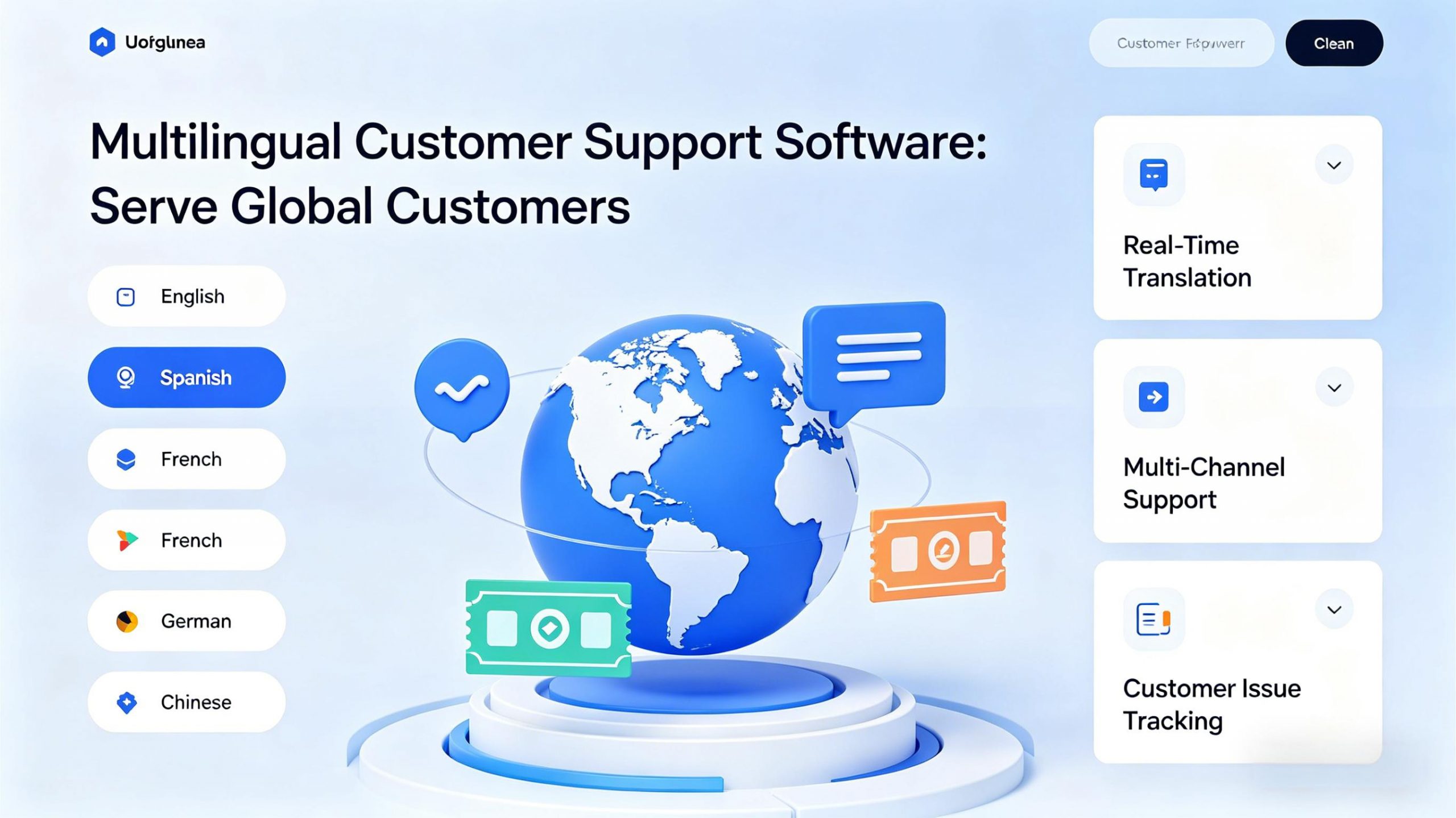
3. Key Solutions Powering Multilingual Customer Support
Modern multilingual customer support software addresses these challenges through three interconnected technological pillars. These solutions work together to create a seamless, scalable global service infrastructure.
3.1 AI Real-Time Translation: The End of the “Hold for Interpreter” Era
Real-time translation is fundamentally changing how global customer support operates. Instead of waiting for a specialized agent who speaks their language—or an interpreter who adds delays—customers can now communicate naturally with support agents in their native tongue.
Leading platforms now offer robust real-time translation capabilities:
-
Cresta Real-Time Voice Translation enables agents to speak and understand customers in multiple languages, with AI agents serving customers in 30+ languages. The platform automatically detects the customer‘s language and translates instantly.
-
Krisp AI Voice Translation v2.0 supports synchronous translation across 80+ languages, allowing both parties to speak and hear in their own languages. Features include automatic quality scoring, custom prompts, and language auto-detection within seconds.
-
Freddy Copilot’s Live Translate automatically translates messages into the customer’s preferred language on a per-message basis, with smart language detection requiring no agent action.
Efficiency Impact: Businesses using real-time translation reduce the need for multilingual staffing or interpreters. Contact center agents avoid the frustration of understanding issues and can communicate effectively with empathy—humans supporting humans. A platform with automatic language detection can deliver translations in near real-time, enabling faster resolutions and stronger customer relationships at every level of the contact center.
3.2 Multilingual AI Chatbots: Self-Service at Scale
For routine inquiries—order status, shipping tracking, password resets, FAQ lookups—multilingual AI chatbots deliver instant, automated support without human involvement.
These systems excel because they:
-
Cover extensive language portfolios at low marginal cost. JivoChat‘s multilingual chatbot can handle customer conversations across languages with automation, personalization, and live agent backup. Platform examples like ShopBot AI for WooCommerce automatically detect customer language and respond in the same language, while Qmatic Aiva supports concurrent calls in 30+ languages.
-
Maintain a single knowledge base across all languages. Instead of maintaining parallel knowledge bases for each language—which multiply content management overhead—the best platforms generate accurate responses in any supported language from a single source of truth.
-
Operate 24/7 across all time zones, eliminating the service gaps that occur when human agents are offline. Multilingual support automation lets businesses provide seamless experiences across markets and time zones.
How to identify quality multilingual chatbot solutions: Strong platforms offer native language generation through LLMs rather than simple translation layers, handle code-switching (customers who mix languages mid-conversation) and regional dialects reliably, and maintain consistent accuracy across channels including chat, email, and voice.
3.3 Udesk: A Comprehensive International Customer Support Platform
Udesk provides all-in-one multilingual customer support software designed specifically for businesses going global. Built on cloud computing, big data, and AI technologies, the platform integrates omnichannel customer service systems, large-model AI bots, and intelligent quality monitoring across 20+ channels including phone, online chat, and social media.
Udesk‘s Multilingual Capabilities at a Glance:
| Feature | Specification |
|---|---|
| Supported languages | 20+ mainstream languages (English, Spanish, French, German, Japanese, etc.) plus 50+ minor languages |
| AI translation engine | Proprietary engine; 98%+ intent recognition accuracy across 5 test languages |
| Language auto-detection | Automatically identifies customer language from first message |
| Omnichannel coverage | WhatsApp, LINE, Facebook Messenger, email, website, phone, SMS, and 20+ other channels |
| Compliance readiness | Supports GDPR, CCPA, PDPA and 38+ global data regulations with localized data storage options |
| Cross-language analytics | Multilingual AI Analyst capabilities uncover insights across languages in one place |
Key Strengths:
Precision for minor languages. Udesk‘s proprietary AI translation engine delivers exceptional accuracy even for Southeast Asian minor languages, accurately parsing dialect variants. For the Indonesian market, the platform automatically presets honorific language patterns and avoids cultural conflicts—a capability far beyond basic translation. The platform’s natural language processing ensures accurate and natural communication, making users feel genuinely supported.
Cultural adaptation layer. Udesk goes beyond translation to handle cultural nuances. The platform‘s cultural rule engine can identify taboos (e.g., avoiding left-hand gestures in Arab regions) and contextual differences. One financial enterprise reduced customer complaints in the Middle East by 40% through cultural semantic adaptation. Businesses can maintain term glossaries—one 3C electronics enterprise improved technical issue resolution accuracy to 98% through industry-specific terminology management.
Operational efficiency. 70% of routine inquiries are handled automatically by AI bots, with intelligent ticket routing based on language and issue type. A logistics company cut German-market issue resolution time from 48 hours to just 8 hours using smart ticket distribution.
Hybrid model support. Combining AI efficiency with human expertise, Udesk resolves 70% of standardized issues (logistics tracking, order status, common policies) via multilingual knowledge bases. Only when inquiries require customized consultation or complaint escalation are human agents involved—assisted by intelligent translation rather than requiring native proficiency in the customer‘s language.
Global compliance built-in. The platform automatically retains both original conversation logs and translation records, encrypted for data security. For European operations, Udesk provides localized data storage options that comply with GDPR requirements—businesses can configure data storage policies region by region, directly on the platform.
4. Key Selection Criteria for Multilingual Customer Support Software
When evaluating multilingual customer support software, businesses should look beyond raw language counts. Here are the critical criteria that distinguish effective solutions from superficial ones.
1. Native Language Generation vs. Translation Layers
The strongest AI agents generate responses directly in the target language using LLM-native capabilities. Weaker solutions bolt on a translation layer (Google Translate, DeepL) that introduces latency, loses nuance, and often mistranslates product names and technical terms.
2. Automatic Language Detection Accuracy
Customers should not need to select their language from a dropdown. The system should detect language automatically from the first message and handle mid-conversation switching reliably—even on short messages under 20 characters and mixed-language inputs.
3. Omnichannel Language Coverage
True multilingual support means the AI agent performs equally across chat, email, voice, SMS, social media, and messaging apps. Voice capability remains a critical differentiator many platforms lack.
4. Multilingual Knowledge Base Management
A single knowledge base should suffice. If a platform requires manually translated parallel knowledge bases for each language, content management overhead multiplies with every new language added.
5. Compliance and Data Security
Verify that the platform supports data regulations for your target markets (GDPR, CCPA, PDPA, etc.), including localized data storage options and native-language conversation log retention.
6. Escalation Paths That Respect Language Continuity
When an AI agent escalates to a human, the customer should continue in their native language. Routing to English-speaking humans who cannot understand subsequent messages has not solved the multilingual problem—only deferred it.
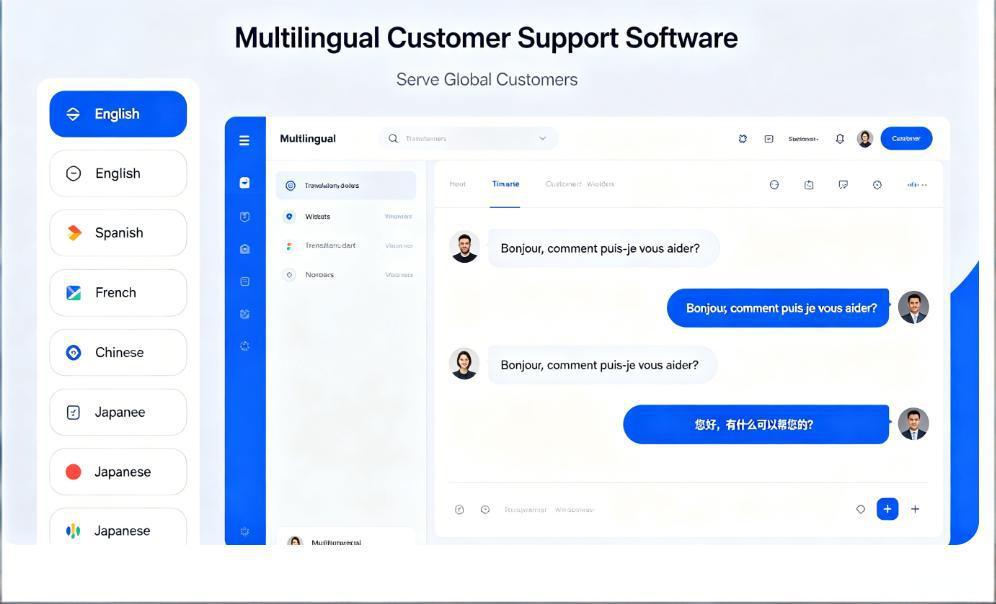
5. Comparing Leading Multilingual Customer Support Platforms
| Platform | Languages | Channel Coverage | Standout Feature |
|---|---|---|---|
| Udesk | 70+ (20 mainstream + 50+ minor) | 20+ channels (WhatsApp, LINE, Messenger, web, phone) | Proprietary AI translation engine with 98%+ accuracy; cultural adaptation layer; full compliance support |
| Cresta | 30+ (AI agents) | Voice, chat, analytics | Real-time voice translation; cross-language AI analyst capabilities |
| Krisp | 80+ | Voice | Synchronous mode translation; auto-scoring quality checks |
| Kore.ai | 100+ | Chat, voice | Single-agent architecture; LLM-native generation |
| Fin AI | 45+ | Chat, email, voice, SMS, WhatsApp, social | Native LLM generation; single knowledge base across all languages |
6. ROI and Business Impact of Multilingual Support
Implementing multilingual customer support software delivers measurable business outcomes.
Customer Retention. 40% of consumers will never buy from websites not in their native language, and 75% are more likely to be repeat customers if support is provided in their native tongue.
Cost Efficiency. Supporting customers in five languages through human agents costs hundreds of thousands annually. AI chatbots cover 85+ languages for a fraction of that cost. Multilingual knowledge base dynamic mapping enables customer service teams to handle multilingual inquiries three times more efficiently. Small language customer service salaries are typically 2–3 times higher than English agents’—multilingual systems reduce human agent requirements by up to 60%.
Resolution Speed. Real-time translation eliminates interpreter delays. Automated ticket translation and knowledge base self-service drastically reduce first-response and resolution times. One manufacturer reduced German-market issue resolution from 48 hours to 8 hours.
Compliance Risk Reduction. Cloud-based distributed architecture ensures 38+ data regulations are met, avoiding non-compliance penalties that can reach up to 4% of global annual revenue.
7. Implementation Best Practices
For businesses ready to deploy multilingual customer support software, follow these proven practices:
Start with your top 3–5 languages. Most businesses see 80%+ of international traffic concentrated in a handful of languages. Begin there, then expand iteratively.
Maintain a single asset, generate everywhere. Build one knowledge base, one set of workflows, one product catalog—and generate localized responses automatically. Adding a new language should not mean rebuilding from scratch.
Test cultural nuance beyond translation. Validate your multilingual responses with native speakers for tone, formality, and cultural appropriateness. What works in the US may fail in Japan.
Monitor language-specific metrics separately. Different markets have different expectations and performance profiles. Track first-contact resolution, CSAT, and handle time by language rather than aggregating across all languages.
Plan escalation paths for complex issues. Even the best AI agent will encounter situations requiring human judgment. Ensure your escalation flows maintain language continuity so customers do not have to re-explain issues when transferred.
FAQ
Q1: How does multilingual customer support software differ from using Google Translate for customer service?
A: Basic translation tools like Google Translate operate on a word-for-word or sentence-for-sentence basis without understanding context, industry terminology, or cultural nuance. They cannot maintain conversation history, learn from interactions, or integrate with support workflows like ticket routing and knowledge bases.
In contrast, multilingual customer support software is purpose-built for service environments. It uses AI-powered natural language processing (NLP) to understand intent, machine learning to improve accuracy over time, and knowledge base integration to deliver consistent answers. Enterprise-grade solutions like Udesk achieve intent recognition accuracy of 98%+ across multiple languages, incorporate cultural adaptation layers to adjust tone and formality, and automatically retain logs for compliance—capabilities well beyond basic translation tools.
Q2: Can I deploy multilingual support without replacing my existing customer support platform?
A: Yes. Most multilingual customer support software integrates with existing helpdesks and CRMs via API or native integrations. Platforms like Udesk work alongside systems like Zendesk, Salesforce, and Intercom, adding multilingual capabilities without requiring a full system replacement. Key integration points include ticket translation, knowledge base access, and real-time translation for live chat.
When evaluating integration, check that the multilingual solution supports your current channels, maintains data security across systems, and provides unified reporting rather than siloed metrics.
Q3: What is the typical ROI timeline for implementing multilingual customer support software?
A: The break-even timeline varies by deployment scale, but most businesses see measurable ROI within 3–6 months. Cost savings come immediately from reduction in multilingual staffing requirements—one electronics manufacturer reduced minor-language agent headcount by 60% while improving resolution rates. Revenue impact follows as international customers experience native-language support, reducing abandonment rates (which can reach 47% due to poor service experiences) and boosting repurchase rates. Additionally, market expansion into new regions becomes feasible without adding proportional headcount costs.
Because most platforms offer flexible, usage-based or subscription pricing, businesses can start with a pilot deployment in their top 1–2 non-native languages to validate ROI before scaling.
Conclusion
In 2026, multilingual customer support software has moved from competitive advantage to operational necessity. For businesses serving global customers, the choice is no longer whether to implement multilingual capabilities—but how quickly to do so effectively.
The technology now exists to deliver real-time translation, AI-powered chatbots across 100+ languages, and comprehensive platforms like Udesk that handle cultural adaptation, 20+ communication channels, and global compliance requirements in a single unified system. Businesses that embrace these capabilities will capture international markets, retain customers across linguistic boundaries, and build brands that speak the language of loyalty. Those that do not will watch their global revenue leak away—one untranslated conversation at a time.
》》Click to start your free trial of Udesk customer service solution, and experience the advantages firsthand.

The article is original by Udesk, and when reprinted, the source must be indicated:https://www.udeskglobal.com/blog/multilingual-customer-support-software-serve-global-customers.html
customer support softwaremultilingual customer support software