 Customer Service Software Guides & AI Agent Blogs | Udesk
Video Customer Service: The Future of High-Touch Support
Article Summary:The gap between what customers expect and what traditional support channels deliver has never been wider. In 2026, video customer service is no longer an option—it is the defining characteristic of high-touch, high-trust support. For organizations ready to deliver visual, personal, and efficient customer experiences, Udesk provides a complete enterprise-grade video customer service platform that bridges every channel and exceeds every expectation.



Table of contents for this article
- 1. Definition and Core Value
- 2. Key Application Scenarios for Video Customer Service
- 3. Technical Requirements for Video Customer Service
- 4. Key Considerations for Video Customer Service Deployment
- 5. FAQ
- 》》Click to start your free trial of Udesk customer service solution, and experience the advantages firsthand.
In 2026, the standard for digital customer service is higher than ever, yet traditional channels are hitting their limits. Text-based chats struggle to convey nuance. Voice calls lack visual context. And customers are growing increasingly frustrated with having to describe what they can simply show. The solution? Video customer service. By enabling real-time, face-to-face interactions between agents and customers, video support bridges the gap between digital efficiency and human connection. In this comprehensive guide, we will explore what video customer service is, why it matters, where it delivers the most impact, what technology it requires, and how to deploy it successfully across your organization.
1. Definition and Core Value
1.1 What Is Video Customer Service?
Video customer service refers to the integration of live video communication into customer support operations, allowing agents and customers to see and interact with each other in real time. Unlike traditional support channels that rely solely on text or voice, video service encompasses live video calls, screen sharing, co-browsing, and visual engagement tools such as augmented reality (AR) overlays and image-based diagnostics. Organizations introducing visual-support workflows consistently report 20 to 30 percent faster issue resolution in complex service scenarios where explanation alone is insufficient.
Udesk offers a comprehensive video customer service solution that integrates real-time video calling, screen sharing, text chat, and multi-device synchronization into a unified enterprise-grade platform. Built on Tencent’s TRTC video backbone, Udesk delivers ultra-low latency, anti-packet-loss resilience of over 80 percent, and dynamic resolution scaling from 480p to 1080p. With support for over 30 domestic and international channels including WeChat mini-programs, H5, and mobile apps, Udesk enables businesses to launch video support instantly without requiring customers to download additional software.
1.2 Why Video Customer Service Matters in 2026
The shift toward video is driven by clear market data and customer expectations. According to recent research, video support options have yielded 17 percent higher customer satisfaction than traditional support systems—92 percent for video versus 75 percent for traditional channels. They also deliver 20 percent higher first-contact resolution rates (85 percent versus 65 percent) and 18 percent higher customer retention (88 percent versus 70 percent). Beyond these metrics, 79 percent of consumers say the ability to share media makes it easier to get support, and 76 percent would choose a company that allows them to share text, images, and video in the same conversation without starting over.
The gap between what customers want and what companies offer is substantial. While 90 percent of consumers want to visually engage with businesses—especially for troubleshooting, consultative calls, and online shopping—only 48 percent of companies currently use video, and nearly half of those only offer it when an agent permits escalation. Moreover, 40 percent of consumers say companies do not make it easy to communicate over video, and 29 percent say they would like to communicate over video but no company they have interacted with offers it. This represents a significant opportunity for early adopters.
2. Key Application Scenarios for Video Customer Service
2.1 Technical Support and Complex Troubleshooting
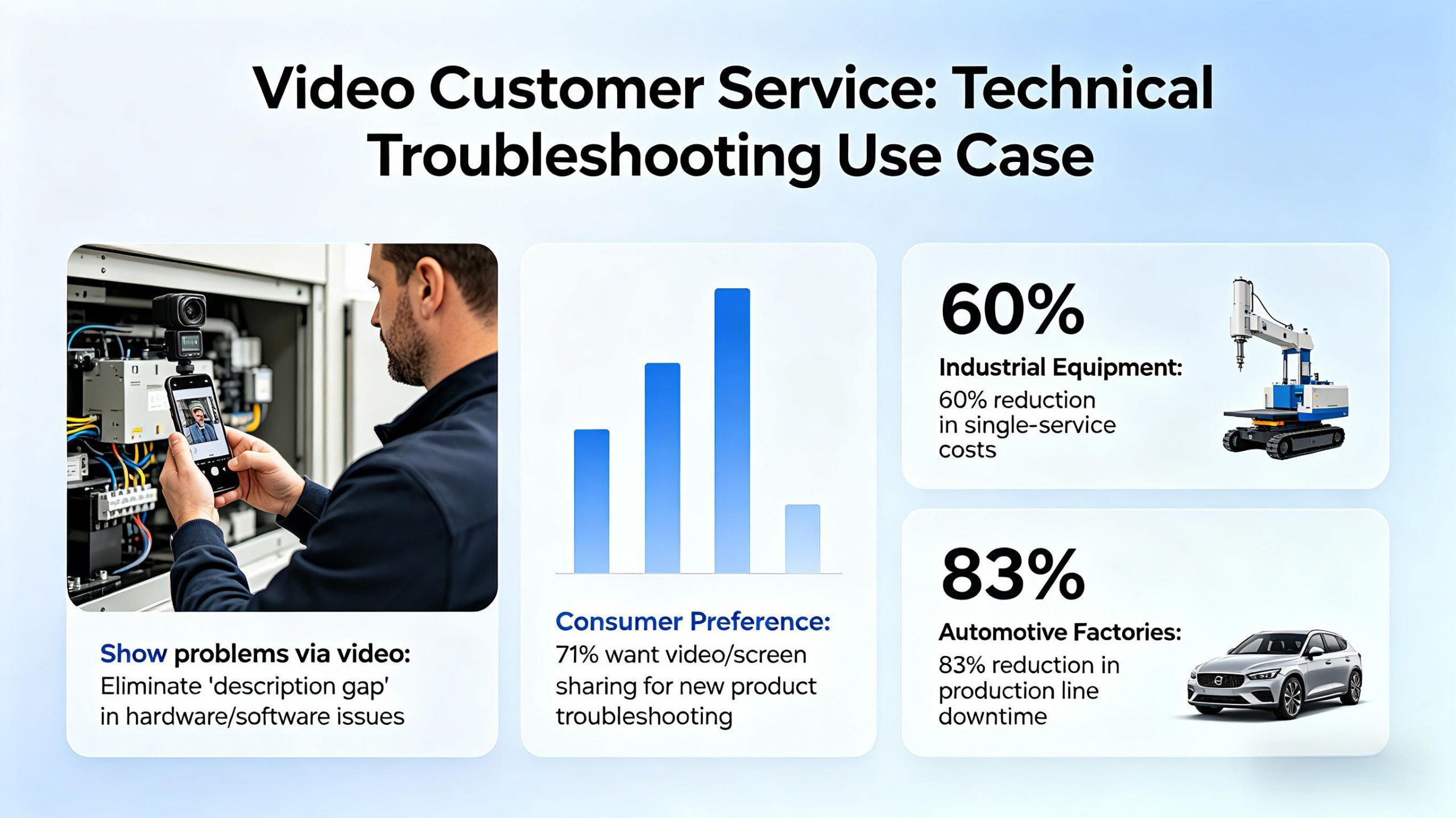
Perhaps the most compelling use case for video customer service is technical troubleshooting. When a customer struggles with a hardware installation, software configuration, or device malfunction, describing the problem over text or voice often leads to miscommunication and prolonged resolution times. Video allows customers to show agents exactly what is wrong using their smartphone cameras, eliminating the “description gap”. According to Metrigy research, 71 percent of consumers want to use video or video with screen sharing when troubleshooting new products. For industrial equipment manufacturers, remote video support has reduced single-service costs by 60 percent, while automotive factories using expert remote diagnosis have cut production line downtime by 83 percent.
2.2 Remote Installation and Onboarding
Product onboarding and installation are naturally visual processes. Whether guiding a customer through assembling furniture, setting up a router, or configuring software, live video guidance significantly improves success rates. For instance, home appliance brands using video to demonstrate product operation have achieved installation success rates as high as 97 percent. Udesk video customer service excels in installation and maintenance scenarios, enabling agents to provide real-time visual guidance for hardware setup and software configuration, reducing false reporting rates and saving service costs.
2.3 Pre-Sales Consultations and Product Demonstrations
In high-consideration purchases—such as real estate, automotive, and luxury goods—video enables personalized, consultative selling without physical presence. Remote property viewings allow agents to walk prospective buyers through apartments in real time. Automotive dealers can conduct remote car walkarounds, highlighting features and answering questions live. In B2B contexts, sales teams can walk customers through SaaS workflows live instead of sending static documents. Organizations introducing video into pre-sales workflows consistently report fewer follow-up calls and shorter decision cycles.
2.4 Healthcare and Telemedicine
The healthcare sector has been one of the earliest and most enthusiastic adopters of video customer service. Telemedicine platforms enable clinicians to visually assess conditions, guide patients through home care, and support device usage without requiring in-person visits. Major hospitals using video consultations have achieved threefold improvements in patient revisit efficiency by integrating electronic medical records with real-time symptom observation. Remote video service in healthcare addresses both access and efficiency challenges simultaneously.
2.5 Insurance and Financial Services
Insurance claims processing is another natural fit for video customer service. Policyholders can show damage photos or videos in real time, allowing adjusters to assess claims immediately without scheduling on-site inspections. In financial services, wealth advisors conducting face-to-face consultations via video maintain the trust and personal connection that clients expect, while video-based identity verification has reduced high-risk transaction times to as little as 15 minutes. Udesk video customer service supports banking-specific privacy compliance requirements for such regulated applications.
2.6 Cross-Border and Remote Service Operations
For organizations serving global customers, video customer service breaks down geographic barriers entirely. Export-oriented businesses using video with AI-powered real-time translation and screen annotation have improved communication efficiency fivefold, while multinational negotiations with instant document translation have shortened contract-signing cycles by 60 percent. Udesk’s global node deployment ensures millisecond-level response times for overseas users, while its multilingual interface and AI-powered translation capabilities make it particularly suited to cross-border operations.
2.7 VIP and High-Touch Service
Not all customers require the same level of service. For high-value accounts, personalized video service differentiates brands from competitors by delivering a concierge-level experience through direct face-to-face interaction. This approach has proven particularly effective in luxury retail, private banking, and enterprise software sectors.
3. Technical Requirements for Video Customer Service
3.1 Bandwidth and Network Infrastructure
Video customer service imposes specific technical requirements that organizations must address before deployment. For HD video (720p), a stable upstream and downstream bandwidth of 1.2 to 2.5 Mbps per stream is typically required. For 1080p Full HD, 2 to 3 Mbps is recommended, while 4K video exceeds 8 Mbps per stream. Latency should remain under 100 milliseconds to avoid awkward pauses, and jitter should stay below 30 milliseconds. Solutions must also support Adaptive Bitrate technology to dynamically adjust quality based on network conditions, ensuring connections remain stable even on congested Wi-Fi or 4G networks. Udesk meets these requirements through its TRTC-powered infrastructure, featuring global node deployment for ultra-low latency, anti-packet-loss exceeding 80 percent, and high-definition encoding at 480p, 720p, and 1080p resolutions.
3.2 Hardware and Device Compatibility
Modern video customer service solutions must support a wide range of devices across both agent and customer endpoints. Agent-side compatibility should include computers, tablets, and smartphones with seamless state synchronization across devices. Customer-side access should require no downloads, supporting direct initiation via web browsers, H5 pages, and native mobile apps. Quality hardware is equally important—modern CPUs with hardware acceleration, at least 4 GB of RAM, and high-quality webcams and microphones reduce CPU spikes and visual artifacts. Udesk provides full cross-platform support including native iOS and Android SDKs, WeChat mini-program SDK, web, and desktop clients, ensuring customers can initiate video calls instantly without friction. Its client-side support spans WeChat mini-programs, H5, web browsers, and mobile apps, eliminating installation barriers.
3.3 Real-Time Communication and Streaming Technology
At the core of any video customer service platform lies WebRTC (Web Real-Time Communication), the open-source protocol enabling peer-to-peer audio, video, and data transfer directly between browsers without plugins. Most modern video conferencing tools—including Google Meet, Microsoft Teams, and telehealth applications—are built on WebRTC technology. For enterprise-scale deployments, platforms must also implement global media server infrastructure, STUN/TURN servers to traverse firewalls, and automatic failover mechanisms to maintain session reliability under heavy load. Udesk‘s cloud-native distributed architecture is built on Tencent TRTC, a WebRTC-based enterprise video backbone, providing global node coverage, automatic service failover, and support for tens of millions of concurrent requests with sub-200ms response times.
3.4 Recording, Storage, and Analytics
Video customer service sessions generate valuable data that organizations should leverage for quality assurance, training, and compliance. Essential features include cloud-based automatic real-time recording, session playback and download, speech-to-text transcription for full call quality inspection, and comprehensive dashboards displaying key metrics such as call volume, average duration, answer rates, and customer satisfaction scores. Udesk provides end-to-end session recording with cloud storage, automated transcription for quality management, and real-time analytics dashboards enabling data-driven coaching and operational optimization.
3.5 Video Enhancement and AR Integration
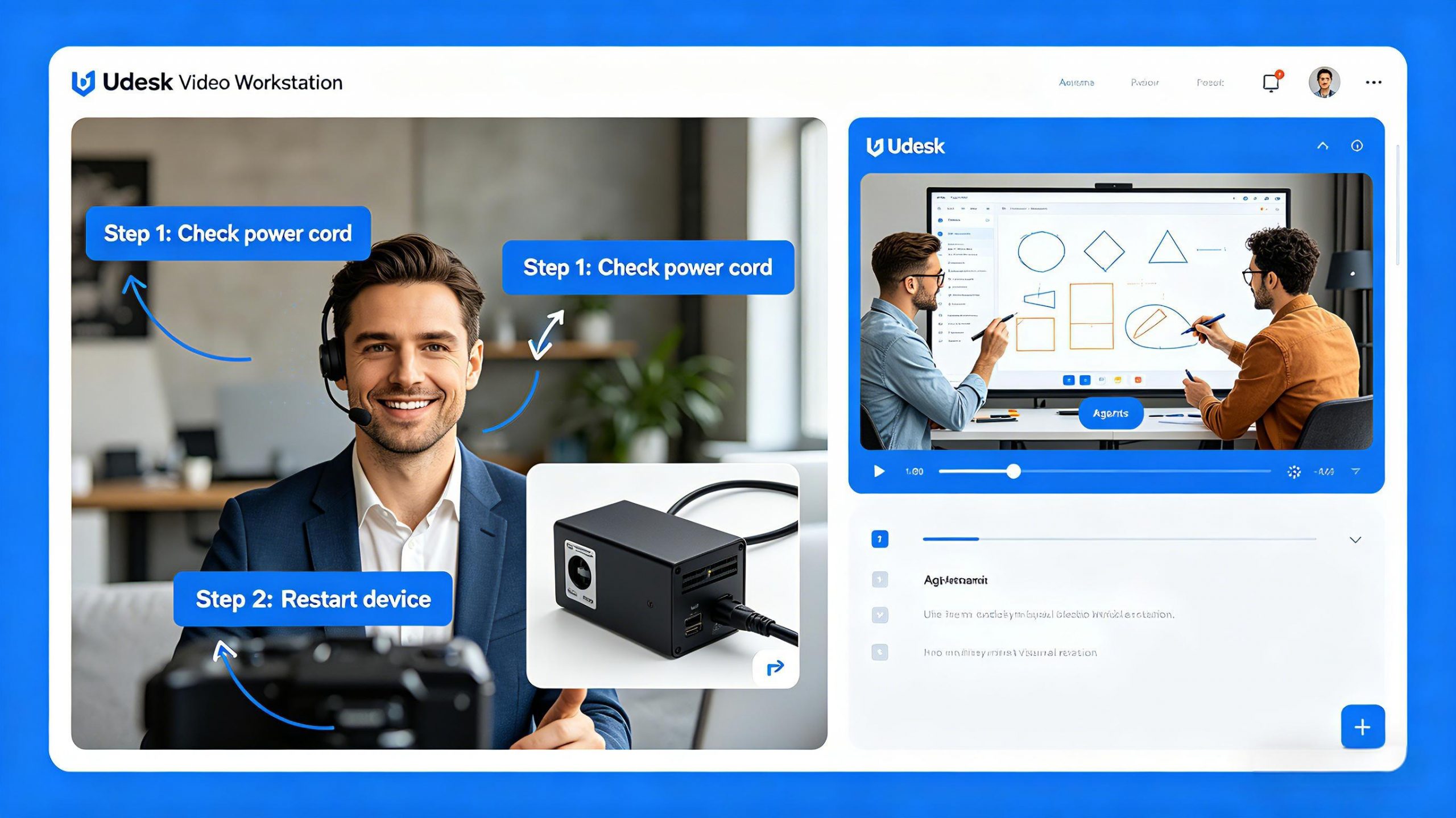
Forward-looking platforms increasingly incorporate AR capabilities that allow agents to overlay annotations and step-by-step instructions directly onto the customer‘s live camera feed. This transforms troubleshooting from verbal guidance into visual demonstration, reducing training time and eliminating confusion. Udesk supports screen sharing and on-screen annotations during video calls, helping agents quickly identify issues and guide customers effectively. Its video workstations include tools for real-time drawing on shared screens, making complex guidance visual and intuitive.
4. Key Considerations for Video Customer Service Deployment
4.1 Security and Compliance
Video customer service introduces additional security considerations beyond standard support channels. Video communications contain potentially sensitive information—customer identities, product details, financial data, and even physical environments. Meeting these requirements is essential:
-
encryption in transit: All video and audio streams must be encrypted end-to-end using protocols such as TLS 1.2+ for transmission and AES-256 for data at rest.
-
Authentication and access control: Secure Single Sign-On (SSO), Multi-Factor Authentication (MFA), and role-based access controls ensure that only authorized agents initiate and participate in video sessions. Explicit customer consent must be captured before any session begins.
-
Compliance certifications: Organizations must verify that their video service provider holds industry-recognized certifications. In regulated sectors such as healthcare (HIPAA) and finance (SOC2, GDPR), platforms must sign Business Associate Agreements (BAAs) and provide data residency options where required.
Udesk addresses these requirements through multiple layers of security: end-to-end encryption for calls and files stored in dedicated databases, role-based access control with explicit consent for video call authorization, support for SOC2 and GDPR-aligned compliance, and enterprise identity integration. Its cloud infrastructure includes optional private cloud and hybrid deployment models for organizations with strict data sovereignty requirements.
4.2 Integration with Existing Support Ecosystems
Video customer service should not operate in isolation. It must integrate seamlessly with existing ticketing systems, CRM platforms, knowledge bases, and chat channels. Co-browsing, which allows agents to view and interact with a customer‘s web browser or mobile app in real time, is particularly valuable for digital support interactions. Modern enterprise co-browsing requires zero downloads, supports automatic masking of sensitive fields, and enables agents to guide customers through complex processes without leaving the company‘s authenticated environment.
Udesk excels in ecosystem integration, functioning as a fully unified omnichannel customer service platform that combines video, voice chat, text chat, ticket management, and knowledge base into a single workspace. It provides SDK, API, and front-end component integration options, ensuring video interaction data flows seamlessly into enterprise databases. One of Udesk‘s standout differentiators is its native integration of domestic Chinese channels—including WeChat official accounts, mini-programs, and enterprise WeChat—alongside international channels such as WhatsApp, Facebook Messenger, and SMS, all accessible from a single agent interface.
4.3 Agent Training and Organizational Readiness
Deploying video customer service requires more than technology. It demands changes in agent skills, workflows, and performance management. Organizations should implement: staged training programs with role-specific coaching for visual communication and AR annotation, simulated training systems for practice scenarios before live deployment, performance dashboards to track video-specific KPIs such as average handle time, first-contact resolution, and customer satisfaction, and a gradual rollout starting with pilot groups in technical support or VIP service before scaling organization-wide. Udesk contributes by providing a unified agent workspace where all channel interactions—video, voice, and text—are handled from a single console with a 360-degree customer view.
4.4 Cost-Benefit and ROI Analysis
Implementing video customer service involves both direct and indirect costs. Direct costs include platform licensing fees, any incremental bandwidth or storage charges, agent hardware upgrades (webcams, headsets), and potential integration and customization costs for existing systems. Indirect costs cover agent training time and process re-engineering. However, the returns are substantial. Organizations adopting visual capabilities see measurably improved metrics: 74 percent report customer satisfaction improvements, 67 percent increased resolution speed by 40 percent, and 43 percent increased sales by 33 percent. Additionally, video service intercepts 30 to 60 percent of basic post-sales issues, eliminating costs associated with on-site repairs, physical logistics, and in-person maintenance visits. The combination of reduced operational costs and improved customer outcomes makes video customer service one of the highest-ROI investments available to support organizations in 2026.
4.5 Gradual Adoption and Scaling Strategy
For organizations new to video customer service, a phased approach reduces risk and allows for iterative improvement. Begin with high-impact, low-complexity scenarios targeted to specific customer segments, establish baseline metrics and run controlled pilots, gather customer and agent feedback iteratively, and expand use cases and user populations based on data-driven results. This ensures that video customer service becomes an operational asset rather than an experimental distraction.
5. FAQ
Q1. How much bandwidth is needed to implement video customer service?
For HD video at 720p resolution, a minimum bandwidth of 1.2 to 2.5 megabits per second per video stream is recommended. For 1080p Full HD, 2 to 3 megabits per second is typically sufficient. Network latency should remain under 100 milliseconds to ensure natural conversation flow, and jitter should stay below 30 milliseconds. Modern video platforms use adaptive bitrate technology to dynamically adjust quality based on network conditions, ensuring stable performance even on congested Wi-Fi or 4G connections.
Q2. Is video customer service secure enough for regulated industries like healthcare and finance?
Yes, provided the platform meets industry-specific compliance standards. Look for solutions with end-to-end encryption for all communications, explicit customer consent capture before sessions begin, SOC2 certification and GDPR compliance, and support for HIPAA with signed Business Associate Agreements. For highest security requirements, private cloud or on-premises deployment options that maintain complete data control within your organization are available.
Q3. Do customers need to download special software to use video customer service?
Modern video customer service solutions require no downloads from customer endpoints. Using WebRTC technology, customers can initiate video calls directly through their web browsers, WeChat mini-programs, H5 pages, or their existing mobile app if video SDK is integrated. The experience is instant and friction-free. Agent-side typically has broader platform support including desktop, tablet, and mobile applications with seamless device switching.
》》Click to start your free trial of Udesk customer service solution, and experience the advantages firsthand.

The article is original by Udesk, and when reprinted, the source must be indicated:https://www.udeskglobal.com/blog/video-customer-service-the-future-of-high-touch-support.html