In the digital era of 2026, customer expectations have evolved beyond simple accessibility—they demand seamless, consistent, and personalized experiences across every touchpoint, from social media and mobile apps to phone calls and in-store interactions. As businesses strive to stand out in a crowded marketplace, omnichannel customer service has transitioned from a “nice-to-have” to an absolute necessity. To navigate this complex landscape effectively, partnering with a trusted provider like Udesk is your first step toward success. This complete guide will break down everything you need to know about
omnichannel customer service in 2026—from its definition and core value to emerging trends, technical architecture, and practical selection criteria—empowering you to build a customer service strategy that drives growth.
1. Definition and Core Value of Omnichannel Customer Service in 2026
1.1 What Is Omnichannel Customer Service in 2026? A Clear Definition
Omnichannel customer service is a strategic approach to delivering fully connected, consistent, and user-centric support across every channel a customer may use—whether it’s social media (TikTok, Instagram, WeChat), messaging apps (WhatsApp, Line), phone calls, emails, live chat, mobile apps, or in-person interactions. Unlike fragmented service models, omnichannel unifies all customer touchpoints into a single, cohesive system, ensuring that customer data, conversation history, and preferences are seamlessly shared across channels. In 2026, this definition has evolved to emphasize not just “connection” but also “intelligence”: omnichannel service now integrates advanced AI, predictive analytics, and emotional recognition to anticipate customer needs and deliver proactive, personalized support before customers even ask for help. As defined by Salesforce, omnichannel customer service creates “connected and consistent experiences across all customer interactions, no matter the channel,” giving service teams access to unified data that boosts quality and efficiency. Udesk’s omnichannel solution embodies this evolution, unifying channels, data, and AI capabilities to create a frictionless experience for both customers and agents.
1.2 Core Value: Why Omnichannel Customer Service Matters in 2026
The value of omnichannel customer service extends far beyond improving customer satisfaction—it directly impacts a business’s bottom line, brand reputation, and long-term competitiveness. In 2026, with customers increasingly prioritizing experience over price, the core value of omnichannel service can be broken down into four key areas:
First, enhanced customer satisfaction and loyalty. Research shows that 89.2% of consumers express significant frustration when required to repeat information across different service channels, leading to a 34% increase in customer churn rates for organizations using disconnected systems. Omnichannel service eliminates this friction by providing a seamless experience, driving higher satisfaction scores: organizations adopting omnichannel cloud platforms demonstrate 31.5% higher CSAT than those maintaining disparate systems. Udesk’s solution further amplifies this value by enabling real-time context synchronization across all channels.
Second, improved operational efficiency. By unifying channels into a single dashboard, omnichannel service reduces agent workload and streamlines workflows. A study of 478 contact centers found that integrated cloud solutions achieved a 47.3% enhancement in first-contact resolution rates and a 34.8% reduction in operational costs. AI-powered tools handle routine inquiries 24/7, freeing agents for complex tasks. Udesk’s AI-driven platform, for example, enables AI robots to resolve 85% of common customer inquiries.
Third, data-driven customer insights. Omnichannel systems collect and unify data from all touchpoints, creating a 360-degree customer view. In 2026, advanced analytics tools predict customer needs and enable proactive support. Udesk’s solution integrates with CRM systems to build detailed customer profiles, enabling tailored experiences.
Fourth, competitive differentiation. A Zendesk report found that omnichannel support investment declined by 10% last year, creating an opportunity for businesses to stand out. Udesk helps businesses seize this opportunity with comprehensive, industry-tailored omnichannel solutions.
2. Omnichannel vs. Multichannel Customer Service: Key Differences in 2026
One of the most common misconceptions is confusing omnichannel with multichannel support. The core difference lies in continuity and integration. Below is a detailed breakdown of the two models and why omnichannel is superior for modern businesses.
2.1 Multichannel Customer Service: Separate Channels Without Continuity
Multichannel customer service offers support through multiple channels but operates each as a siloed system, with no data sharing. This leads to customer frustration, longer resolution times, and disjointed experiences. IJFMR research shows organizations using disconnected multichannel systems face higher churn and lower satisfaction than those with integrated omnichannel solutions.
2.2 Omnichannel Customer Service: Connected Experiences Across All Touchpoints
Omnichannel unifies all channels into an integrated system, sharing customer data in real time. Customers can switch channels seamlessly without repeating information, and agents access a complete customer journey view. In 2026, omnichannel includes AI-driven personalization—for example, sending personalized follow-ups to customers who browse but don’t purchase. Udesk’s platform exemplifies this, unifying channels into a single dashboard with real-time synchronization.
2.3 Key Differences: Continuity vs. Accessibility (2026 Update)
To summarize, the core difference boils down to continuity and integration. Below is a table highlighting key distinctions:
|
Factor
|
Multichannel Customer Service
|
Omnichannel Customer Service
|
|
Channel Integration
|
Siloed channels with no data sharing
|
Fully integrated channels with real-time data synchronization
|
|
Customer Experience
|
Disjointed; customers repeat information
|
Seamless; no repeated information
|
|
Data Usage
|
Channel-specific data; no 360-degree view
|
Unified data; 360-degree customer view
|
|
AI Integration
|
Basic AI limited to individual channels
|
Advanced AI across all channels
|
|
Business Impact
|
Moderate satisfaction; higher churn
|
High satisfaction; lower churn; revenue gains
|
In short, multichannel is about “being everywhere”—while omnichannel is about “being connected everywhere.” For 2026 success, omnichannel is the only choice to meet evolving customer expectations.
3. Core Technical Architecture of Omnichannel Customer Service in 2026
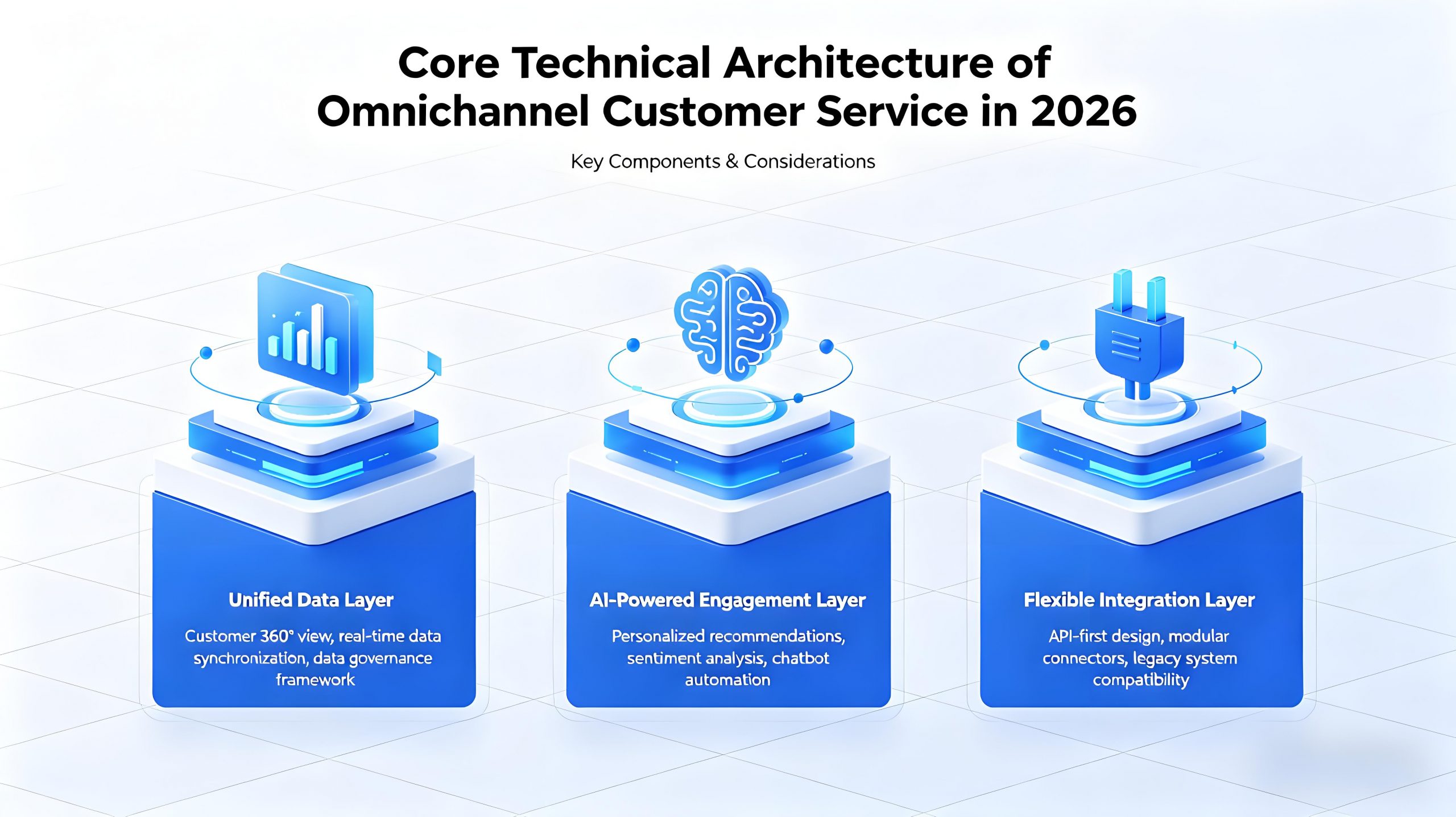
Modern omnichannel architectures are built around three core pillars: a unified data layer, an AI-powered engagement layer, and a flexible integration layer. Below is a concise breakdown of key components and considerations.
3.1 The Unified Data Layer: The Foundation
The unified data layer collects and unifies customer data from all touchpoints into a single profile, powered by cloud-based CDPs for real-time synchronization. Key components include: CDPs (Udesk’s CDP integrates 20+ channels), API-first data integration tools, and robust security/compliance (Udesk complies with global regulations, supporting private cloud for sensitive industries).
3.2 The AI-Powered Engagement Layer
AI is integral to 2026 omnichannel service, enabling personalization and efficiency. Key components: Intelligent Virtual Assistants (IVAs) handling 80%+ routine inquiries (Udesk’s IVAs support multimodal interactions), predictive analytics (reducing churn by up to 30%), and intelligent routing (improving resolution times).
3.3 The Flexible Integration Layer
This layer connects channels and backend systems, built for flexibility. Key components: API gateways (Udesk integrates 20+ global channels), cloud-native architecture (supporting 10,000+ concurrent agents, 99.99% SLA), and a centralized dashboard (Udesk’s dashboard includes real-time analytics).
3.4 Key Technical Considerations
Focus on scalability, interoperability, and user experience. Udesk’s architecture addresses all three, adapting to evolving business needs.
4. Omnichannel Customer Service Selection Checklist for 2026
Choosing the right solution requires focusing on fit, not just features. Below is a streamlined checklist for 2026:
4.1 Evaluate True Omnichannel Integration
Prioritize solutions with real integration (not just channel stacking). Udesk offers true omnichannel integration with 20+ channels and fast new channel adaptation.
4.2 Evaluate AI Capabilities
Focus on value-driving AI: high IVA performance, predictive analytics, intelligent routing, and knowledge base integration.
4.3 Ensure Deployment and Compliance Fit
Choose from public cloud (SaaS for SMBs), private cloud (for enterprises), or hybrid cloud.
4.4 Test Stability and Scalability
Prioritize solutions handling peak traffic
4.5 Evaluate System Integration
Udesk offers pre-built integrations with 50+ popular systems and custom API integration for seamless connectivity.
4.6 Consider Cost Transparency
Choose transparent pricing (Udesk offers flexible, no-hidden-fee models) and focus on ROI (average 300–500% within 12 months).
4.7 Assess Post-Sales Support
Udesk provides 24/7 global support, comprehensive training, and regular updates.
5. 2026 Trends Shaping Omnichannel Customer Service
Three key trends redefine 2026 omnichannel service: multimodal AI, sentiment analysis 2.0, and predictive service. Additional trends include privacy-first approaches and self-service omnichannel.
5.1 Multimodal AI
Seamless interactions across text, voice, images, and video. Udesk supports multimodal interactions, reducing friction and improving satisfaction. Gartner predicts 70% of 2027 interactions will use multimodal AI.
5.2 Sentiment Analysis 2.0
Real-time emotional recognition across all channels. Udesk integrates this technology, boosting retention by 25%+ and CSAT by 15%+.
5.3 Predictive Service
Proactive support by anticipating customer needs. Udesk’s predictive capabilities reduce support tickets and churn—one retail client saw a 32% churn reduction.
5.4 Privacy-First Omnichannel
Balancing personalization and data security. Udesk builds privacy-by-design principles, complying with global regulations.
5.5 Self-Service Omnichannel
Empowering customers to resolve issues independently. Udesk’s self-service tools reduce support costs by 40%+ and improve satisfaction by 20%+.
6. FAQ
Q1: How to Implement Omnichannel Without Disrupting Operations?
Start with a 2–3 channel pilot, choose a vendor with pre-built integrations (Udesk deploys SMBs in 1–2 weeks), train teams incrementally, and monitor/optimize post-deployment. Most businesses implement in 4–8 weeks.
Q2: Is Omnichannel Investment High? How to Control Costs?
Cost varies by size, but ROI offsets expenses (300–500% in 12 months). Control costs with Udesk’s transparent pricing, AI to reduce labor (85% routine inquiry resolution), and scalable plans. SMBs benefit from Udesk’s low-cost SaaS option.
Q3: Are SMBs Suitable for Omnichannel in 2026?
Yes. Udesk offers SMB-specific, low-cost solutions. Omnichannel levels the playing field, and SMBs can start small (2–3 channels) and scale. AI reduces workload for small teams, making omnichannel feasible and affordable.
In conclusion, 2026 omnichannel service is about intelligent, seamless experiences. By understanding its value, distinguishing it from multichannel, building a robust architecture, choosing the right solution, and adapting to trends, businesses drive growth. With Udesk as your partner, you can deliver exceptional support that sets your business apart.
 Customer Service Software Guides & AI Agent Blogs | Udesk