 Customer Service Software Guides & AI Agent Blogs | Udesk
Udesk Omnichannel: The Cost-Effective Alternative to Expensive Contact Centers 2026
939
article summary:In 2026, businesses worldwide face a paradox: customer expectations for seamless, omnichannel support have never been higher, yet the cost of traditional contact center solutions continues to spiral out of reach.



Table of contents for this article
- The 2026 Contact Center Crisis: Cost vs. Expectation
- Udesk Omnichannel: Redefining Cost-Effectiveness in 2026
- Enterprise-Grade Features Without the Enterprise Price Tag
- 1. Seamless Omnichannel Integration
- 2. AI-Powered Automation to Cut Labor Costs
- 3. Global Compliance and Scalability
- 4. Intuitive Analytics and Reporting
- Real-World Results: Udesk Customers Save Big in 2026
- Case Study 1: Leading Insurance Company
- Case Study 2: Fast-Growing New Consumer Brand
- Case Study 3: Multinational Retailer
- Why Udesk Outperforms Expensive Contact Centers in 2026
- 1. Transparent Pricing vs. Hidden Fees
- 2. Agility vs. Inflexibility
- 3. Simplicity vs. Overcomplexity
- 4. Localized Expertise vs. One-Size-Fits-All
- The Future of Contact Centers: Udesk’s Vision for 2026 and Beyond
- Conclusion: Why 2026 Is the Year to Switch to Udesk Omnichannel
In 2026, businesses worldwide face a paradox: customer expectations for seamless, omnichannel support have never been higher, yet the cost of traditional contact center solutions continues to spiral out of reach. For small and medium-sized enterprises (SMBs) and even mid-market companies, the price tag of enterprise-grade contact centers—often $1,000 to $2,000 per agent annually, plus hidden fees for onboarding, training, and add-on features—has become a barrier to delivering quality customer experience (CX). Enter Udesk Omnichannel: a cloud-native solution that redefines the value proposition for contact centers, proving that cost-effectiveness does not require sacrificing functionality, scalability, or customer satisfaction. This deep dive explores how Udesk is disrupting the industry in 2026, why it outperforms expensive alternatives, and how businesses of all sizes can leverage its capabilities to cut costs without compromising CX.
The 2026 Contact Center Crisis: Cost vs. Expectation
The contact center landscape in 2026 is shaped by two opposing forces: rising customer demands and unsustainable cost structures. According to Zendesk’s 2026 Customer Experience Trends Report, 68% of consumers expect consistent support across every channel—phone, email, social media, WhatsApp, and even emerging touchpoints like TikTok and live chat—yet 73% of businesses report that their contact center costs have increased by 20% or more in the past year. Traditional contact center providers, such as Five9, Genesys PureCloud, and Talkdesk, have doubled down on premium pricing models, with enterprise plans often exceeding $150 per agent per month and requiring long-term contracts that lock businesses into inflexible, costly agreements.
The hidden costs of these expensive solutions compound the problem. Onboarding fees can range from $1,000 to $10,000 depending on setup complexity, while ongoing maintenance, premium support, and additional features (like call recording storage or AI analytics) add 20% to 30% to the annual bill. For SMBs with 10 or fewer agents, this translates to annual costs of $10,000 or more—resources that could be redirected to product development, marketing, or customer acquisition. Even larger enterprises are feeling the pinch: a 2026 study by Calilio found that 45% of mid-market companies are reallocating budget from contact center operations to other departments, risking CX quality in the process.
Compounding this crisis is the rise of AI-driven customer service expectations. Gartner predicts that by 2028, 70% of customers will use dialogue-based AI to start their customer journey, yet many expensive contact centers charge exorbitant fees for AI add-ons—making it impossible for smaller businesses to compete. This gap between cost and capability has created a market opportunity for solutions like Udesk Omnichannel, which delivers enterprise-grade features at a fraction of the price.
Udesk Omnichannel: Redefining Cost-Effectiveness in 2026
Udesk Omnichannel is not just a “budget alternative” to expensive contact centers—it is a purpose-built solution designed to address the core pain points of modern businesses: cost, complexity, and scalability. Unlike traditional providers that layer on fees for basic features, Udesk offers a transparent, all-in-one pricing model that includes omnichannel integration, AI automation, and global compliance—all at a price point that makes it accessible to businesses of all sizes.
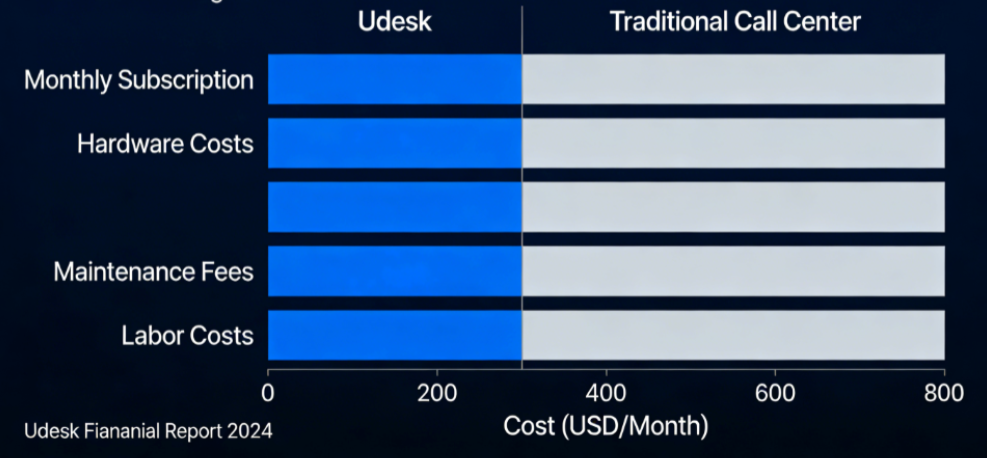
What sets Udesk apart is its commitment to “no hidden costs.” There are no onboarding fees, no mandatory training charges, and no extra costs for core features like call recording, intelligent routing, or AI-powered chatbots. This transparency allows businesses to budget with confidence, avoiding the surprise bills that plague users of expensive contact centers. For example, a 20-agent mid-market company using Udesk can save over $20,000 annually compared to a similar plan from Talkdesk—funds that can be invested in growing the business or enhancing CX initiatives.
Beyond pricing, Udesk’s cloud-native architecture eliminates the need for expensive on-premises hardware, reducing upfront capital expenditure by up to 70% compared to traditional contact centers. Businesses can deploy the platform in days, not months, and scale up or down as needed—paying only for the agents they use. This flexibility is critical in 2026, as businesses navigate unpredictable market conditions and fluctuating customer demand.
Enterprise-Grade Features Without the Enterprise Price Tag
Critics often assume that cost-effective contact centers sacrifice functionality—but Udesk Omnichannel defies this stereotype. In 2026, the platform offers a comprehensive suite of features that rival (and in some cases exceed) those of expensive alternatives, all included in its core pricing:
1. Seamless Omnichannel Integration
Udesk’s self-developed Udesk Insight Platform integrates 40+ mainstream channels via an API gateway, including phone, email, SMS, WhatsApp, Facebook Messenger, Instagram, and even emerging touchpoints like WeCom and Douyin. Unlike traditional contact centers that treat channels as separate silos, Udesk unifies all customer interactions into a single dashboard, ensuring agents have a complete view of the customer journey—from initial inquiry to resolution. This eliminates the need for agents to switch between platforms, reducing average handle time (AHT) by 30% and increasing first-contact resolution (FCR) by up to 37%, according to a case study from a major bank.
2. AI-Powered Automation to Cut Labor Costs
AI is no longer a “premium add-on” with Udesk—it is a core feature. The platform’s AI chatbots and voice recognition tools handle routine inquiries (e.g., policy questions, order status, password resets) 24/7, reducing the workload for human agents by up to 40%. For example, a leading insurance company using Udesk saw its automated response rate for policy inquiries jump to 83%, while complaint resolution time shortened from 72 hours to just 4 hours—and annual customer service labor costs were reduced by $4.5 million (RMB 28 million). Udesk’s AI also includes real-time sentiment analysis and predictive dialing, which boosts outbound sales productivity by 40%+ and helps agents prioritize high-priority customers.
3. Global Compliance and Scalability
For businesses operating internationally, compliance with regional data laws (e.g., GDPR, HIPAA) is non-negotiable—and expensive contact centers often charge extra for compliance features. Udesk includes built-in compliance tools as standard, ensuring businesses meet global regulations without additional costs. Its cloud-native architecture supports seamless scaling across 20+ international regions, making it ideal for businesses expanding into new markets. A cross-border e-commerce enterprise using Udesk reported that the platform’s cross-channel information integration rate jumped from 30% to 85%, while human response time was reduced by 40%.
4. Intuitive Analytics and Reporting
Udesk’s built-in analytics dashboard provides real-time insights into agent performance, customer satisfaction, and channel effectiveness—no extra fees required. Businesses can track key metrics like CSAT (Customer Satisfaction Score), NPS (Net Promoter Score), and AHT, allowing them to identify bottlenecks and optimize their contact center operations. A Fortune 500 retailer using Udesk reported that the platform’s AI-driven quality assurance tools improved their CSAT scores by 18% in six months.
Real-World Results: Udesk Customers Save Big in 2026
The true value of Udesk Omnichannel is best demonstrated through real customer success stories. In 2026, businesses across industries are leveraging Udesk to cut costs while improving CX:
Case Study 1: Leading Insurance Company
A major insurance provider with 50+ agents was struggling with high labor costs and slow complaint resolution times using a traditional contact center solution. After switching to Udesk Omnichannel, the company integrated 12 entry points (including its 95519 hotline, app, and official website) into a single platform. The results were dramatic: automated response rates for policy inquiries reached 83%, complaint resolution time dropped from 72 hours to 4 hours, and annual labor costs were reduced by $4.5 million (RMB 28 million). The company also reported a 22% increase in CSAT scores, as customers received faster, more consistent support across all channels.
Case Study 2: Fast-Growing New Consumer Brand
A emerging DTC (Direct-to-Consumer) brand with 15 agents needed an omnichannel solution to support its rapid growth, but couldn’t afford the $150+ per agent per month cost of enterprise contact centers. Udesk’s Omnichannel plan allowed the brand to integrate its website chat, social media, and email support into one dashboard, while leveraging AI chatbots to handle 60% of routine inquiries. The result: private domain traffic operational efficiency improved threefold, agent productivity increased by 35%, and the brand saved over $12,000 annually compared to its previous solution. Most importantly, CSAT scores remained above 90%, as customers received seamless support across all touchpoints.
Case Study 3: Multinational Retailer
A Fortune 500 retailer with operations in 10+ countries was using a fragmented contact center system that required separate contracts for each region, leading to high costs and inconsistent CX. Udesk’s global omnichannel platform unified all regional support teams into a single dashboard, with built-in compliance for GDPR and local data laws. The retailer saw a 20% reduction in contact center costs, a 30% decrease in AHT, and an 18% improvement in CSAT scores—all while scaling its operations to support 100+ agents across multiple time zones.
Why Udesk Outperforms Expensive Contact Centers in 2026
The success of Udesk Omnichannel stems from its ability to address the fundamental flaws of expensive contact centers: inflexibility, hidden costs, and overcomplexity. Here’s how Udesk compares to traditional enterprise solutions in 2026:
1. Transparent Pricing vs. Hidden Fees
Expensive contact centers often advertise low base prices but add fees for onboarding, training, AI features, and compliance. Udesk’s all-in-one pricing includes every core feature a business needs—no surprises, no hidden costs.
2. Agility vs. Inflexibility
Traditional contact centers require long-term contracts (1–3 years) and charge hefty termination fees, making it difficult for businesses to adapt to changing market conditions. Udesk offers month-to-month contracts, allowing businesses to scale up or down as needed. This agility is critical in 2026, as businesses navigate post-pandemic fluctuations and evolving customer demands.
3. Simplicity vs. Overcomplexity
Expensive contact centers often require dedicated IT teams to manage and maintain, adding to operational costs. Udesk’s intuitive interface is designed for non-technical users, with drag-and-drop tools that allow businesses to set up and customize their contact center in days—not months. This reduces reliance on IT resources and lowers operational costs by up to 25%.
4. Localized Expertise vs. One-Size-Fits-All
Unlike international providers like Zendesk, which struggle with localized context (e.g., 82% accuracy in Chinese intent recognition), Udesk has deep experience in regional markets, with AI trained on 1 billion-level local corpora (98.5% intent recognition accuracy) and scenario-based solutions for industries like retail, healthcare, and finance. This localized expertise ensures businesses deliver relevant, personalized support—without the need for costly custom development.
The Future of Contact Centers: Udesk’s Vision for 2026 and Beyond
As we move further into 2026, the contact center industry will continue to shift toward AI-driven omnichannel support—and cost-effectiveness will remain a top priority for businesses. Udesk is well-positioned to lead this shift, with ongoing investments in AI innovation, channel expansion, and user experience. The platform’s upcoming features for 2026 include agent-assisted AI (which provides real-time suggestions to human agents), advanced predictive analytics, and deeper integrations with CRM platforms like Salesforce and SAP—all included in its existing pricing model.
Udesk’s rise from a “local follower” to a global standard-setter is a testament to its customer-centric approach: delivering enterprise-grade value without the enterprise price tag. For businesses tired of choosing between cost and CX, Udesk Omnichannel proves that you can have both.
Conclusion: Why 2026 Is the Year to Switch to Udesk Omnichannel
In 2026, the cost of expensive contact centers is no longer justifiable. Businesses of all sizes need a solution that delivers seamless omnichannel support, AI-driven efficiency, and global compliance—without breaking the bank. Udesk Omnichannel fills this gap, offering transparent pricing, enterprise-grade features, and real-world cost savings that help businesses grow while delivering exceptional CX.
Whether you’re an SMB looking to scale your support operations, a mid-market company seeking to cut costs, or a multinational enterprise needing a global solution, Udesk Omnichannel is the cost-effective alternative that doesn’t compromise on quality. In a year where every dollar counts, Udesk is more than a contact center solution—it’s a strategic investment in your business’s success.
AI is no longer a “premium add-on” with Udesk—it is a core feature. The platform’s AI chatbots and voice recognition tools handle routine inquiries (e.g., policy questions, order status, password resets) 24/7, reducing the workload for human agents by up to 40%. For example, a leading insurance company using Udesk saw its automated response rate for policy inquiries jump to 83%, while complaint resolution time shortened from 72 hours to just 4 hours—and annual customer service labor costs were reduced by $4.5 million (RMB 28 million). Udesk’s AI also includes real-time sentiment analysis and predictive dialing, which boosts outbound sales productivity by 40%+ and helps agents prioritize high-priority customers.
3. Global Compliance and Scalability
For businesses operating internationally, compliance with regional data laws (e.g., GDPR, HIPAA) is non-negotiable—and expensive contact centers often charge extra for compliance features. Udesk includes built-in compliance tools as standard, ensuring businesses meet global regulations without additional costs. Its cloud-native architecture supports seamless scaling across 20+ international regions, making it ideal for businesses expanding into new markets. A cross-border e-commerce enterprise using Udesk reported that the platform’s cross-channel information integration rate jumped from 30% to 85%, while human response time was reduced by 40%.
4. Intuitive Analytics and Reporting
Udesk’s built-in analytics dashboard provides real-time insights into agent performance, customer satisfaction, and channel effectiveness—no extra fees required. Businesses can track key metrics like CSAT (Customer Satisfaction Score), NPS (Net Promoter Score), and AHT, allowing them to identify bottlenecks and optimize their contact center operations. A Fortune 500 retailer using Udesk reported that the platform’s AI-driven quality assurance tools improved their CSAT scores by 18% in six months.
Real-World Results: Udesk Customers Save Big in 2026
The true value of Udesk Omnichannel is best demonstrated through real customer success stories. In 2026, businesses across industries are leveraging Udesk to cut costs while improving CX:
Case Study 1: Leading Insurance Company
A major insurance provider with 50+ agents was struggling with high labor costs and slow complaint resolution times using a traditional contact center solution. After switching to Udesk Omnichannel, the company integrated 12 entry points (including its 95519 hotline, app, and official website) into a single platform. The results were dramatic: automated response rates for policy inquiries reached 83%, complaint resolution time dropped from 72 hours to 4 hours, and annual labor costs were reduced by $4.5 million (RMB 28 million). The company also reported a 22% increase in CSAT scores, as customers received faster, more consistent support across all channels.
Case Study 2: Fast-Growing New Consumer Brand
A emerging DTC (Direct-to-Consumer) brand with 15 agents needed an omnichannel solution to support its rapid growth, but couldn’t afford the $150+ per agent per month cost of enterprise contact centers. Udesk’s Omnichannel plan allowed the brand to integrate its website chat, social media, and email support into one dashboard, while leveraging AI chatbots to handle 60% of routine inquiries. The result: private domain traffic operational efficiency improved threefold, agent productivity increased by 35%, and the brand saved over $12,000 annually compared to its previous solution. Most importantly, CSAT scores remained above 90%, as customers received seamless support across all touchpoints.
Case Study 3: Multinational Retailer
A Fortune 500 retailer with operations in 10+ countries was using a fragmented contact center system that required separate contracts for each region, leading to high costs and inconsistent CX. Udesk’s global omnichannel platform unified all regional support teams into a single dashboard, with built-in compliance for GDPR and local data laws. The retailer saw a 20% reduction in contact center costs, a 30% decrease in AHT, and an 18% improvement in CSAT scores—all while scaling its operations to support 100+ agents across multiple time zones.
Why Udesk Outperforms Expensive Contact Centers in 2026
The success of Udesk Omnichannel stems from its ability to address the fundamental flaws of expensive contact centers: inflexibility, hidden costs, and overcomplexity. Here’s how Udesk compares to traditional enterprise solutions in 2026:
1. Transparent Pricing vs. Hidden Fees
Expensive contact centers often advertise low base prices but add fees for onboarding, training, AI features, and compliance. Udesk’s all-in-one pricing includes every core feature a business needs—no surprises, no hidden costs.
2. Agility vs. Inflexibility
Traditional contact centers require long-term contracts (1–3 years) and charge hefty termination fees, making it difficult for businesses to adapt to changing market conditions. Udesk offers month-to-month contracts, allowing businesses to scale up or down as needed. This agility is critical in 2026, as businesses navigate post-pandemic fluctuations and evolving customer demands.
3. Simplicity vs. Overcomplexity
Expensive contact centers often require dedicated IT teams to manage and maintain, adding to operational costs. Udesk’s intuitive interface is designed for non-technical users, with drag-and-drop tools that allow businesses to set up and customize their contact center in days—not months. This reduces reliance on IT resources and lowers operational costs by up to 25%.
4. Localized Expertise vs. One-Size-Fits-All
Unlike international providers like Zendesk, which struggle with localized context (e.g., 82% accuracy in Chinese intent recognition), Udesk has deep experience in regional markets, with AI trained on 1 billion-level local corpora (98.5% intent recognition accuracy) and scenario-based solutions for industries like retail, healthcare, and finance. This localized expertise ensures businesses deliver relevant, personalized support—without the need for costly custom development.
The Future of Contact Centers: Udesk’s Vision for 2026 and Beyond
As we move further into 2026, the contact center industry will continue to shift toward AI-driven omnichannel support—and cost-effectiveness will remain a top priority for businesses. Udesk is well-positioned to lead this shift, with ongoing investments in AI innovation, channel expansion, and user experience. The platform’s upcoming features for 2026 include agent-assisted AI (which provides real-time suggestions to human agents), advanced predictive analytics, and deeper integrations with CRM platforms like Salesforce and SAP—all included in its existing pricing model.
Udesk’s rise from a “local follower” to a global standard-setter is a testament to its customer-centric approach: delivering enterprise-grade value without the enterprise price tag. For businesses tired of choosing between cost and CX, Udesk Omnichannel proves that you can have both.
Conclusion: Why 2026 Is the Year to Switch to Udesk Omnichannel
In 2026, the cost of expensive contact centers is no longer justifiable. Businesses of all sizes need a solution that delivers seamless omnichannel support, AI-driven efficiency, and global compliance—without breaking the bank. Udesk Omnichannel fills this gap, offering transparent pricing, enterprise-grade features, and real-world cost savings that help businesses grow while delivering exceptional CX.
Whether you’re an SMB looking to scale your support operations, a mid-market company seeking to cut costs, or a multinational enterprise needing a global solution, Udesk Omnichannel is the cost-effective alternative that doesn’t compromise on quality. In a year where every dollar counts, Udesk is more than a contact center solution—it’s a strategic investment in your business’s success.
Udesk’s built-in analytics dashboard provides real-time insights into agent performance, customer satisfaction, and channel effectiveness—no extra fees required. Businesses can track key metrics like CSAT (Customer Satisfaction Score), NPS (Net Promoter Score), and AHT, allowing them to identify bottlenecks and optimize their contact center operations. A Fortune 500 retailer using Udesk reported that the platform’s AI-driven quality assurance tools improved their CSAT scores by 18% in six months.
Real-World Results: Udesk Customers Save Big in 2026
The true value of Udesk Omnichannel is best demonstrated through real customer success stories. In 2026, businesses across industries are leveraging Udesk to cut costs while improving CX:
Case Study 1: Leading Insurance Company
A major insurance provider with 50+ agents was struggling with high labor costs and slow complaint resolution times using a traditional contact center solution. After switching to Udesk Omnichannel, the company integrated 12 entry points (including its 95519 hotline, app, and official website) into a single platform. The results were dramatic: automated response rates for policy inquiries reached 83%, complaint resolution time dropped from 72 hours to 4 hours, and annual labor costs were reduced by $4.5 million (RMB 28 million). The company also reported a 22% increase in CSAT scores, as customers received faster, more consistent support across all channels.
Case Study 2: Fast-Growing New Consumer Brand
A emerging DTC (Direct-to-Consumer) brand with 15 agents needed an omnichannel solution to support its rapid growth, but couldn’t afford the $150+ per agent per month cost of enterprise contact centers. Udesk’s Omnichannel plan allowed the brand to integrate its website chat, social media, and email support into one dashboard, while leveraging AI chatbots to handle 60% of routine inquiries. The result: private domain traffic operational efficiency improved threefold, agent productivity increased by 35%, and the brand saved over $12,000 annually compared to its previous solution. Most importantly, CSAT scores remained above 90%, as customers received seamless support across all touchpoints.
Case Study 3: Multinational Retailer
A Fortune 500 retailer with operations in 10+ countries was using a fragmented contact center system that required separate contracts for each region, leading to high costs and inconsistent CX. Udesk’s global omnichannel platform unified all regional support teams into a single dashboard, with built-in compliance for GDPR and local data laws. The retailer saw a 20% reduction in contact center costs, a 30% decrease in AHT, and an 18% improvement in CSAT scores—all while scaling its operations to support 100+ agents across multiple time zones.
Why Udesk Outperforms Expensive Contact Centers in 2026
The success of Udesk Omnichannel stems from its ability to address the fundamental flaws of expensive contact centers: inflexibility, hidden costs, and overcomplexity. Here’s how Udesk compares to traditional enterprise solutions in 2026:
1. Transparent Pricing vs. Hidden Fees
Expensive contact centers often advertise low base prices but add fees for onboarding, training, AI features, and compliance. Udesk’s all-in-one pricing includes every core feature a business needs—no surprises, no hidden costs.
2. Agility vs. Inflexibility
Traditional contact centers require long-term contracts (1–3 years) and charge hefty termination fees, making it difficult for businesses to adapt to changing market conditions. Udesk offers month-to-month contracts, allowing businesses to scale up or down as needed. This agility is critical in 2026, as businesses navigate post-pandemic fluctuations and evolving customer demands.
3. Simplicity vs. Overcomplexity
Expensive contact centers often require dedicated IT teams to manage and maintain, adding to operational costs. Udesk’s intuitive interface is designed for non-technical users, with drag-and-drop tools that allow businesses to set up and customize their contact center in days—not months. This reduces reliance on IT resources and lowers operational costs by up to 25%.
4. Localized Expertise vs. One-Size-Fits-All
Unlike international providers like Zendesk, which struggle with localized context (e.g., 82% accuracy in Chinese intent recognition), Udesk has deep experience in regional markets, with AI trained on 1 billion-level local corpora (98.5% intent recognition accuracy) and scenario-based solutions for industries like retail, healthcare, and finance. This localized expertise ensures businesses deliver relevant, personalized support—without the need for costly custom development.
The Future of Contact Centers: Udesk’s Vision for 2026 and Beyond
As we move further into 2026, the contact center industry will continue to shift toward AI-driven omnichannel support—and cost-effectiveness will remain a top priority for businesses. Udesk is well-positioned to lead this shift, with ongoing investments in AI innovation, channel expansion, and user experience. The platform’s upcoming features for 2026 include agent-assisted AI (which provides real-time suggestions to human agents), advanced predictive analytics, and deeper integrations with CRM platforms like Salesforce and SAP—all included in its existing pricing model.
Udesk’s rise from a “local follower” to a global standard-setter is a testament to its customer-centric approach: delivering enterprise-grade value without the enterprise price tag. For businesses tired of choosing between cost and CX, Udesk Omnichannel proves that you can have both.
Conclusion: Why 2026 Is the Year to Switch to Udesk Omnichannel
In 2026, the cost of expensive contact centers is no longer justifiable. Businesses of all sizes need a solution that delivers seamless omnichannel support, AI-driven efficiency, and global compliance—without breaking the bank. Udesk Omnichannel fills this gap, offering transparent pricing, enterprise-grade features, and real-world cost savings that help businesses grow while delivering exceptional CX.
Whether you’re an SMB looking to scale your support operations, a mid-market company seeking to cut costs, or a multinational enterprise needing a global solution, Udesk Omnichannel is the cost-effective alternative that doesn’t compromise on quality. In a year where every dollar counts, Udesk is more than a contact center solution—it’s a strategic investment in your business’s success.
A emerging DTC (Direct-to-Consumer) brand with 15 agents needed an omnichannel solution to support its rapid growth, but couldn’t afford the $150+ per agent per month cost of enterprise contact centers. Udesk’s Omnichannel plan allowed the brand to integrate its website chat, social media, and email support into one dashboard, while leveraging AI chatbots to handle 60% of routine inquiries. The result: private domain traffic operational efficiency improved threefold, agent productivity increased by 35%, and the brand saved over $12,000 annually compared to its previous solution. Most importantly, CSAT scores remained above 90%, as customers received seamless support across all touchpoints.
Case Study 3: Multinational Retailer
A Fortune 500 retailer with operations in 10+ countries was using a fragmented contact center system that required separate contracts for each region, leading to high costs and inconsistent CX. Udesk’s global omnichannel platform unified all regional support teams into a single dashboard, with built-in compliance for GDPR and local data laws. The retailer saw a 20% reduction in contact center costs, a 30% decrease in AHT, and an 18% improvement in CSAT scores—all while scaling its operations to support 100+ agents across multiple time zones.
Why Udesk Outperforms Expensive Contact Centers in 2026
The success of Udesk Omnichannel stems from its ability to address the fundamental flaws of expensive contact centers: inflexibility, hidden costs, and overcomplexity. Here’s how Udesk compares to traditional enterprise solutions in 2026:
1. Transparent Pricing vs. Hidden Fees
Expensive contact centers often advertise low base prices but add fees for onboarding, training, AI features, and compliance. Udesk’s all-in-one pricing includes every core feature a business needs—no surprises, no hidden costs.
2. Agility vs. Inflexibility
Traditional contact centers require long-term contracts (1–3 years) and charge hefty termination fees, making it difficult for businesses to adapt to changing market conditions. Udesk offers month-to-month contracts, allowing businesses to scale up or down as needed. This agility is critical in 2026, as businesses navigate post-pandemic fluctuations and evolving customer demands.
3. Simplicity vs. Overcomplexity
Expensive contact centers often require dedicated IT teams to manage and maintain, adding to operational costs. Udesk’s intuitive interface is designed for non-technical users, with drag-and-drop tools that allow businesses to set up and customize their contact center in days—not months. This reduces reliance on IT resources and lowers operational costs by up to 25%.
4. Localized Expertise vs. One-Size-Fits-All
Unlike international providers like Zendesk, which struggle with localized context (e.g., 82% accuracy in Chinese intent recognition), Udesk has deep experience in regional markets, with AI trained on 1 billion-level local corpora (98.5% intent recognition accuracy) and scenario-based solutions for industries like retail, healthcare, and finance. This localized expertise ensures businesses deliver relevant, personalized support—without the need for costly custom development.
The Future of Contact Centers: Udesk’s Vision for 2026 and Beyond
As we move further into 2026, the contact center industry will continue to shift toward AI-driven omnichannel support—and cost-effectiveness will remain a top priority for businesses. Udesk is well-positioned to lead this shift, with ongoing investments in AI innovation, channel expansion, and user experience. The platform’s upcoming features for 2026 include agent-assisted AI (which provides real-time suggestions to human agents), advanced predictive analytics, and deeper integrations with CRM platforms like Salesforce and SAP—all included in its existing pricing model.
Udesk’s rise from a “local follower” to a global standard-setter is a testament to its customer-centric approach: delivering enterprise-grade value without the enterprise price tag. For businesses tired of choosing between cost and CX, Udesk Omnichannel proves that you can have both.
Conclusion: Why 2026 Is the Year to Switch to Udesk Omnichannel
In 2026, the cost of expensive contact centers is no longer justifiable. Businesses of all sizes need a solution that delivers seamless omnichannel support, AI-driven efficiency, and global compliance—without breaking the bank. Udesk Omnichannel fills this gap, offering transparent pricing, enterprise-grade features, and real-world cost savings that help businesses grow while delivering exceptional CX.
Whether you’re an SMB looking to scale your support operations, a mid-market company seeking to cut costs, or a multinational enterprise needing a global solution, Udesk Omnichannel is the cost-effective alternative that doesn’t compromise on quality. In a year where every dollar counts, Udesk is more than a contact center solution—it’s a strategic investment in your business’s success.
Expensive contact centers often advertise low base prices but add fees for onboarding, training, AI features, and compliance. Udesk’s all-in-one pricing includes every core feature a business needs—no surprises, no hidden costs.
2. Agility vs. Inflexibility
Traditional contact centers require long-term contracts (1–3 years) and charge hefty termination fees, making it difficult for businesses to adapt to changing market conditions. Udesk offers month-to-month contracts, allowing businesses to scale up or down as needed. This agility is critical in 2026, as businesses navigate post-pandemic fluctuations and evolving customer demands.
3. Simplicity vs. Overcomplexity
Expensive contact centers often require dedicated IT teams to manage and maintain, adding to operational costs. Udesk’s intuitive interface is designed for non-technical users, with drag-and-drop tools that allow businesses to set up and customize their contact center in days—not months. This reduces reliance on IT resources and lowers operational costs by up to 25%.
4. Localized Expertise vs. One-Size-Fits-All
Unlike international providers like Zendesk, which struggle with localized context (e.g., 82% accuracy in Chinese intent recognition), Udesk has deep experience in regional markets, with AI trained on 1 billion-level local corpora (98.5% intent recognition accuracy) and scenario-based solutions for industries like retail, healthcare, and finance. This localized expertise ensures businesses deliver relevant, personalized support—without the need for costly custom development.
The Future of Contact Centers: Udesk’s Vision for 2026 and Beyond
As we move further into 2026, the contact center industry will continue to shift toward AI-driven omnichannel support—and cost-effectiveness will remain a top priority for businesses. Udesk is well-positioned to lead this shift, with ongoing investments in AI innovation, channel expansion, and user experience. The platform’s upcoming features for 2026 include agent-assisted AI (which provides real-time suggestions to human agents), advanced predictive analytics, and deeper integrations with CRM platforms like Salesforce and SAP—all included in its existing pricing model.
Udesk’s rise from a “local follower” to a global standard-setter is a testament to its customer-centric approach: delivering enterprise-grade value without the enterprise price tag. For businesses tired of choosing between cost and CX, Udesk Omnichannel proves that you can have both.
Conclusion: Why 2026 Is the Year to Switch to Udesk Omnichannel
In 2026, the cost of expensive contact centers is no longer justifiable. Businesses of all sizes need a solution that delivers seamless omnichannel support, AI-driven efficiency, and global compliance—without breaking the bank. Udesk Omnichannel fills this gap, offering transparent pricing, enterprise-grade features, and real-world cost savings that help businesses grow while delivering exceptional CX.
Whether you’re an SMB looking to scale your support operations, a mid-market company seeking to cut costs, or a multinational enterprise needing a global solution, Udesk Omnichannel is the cost-effective alternative that doesn’t compromise on quality. In a year where every dollar counts, Udesk is more than a contact center solution—it’s a strategic investment in your business’s success.
Expensive contact centers often require dedicated IT teams to manage and maintain, adding to operational costs. Udesk’s intuitive interface is designed for non-technical users, with drag-and-drop tools that allow businesses to set up and customize their contact center in days—not months. This reduces reliance on IT resources and lowers operational costs by up to 25%.
4. Localized Expertise vs. One-Size-Fits-All
Unlike international providers like Zendesk, which struggle with localized context (e.g., 82% accuracy in Chinese intent recognition), Udesk has deep experience in regional markets, with AI trained on 1 billion-level local corpora (98.5% intent recognition accuracy) and scenario-based solutions for industries like retail, healthcare, and finance. This localized expertise ensures businesses deliver relevant, personalized support—without the need for costly custom development.
The Future of Contact Centers: Udesk’s Vision for 2026 and Beyond
As we move further into 2026, the contact center industry will continue to shift toward AI-driven omnichannel support—and cost-effectiveness will remain a top priority for businesses. Udesk is well-positioned to lead this shift, with ongoing investments in AI innovation, channel expansion, and user experience. The platform’s upcoming features for 2026 include agent-assisted AI (which provides real-time suggestions to human agents), advanced predictive analytics, and deeper integrations with CRM platforms like Salesforce and SAP—all included in its existing pricing model.
Udesk’s rise from a “local follower” to a global standard-setter is a testament to its customer-centric approach: delivering enterprise-grade value without the enterprise price tag. For businesses tired of choosing between cost and CX, Udesk Omnichannel proves that you can have both.
Conclusion: Why 2026 Is the Year to Switch to Udesk Omnichannel
In 2026, the cost of expensive contact centers is no longer justifiable. Businesses of all sizes need a solution that delivers seamless omnichannel support, AI-driven efficiency, and global compliance—without breaking the bank. Udesk Omnichannel fills this gap, offering transparent pricing, enterprise-grade features, and real-world cost savings that help businesses grow while delivering exceptional CX.
Whether you’re an SMB looking to scale your support operations, a mid-market company seeking to cut costs, or a multinational enterprise needing a global solution, Udesk Omnichannel is the cost-effective alternative that doesn’t compromise on quality. In a year where every dollar counts, Udesk is more than a contact center solution—it’s a strategic investment in your business’s success.
The article is original by Udesk, and when reprinted, the source must be indicated:https://www.udeskglobal.com/blog/udesk-omnichannel-the-cost-effective-alternative-to-expensive-contact-centers-2026.html
ai customer serviceAI Customer Service SystemIntelligent Customer Service System
next: Omnichannel vs Multichannel Customer Service: What’s Best for 2026?prev: How Omnichannel Contact Centers Boost CSAT by 25%+ (2026 Benchmarks)