 Customer Service Software Guides & AI Agent Blogs | Udesk
AI Chatbot for Financial Services: Compliant, Secure & Scalable
article summary:The financial services industry operates under intense regulatory scrutiny, ever-present cybersecurity threats, and rising customer expectations for instant support. An AI chatbot for financial services is no longer a luxury—it's a necessity. However, unlike generic chatbots, a finance-grade solution must prioritize compliance (SOC 2, GDPR, FINRA), bank-level security, and seamless scalability.



Table of contents for this article
- 1. Why Financial Services Need Specialized AI Chatbots
- 2. Core Compliance Requirements for Financial Chatbots
- 2.1 Regulatory Frameworks
- 2.2 Audit Trails & Explainability
- 2.3 Consent & Disclosure
- 3. Security Architecture: Zero-Trust for AI Chatbot in Finance
- 4. Scalability: From Startup to Global Bank
- 4.1 Technical Scalability
- 4.2 Operational Scalability
- 5. Key Use Cases of AI Chatbot in Finance
- 6. Conclusion
- Frequently Asked Questions (FAQ)
- Q1: Can an AI chatbot for financial services handle sensitive data like credit card numbers securely?
- Q2: How do AI chatbots maintain compliance with regulations like FINRA or SEC?
- Q3: Can the chatbot scale during peak periods like tax season or market volatility?
- 》》Click to start your free trial of AI chatbot, and experience the advantages firsthand.
The financial services industry operates under intense regulatory scrutiny, ever-present cybersecurity threats, and rising customer expectations for instant support. An AI chatbot for financial services is no longer a luxury—it's a necessity. However, unlike generic chatbots, a finance-grade solution must prioritize compliance (SOC 2, GDPR, FINRA), bank-level security, and seamless scalability.
This article explores how modern AI chatbot solutions are transforming banking, wealth management, and insurance while adhering to strict financial regulations.
1. Why Financial Services Need Specialized AI Chatbots
| Feature | Generic Chatbot | Financial Services AI Chatbot |
|---|---|---|
| Compliance | Basic opt-in only | SOC 2, GDPR, PCI DSS, FINRA, MiFID II ready |
| Data Security | Standard encryption | End-to-end AES-256, role-based access, audit logs |
| Scalability | Limited to 1K–10K concurrent users | Auto-scaling to millions of users |
| Domain Knowledge | General Q&A | Banking, trading, mortgage, insurance workflows |
| Integration | Simple APIs | Core banking systems, CRM, KYC/AML tools |
Key takeaway: A purpose-built AI chatbot for finance reduces operational costs by up to 30% while increasing first-contact resolution rates by 45% (source: Juniper Research).
2. Core Compliance Requirements for Financial Chatbots
2.1 Regulatory Frameworks
-
GDPR (EU) – Right to deletion, data minimization, consent management.
-
CCPA (California) – Opt-out of data selling, access requests.
-
FINRA (U.S. Securities) – Record retention, supervision of electronic communications.
-
PCI DSS – No storage of PAN/CVV; tokenized payment conversations.
2.2 Audit Trails & Explainability
-
Every conversation must be immutable, time-stamped, and retrievable for 5–7 years.
-
The AI chatbot must log intents, confidence scores, and any human handoff events.
2.3 Consent & Disclosure
-
Explicit user consent before collecting personal financial data.
-
Clear bot disclosure: “I am an AI assistant, not a licensed financial advisor.”
✅ Best Practice: Deploy a “compliance layer” that screens all outgoing bot messages against a pre-approved lexicon before delivery.
GDPR (EU) – Right to deletion, data minimization, consent management.
CCPA (California) – Opt-out of data selling, access requests.
FINRA (U.S. Securities) – Record retention, supervision of electronic communications.
PCI DSS – No storage of PAN/CVV; tokenized payment conversations.
-
Every conversation must be immutable, time-stamped, and retrievable for 5–7 years.
-
The AI chatbot must log intents, confidence scores, and any human handoff events.
2.3 Consent & Disclosure
-
Explicit user consent before collecting personal financial data.
-
Clear bot disclosure: “I am an AI assistant, not a licensed financial advisor.”
✅ Best Practice: Deploy a “compliance layer” that screens all outgoing bot messages against a pre-approved lexicon before delivery.
Explicit user consent before collecting personal financial data.
Clear bot disclosure: “I am an AI assistant, not a licensed financial advisor.”
✅ Best Practice: Deploy a “compliance layer” that screens all outgoing bot messages against a pre-approved lexicon before delivery.
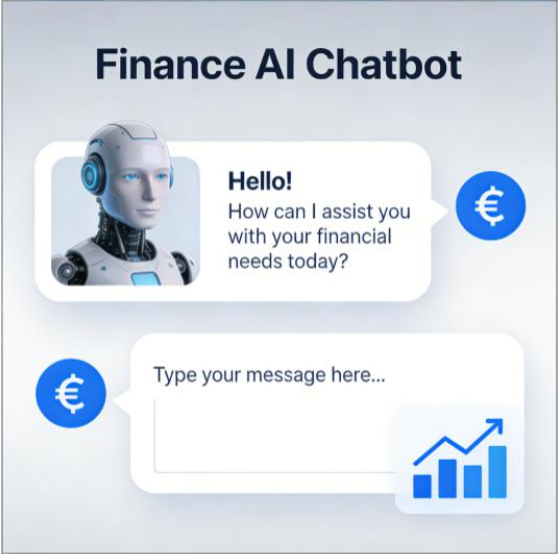
3. Security Architecture: Zero-Trust for AI Chatbot in Finance
Security is the top concern for financial institutions deploying an AI chatbot. Adopt a zero-trust architecture:
| Security Layer | Implementation |
|---|---|
| Data at rest | AES-256 encryption |
| Data in transit | TLS 1.3 |
| Authentication | OAuth 2.0 / OpenID Connect with MFA |
| Session management | Auto-timeout after 5–15 minutes inactivity |
| PII masking | Automatic redaction of SSN, account numbers, DOB |
| Rate limiting | Prevent brute force / scraping attacks |
Additionally:
-
Isolated environments – Chatbot logic separated from core banking databases.
-
Regular penetration testing – Minimum quarterly.
-
Vulnerability disclosure program – Encourage ethical hackers.
4. Scalability: From Startup to Global Bank
A truly scalable AI chatbot for financial services handles traffic spikes (e.g., tax day, market crashes) without breaking.
4.1 Technical Scalability
-
Cloud-native (AWS, Azure, GCP) with auto-scaling groups.
-
Asynchronous processing – Queue-based message handling for high load.
-
Multi-region deployment – Low latency for global users.
4.2 Operational Scalability
-
No-code intent editor – Business teams update responses without engineering.
-
Human-in-the-loop (HITL) – Seamless handoff to live agents during complex queries.
-
Multi-language support – 50+ languages with localized compliance (e.g., German BaFin, Singapore MAS).
📈 Case example: A top-10 U.S. bank deployed an AI chatbot handling 2M+ monthly conversations during tax season with 99.99% uptime.

5. Key Use Cases of AI Chatbot in Finance
Use Case
ROI Impact
24/7 Account balance & transaction history
Reduces call center volume by 35%
Fraud alert verification
Resolves 60% of alerts automatically
Loan pre-approval & document collection
Reduces processing time from days to hours
Investment portfolio Q&A
Increases self-service adoption by 50%
Mortgage rate inquiries & appointment booking
Boosts conversion by 20%
6. Conclusion
Cloud-native (AWS, Azure, GCP) with auto-scaling groups.
Asynchronous processing – Queue-based message handling for high load.
Multi-region deployment – Low latency for global users.
-
No-code intent editor – Business teams update responses without engineering.
-
Human-in-the-loop (HITL) – Seamless handoff to live agents during complex queries.
-
Multi-language support – 50+ languages with localized compliance (e.g., German BaFin, Singapore MAS).
📈 Case example: A top-10 U.S. bank deployed an AI chatbot handling 2M+ monthly conversations during tax season with 99.99% uptime.
5. Key Use Cases of AI Chatbot in Finance
| Use Case | ROI Impact |
|---|---|
| 24/7 Account balance & transaction history | Reduces call center volume by 35% |
| Fraud alert verification | Resolves 60% of alerts automatically |
| Loan pre-approval & document collection | Reduces processing time from days to hours |
| Investment portfolio Q&A | Increases self-service adoption by 50% |
| Mortgage rate inquiries & appointment booking | Boosts conversion by 20% |
6. Conclusion
A compliant, secure, and scalable AI chatbot for financial services delivers measurable ROI: lower operational costs, higher customer satisfaction, and 24/7 availability—without regulatory risk. The key is choosing a solution built for finance, not retrofitted from retail or healthcare.
When evaluating vendors, demand proof of SOC 2 Type II, penetration test results, and real-world scalability metrics.
Frequently Asked Questions (FAQ)
Q1: Can an AI chatbot for financial services handle sensitive data like credit card numbers securely?
A: Yes, but only if it is PCI DSS Level 1 compliant. A secure AI chatbot never stores full PAN (Primary Account Number) or CVV. It can tokenize payment information, pass it directly to a payment gateway, and mask any sensitive data from logs and transcripts. Always verify the vendor’s PCI attestation of compliance.
Q2: How do AI chatbots maintain compliance with regulations like FINRA or SEC?
A: Financial-grade AI chatbot platforms include built-in compliance features: immutable audit trails, pre-approved response libraries, sentiment and lexicon filtering, and supervisory review workflows. For FINRA, the chatbot can be configured to archive all conversations for 7 years and flag specific keywords (e.g., “guaranteed return”) for manual review.
Q3: Can the chatbot scale during peak periods like tax season or market volatility?
A: Absolutely. A cloud-native AI chatbot for financial services uses auto-scaling infrastructure that adds server capacity within seconds. Leading solutions handle from 100 to 1 million+ concurrent conversations without degradation. Load testing for 3–5x normal traffic is recommended before deployment.
》》Click to start your free trial of AI chatbot, and experience the advantages firsthand.
The article is original by Udesk, and when reprinted, the source must be indicated:https://www.udeskglobal.com/blog/ai-chatbot-for-financial-services-compliant-secure-scalable.html