In the industrial manufacturing sector, your product is only half the deal. The other half is uptime.
When a hydraulic press breaks down on a factory floor, the operator doesn’t care about the precision engineering that went into it; they care about how fast you can ship a replacement part or dispatch a technician. This high-stakes environment exposes a critical vulnerability for manufacturers: the "Dealer-to-End-User Disconnect."
While Enterprise Resource Planning (ERP) systems manage inventory and Supply Chain Management (SCM) tracks logistics, Customer Service Software for Manufacturing bridges the emotional gap between a brand promise and a field emergency.
This article explores how modern customer service software transforms the post-sales journey—turning fragmented dealer networks into a unified support front and end-users into loyal advocates.
1. The Manufacturing Support Dilemma: The "Broken Bridge"
Unlike B2C transactions, manufacturing involves a complex ecosystem. You have the Original Equipment Manufacturer (OEM) , the Dealer/Distributor, and the End-User.
Traditionally, the OEM sells to the Dealer, and the Dealer supports the End-User. The OEM loses visibility. This results in three major pain points:
-
The Silent Failure: The dealer lacks technical specs to solve a complex issue, but the OEM doesn't know the end-user is suffering.
-
Warranty Leakage: Manual warranty claims between dealers and OEMs lead to revenue leakage and fraud .
-
The "Shared Inbox" Nightmare: Relying on a single email alias (support@...) leads to lost tickets, duplicate work, and breached Service Level Agreements (SLAs) .
The Fix: Modern software replaces the linear "hand-off" model with a circular "closed-loop" system where data flows from the factory to the forklift and back again.
2. Critical Features of Manufacturing Customer Service Software
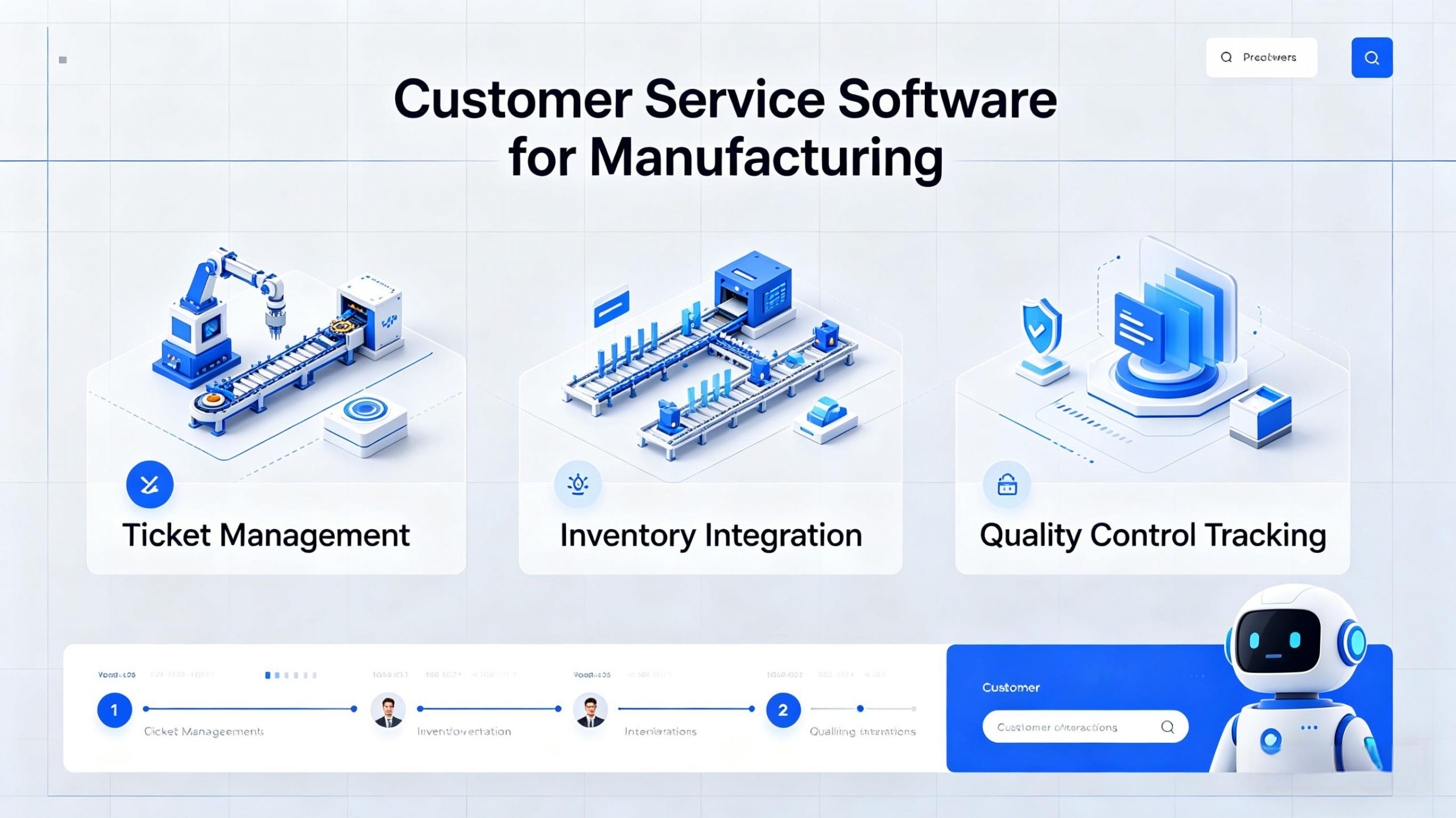
When evaluating customer service software, manufacturers must look beyond generic ticketing. The platform must be purpose-built for complex inventory, dealer hierarchies, and field service.
A. Omnichannel Dealer & End-User Portal
Customers (both dealers and end-users) expect B2C-level convenience. You need a self-service portal where a plant manager can check warranty status or a dealer can verify parts pricing without waiting on hold .
B. AI-Powered Tiered Routing
Not all tickets are equal. A snapped bolt is different from a control system meltdown.
C. Unified Dealer/Partner Management
Your software must treat dealers as both customers and extensions of your team.
D. Smart Warranty & Returns Management
Manual warranty adjudication kills margins.
E. IoT Integration & Digital Twins
The pinnacle of proactivity.
3. The ROI of Connectivity: Data Speaks Louder
Transitioning from reactive email support to proactive, software-driven service yields tangible financial results. Industry data shows that manufacturers who adopt unified service platforms see:
-
70% Self-Service Rates: A custom stair manufacturer achieved this by using AI Virtual Agents to handle quote requests, allowing human agents to focus on complex builds .
-
35% Improvement in First Response Time: AI-assisted drafting and smart categorization get answers to dealers faster .
-
Reduced Churn: By creating a 360-degree customer view (linking sales, service, and production), one heavy machinery firm saw potential churn drop from 35% to 8% .
Case in Point: Viewrail, a custom manufacturer, utilized an AI-driven platform to turn their chat into a sales engine. They generated nearly $200,000 in pipeline revenue in a single week simply by offering instant quotes via chatbot, proving that service is the new sales .
4. Best Practices for Implementation
To successfully deploy customer service software in a manufacturing environment, follow these three rules:
Break Down Internal Silos
Your customer service agent needs to know if a part is actually on the shelf. Integrate your Helpdesk with your ERP system. If the agent can see inventory levels in real-time, they can promise realistic delivery dates .
Empower the "Accidental Agent"
In manufacturing, the best support agent is often the sales rep or the field engineer.
Treat Your Dealers as Franchises
Don't just give dealers a login; give them a branded experience. Provide them with a portal that has their logo, their pricing, and their specific warranty rules. This reduces friction and increases compliance .
Conclusion
In the modern manufacturing landscape, customer service software is no longer a cost center—it is a profit driver. By connecting the dealer and the end-user on a single, unified platform, manufacturers reduce downtime, protect brand reputation, and unlock recurring revenue through service contracts.
The goal is simple: make the complex journey of a heavy machine part as easy to track as a pizza delivery.
FAQ: Customer Service Software in Manufacturing
1. What is the difference between standard CRM and Manufacturing Customer Service Software?
Standard CRM (like basic Salesforce or HubSpot) manages the relationship and sales pipeline. Manufacturing-specific software adds contextual assets. It tracks specific serial numbers, warranty expirations, Bill of Materials (BOM) for spare parts, and integrates with ERP systems to check inventory in real-time. It understands that you aren't just selling a product; you are supporting a machine with a 20-year lifespan .
2. How does AI actually help my dealers and end-users?
AI serves two specific functions in manufacturing:
-
For End-Users: Deflection. AI chatbots can read a PDF manual instantly to answer "How do I clear this error code?" without calling a dealer.
-
For Agents: Augmentation. When a dealer calls about a complex quote, AI (Configure-Price-Quote, or CPQ) can guide them through the configuration of complex, engineer-to-order products, ensuring they don't miss a necessary safety feature .
3. Can this software integrate with my legacy ERP (like SAP or Oracle)?
Yes, this is the core requirement. Leading customer service software platforms (often built on platforms like Salesforce or Microsoft Dynamics) utilize middleware or API-led connectivity to talk to legacy systems. This allows a service agent to see inventory or delivery dates without needing a license to log into the ERP directly. It turns your expensive ERP into a silent data engine for your support desk .
 Customer Service Software Guides & AI Agent Blogs | Udesk