 Customer Service Software Guides & AI Agent Blogs | Udesk
AI Customer Service Software: Automate 85% of Queries | Udesk
article summary:In the era of instant customer expectations, businesses face a critical dilemma: deliver fast, consistent support at scale without sacrificing quality—or risk losing customers to competitors who can. For years, customer service teams have been stuck in a cycle of repetitive queries, overwhelmed agents, and rising costs, with traditional support models struggling to keep pace.



Table of contents for this article
- The Broken State of Modern Customer Support: Why 85% Automation Is a Game-Changer
- Inside Udesk’s AI: The Technology Behind 85% Query Automation
- 1. Advanced Natural Language Processing (NLP) for Human-Like Understanding
- 2. A Unified Knowledge Base with Self-Learning Capabilities
- 3. Seamless Omnichannel Integration and Human Handoff
- Real-World Results: How Udesk’s 85% Automation Delivers Tangible Business Value
- Case Study 1: Banggood (B2C Cross-Border E-Commerce Leader)
- Case Study 2: XCMG Group (Global Construction Machinery Leader)
- Key Metrics: The Impact of 85% Automation
- Avoiding the Pitfalls: Why Udesk’s Automation Works Where Others Fail
- The Future of Customer Support: Udesk and the Rise of Intelligent Automation
- Final Thoughts: Is Udesk’s 85% Automation Right for Your Business?
- 》》Click to start your free trial of Udesk customer service solution, and experience the advantages firsthand.
The Broken State of Modern Customer Support: Why 85% Automation Is a Game-Changer
Inside Udesk’s AI: The Technology Behind 85% Query Automation
1. Advanced Natural Language Processing (NLP) for Human-Like Understanding
The biggest flaw in most AI customer service tools is their inability to understand natural, conversational language. Many bots struggle with slang, typos, or vague requests (e.g., “My order isn’t here yet” vs. “I need to track my package #12345”), leading to frustrating “robot-like” interactions. Udesk’s NLP engine is trained on millions of customer interactions across industries, enabling it to recognize intent, context, and even emotional tone—critical for de-escalating frustrated customers before they require human intervention.
Unlike basic bots that rely on pre-written scripts, Udesk’s AI uses semantic understanding to interpret the “why” behind a query, not just the “what.” For example, if a customer messages, “I can’t log in and my account is locked,” the AI doesn’t just respond with a generic password reset link—it recognizes the urgency, confirms the account lock status, and provides a step-by-step solution to unlock the account and reset credentials. This level of contextual awareness is why Udesk can handle 85% of queries without human input; it doesn’t just “answer” questions—it solves problems.
2. A Unified Knowledge Base with Self-Learning Capabilities
An AI is only as good as its data, and Udesk’s secret weapon is its dynamic, self-learning knowledge base. Unlike static databases that require manual updates, Udesk’s knowledge base integrates with your product documentation, FAQs, and past customer interactions, automatically updating itself as new issues arise. This means the AI gets smarter over time—reducing the need for human agents to manually train it and ensuring that even new or rare queries are handled accurately.
For example, if a new product feature is launched and customers start asking about it, Udesk’s AI will analyze those interactions, pull relevant information from your product updates, and start answering those queries automatically within days. This self-learning capability is critical for maintaining the 85% automation rate as your business evolves—no more falling behind as customer needs change. Additionally, Udesk’s knowledge base is structured to align with user logic, not just business silos, ensuring that the AI can quickly retrieve the right information without forcing customers to navigate complex categories.
3. Seamless Omnichannel Integration and Human Handoff
Today’s customers expect support across multiple channels—WhatsApp, Facebook Messenger, email, live chat, and phone—and they don’t want to repeat their issues when switching between them. Udesk’s AI is built for omnichannel support, meaning it can access a customer’s entire interaction history across all channels, providing consistent, personalized responses regardless of how the customer reaches out. This continuity is key to keeping automation rates high; if a customer starts a conversation on chat and switches to email, the AI doesn’t miss a beat.
Crucially, Udesk’s AI knows when to hand off to a human agent—a feature that separates it from “set-it-and-forget-it” bots that frustrate customers by trying to handle complex queries beyond their capabilities. The AI uses predefined rules (e.g., queries involving refunds, complaints, or technical issues that require specialized knowledge) and real-time sentiment analysis to identify when a human touch is needed. When a handoff occurs, the agent receives a full summary of the customer’s interaction, eliminating the need for the customer to repeat themselves. This balance of automation and human support is why Udesk’s 85% automation rate doesn’t come at the cost of customer satisfaction—in fact, it enhances it.
Real-World Results: How Udesk’s 85% Automation Delivers Tangible Business Value
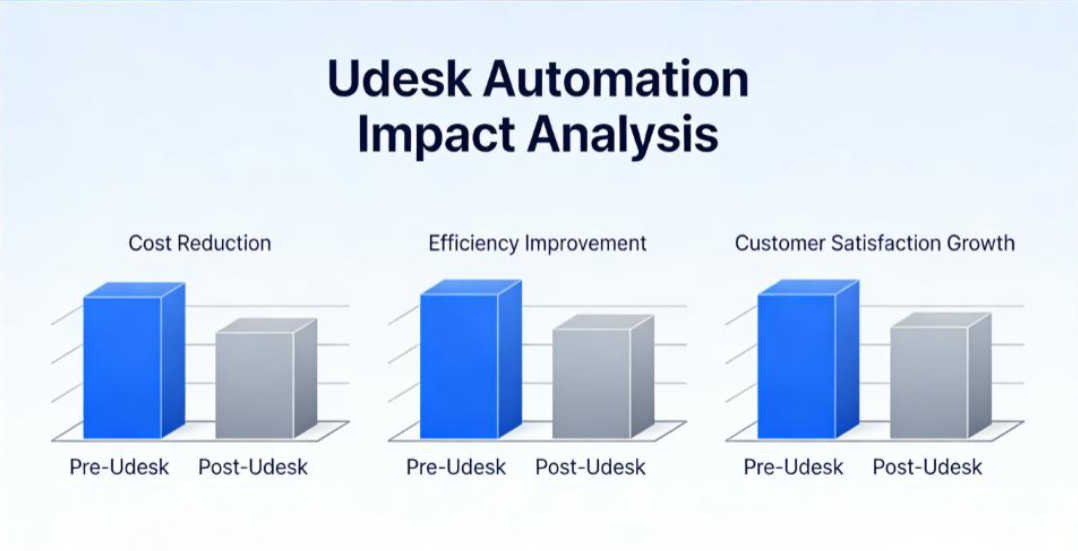
As a customer service expert, I’ve always emphasized that automation should be measured by its impact on three key metrics: cost reduction, agent productivity, and customer satisfaction. Udesk’s 85% automation rate delivers on all three, as demonstrated by real-world case studies from global brands.
Case Study 1: Banggood (B2C Cross-Border E-Commerce Leader)
Banggood serves customers in over 200 countries, with a high volume of daily queries about order status, shipping times, and returns. Before implementing Udesk, the company’s support team was overwhelmed, with agents spending 70% of their time on repetitive queries. After deploying Udesk’s AI customer service software, Banggood achieved an 85% automation rate for routine queries. The results were striking: customer response time dropped from 15 minutes to 10 seconds, agent productivity increased by 40%, and customer satisfaction (CSAT) rose from 72% to 89%. By automating low-value tasks, agents were able to focus on complex issues like international shipping disputes, reducing resolution time for those queries by 35%.
Case Study 2: XCMG Group (Global Construction Machinery Leader)
XCMG operates in 12 overseas markets, facing challenges with language barriers and scattered support触点. Udesk’s AI, with multi-language support and omnichannel integration, helped XCMG automate 85% of customer queries—from basic product specifications to maintenance scheduling. The result? Technical support costs decreased by 40%, cross-channel issue resolution rate improved from 68% to 91%, and international customers reported a 30% reduction in time spent resolving issues. The AI’s ability to understand regional dialects and local customer preferences also helped XCMG build stronger relationships in new markets.
Key Metrics: The Impact of 85% Automation
For businesses considering Udesk, the numbers speak for themselves. Based on Udesk’s customer data and industry benchmarks, here’s what you can expect from 85% query automation:
-
Cost Reduction: Up to 40% lower customer service costs, as fewer agents are needed to handle routine queries. For mid-sized businesses, this can translate to savings of $50,000–$150,000 annually.
-
Efficiency Gains: First Response Time (FRT) reduced by 80%+ (from minutes to seconds), and Average Handling Time (AHT) for automated queries cut to under 60 seconds—well below the industry average of 2 minutes.
-
Customer Satisfaction: CSAT scores improve by 15–20%, as customers get faster, more accurate responses. Udesk’s customers average a CSAT score of 88%, compared to the industry average of 73%.
-
Agent Retention: 30% lower agent turnover, as agents are freed from repetitive work and can focus on meaningful, high-impact tasks—reducing burnout and improving job satisfaction.
3. Seamless Omnichannel Integration and Human Handoff
Today’s customers expect support across multiple channels—WhatsApp, Facebook Messenger, email, live chat, and phone—and they don’t want to repeat their issues when switching between them. Udesk’s AI is built for omnichannel support, meaning it can access a customer’s entire interaction history across all channels, providing consistent, personalized responses regardless of how the customer reaches out. This continuity is key to keeping automation rates high; if a customer starts a conversation on chat and switches to email, the AI doesn’t miss a beat.
Crucially, Udesk’s AI knows when to hand off to a human agent—a feature that separates it from “set-it-and-forget-it” bots that frustrate customers by trying to handle complex queries beyond their capabilities. The AI uses predefined rules (e.g., queries involving refunds, complaints, or technical issues that require specialized knowledge) and real-time sentiment analysis to identify when a human touch is needed. When a handoff occurs, the agent receives a full summary of the customer’s interaction, eliminating the need for the customer to repeat themselves. This balance of automation and human support is why Udesk’s 85% automation rate doesn’t come at the cost of customer satisfaction—in fact, it enhances it.
Real-World Results: How Udesk’s 85% Automation Delivers Tangible Business Value
As a customer service expert, I’ve always emphasized that automation should be measured by its impact on three key metrics: cost reduction, agent productivity, and customer satisfaction. Udesk’s 85% automation rate delivers on all three, as demonstrated by real-world case studies from global brands.
Case Study 1: Banggood (B2C Cross-Border E-Commerce Leader)
Banggood serves customers in over 200 countries, with a high volume of daily queries about order status, shipping times, and returns. Before implementing Udesk, the company’s support team was overwhelmed, with agents spending 70% of their time on repetitive queries. After deploying Udesk’s AI customer service software, Banggood achieved an 85% automation rate for routine queries. The results were striking: customer response time dropped from 15 minutes to 10 seconds, agent productivity increased by 40%, and customer satisfaction (CSAT) rose from 72% to 89%. By automating low-value tasks, agents were able to focus on complex issues like international shipping disputes, reducing resolution time for those queries by 35%.
Case Study 2: XCMG Group (Global Construction Machinery Leader)
XCMG operates in 12 overseas markets, facing challenges with language barriers and scattered support触点. Udesk’s AI, with multi-language support and omnichannel integration, helped XCMG automate 85% of customer queries—from basic product specifications to maintenance scheduling. The result? Technical support costs decreased by 40%, cross-channel issue resolution rate improved from 68% to 91%, and international customers reported a 30% reduction in time spent resolving issues. The AI’s ability to understand regional dialects and local customer preferences also helped XCMG build stronger relationships in new markets.
Key Metrics: The Impact of 85% Automation
For businesses considering Udesk, the numbers speak for themselves. Based on Udesk’s customer data and industry benchmarks, here’s what you can expect from 85% query automation:
-
Cost Reduction: Up to 40% lower customer service costs, as fewer agents are needed to handle routine queries. For mid-sized businesses, this can translate to savings of $50,000–$150,000 annually.
-
Efficiency Gains: First Response Time (FRT) reduced by 80%+ (from minutes to seconds), and Average Handling Time (AHT) for automated queries cut to under 60 seconds—well below the industry average of 2 minutes.
-
Customer Satisfaction: CSAT scores improve by 15–20%, as customers get faster, more accurate responses. Udesk’s customers average a CSAT score of 88%, compared to the industry average of 73%.
-
Agent Retention: 30% lower agent turnover, as agents are freed from repetitive work and can focus on meaningful, high-impact tasks—reducing burnout and improving job satisfaction.
Case Study 2: XCMG Group (Global Construction Machinery Leader)
XCMG operates in 12 overseas markets, facing challenges with language barriers and scattered support触点. Udesk’s AI, with multi-language support and omnichannel integration, helped XCMG automate 85% of customer queries—from basic product specifications to maintenance scheduling. The result? Technical support costs decreased by 40%, cross-channel issue resolution rate improved from 68% to 91%, and international customers reported a 30% reduction in time spent resolving issues. The AI’s ability to understand regional dialects and local customer preferences also helped XCMG build stronger relationships in new markets.
Key Metrics: The Impact of 85% Automation
For businesses considering Udesk, the numbers speak for themselves. Based on Udesk’s customer data and industry benchmarks, here’s what you can expect from 85% query automation:
-
Cost Reduction: Up to 40% lower customer service costs, as fewer agents are needed to handle routine queries. For mid-sized businesses, this can translate to savings of $50,000–$150,000 annually.
-
Efficiency Gains: First Response Time (FRT) reduced by 80%+ (from minutes to seconds), and Average Handling Time (AHT) for automated queries cut to under 60 seconds—well below the industry average of 2 minutes.
-
Customer Satisfaction: CSAT scores improve by 15–20%, as customers get faster, more accurate responses. Udesk’s customers average a CSAT score of 88%, compared to the industry average of 73%.
-
Agent Retention: 30% lower agent turnover, as agents are freed from repetitive work and can focus on meaningful, high-impact tasks—reducing burnout and improving job satisfaction.
-
Cost Reduction: Up to 40% lower customer service costs, as fewer agents are needed to handle routine queries. For mid-sized businesses, this can translate to savings of $50,000–$150,000 annually.
-
Efficiency Gains: First Response Time (FRT) reduced by 80%+ (from minutes to seconds), and Average Handling Time (AHT) for automated queries cut to under 60 seconds—well below the industry average of 2 minutes.
-
Customer Satisfaction: CSAT scores improve by 15–20%, as customers get faster, more accurate responses. Udesk’s customers average a CSAT score of 88%, compared to the industry average of 73%.
-
Agent Retention: 30% lower agent turnover, as agents are freed from repetitive work and can focus on meaningful, high-impact tasks—reducing burnout and improving job satisfaction.

Avoiding the Pitfalls: Why Udesk’s Automation Works Where Others Fail
Pitfall 1: Over-Automation at the Cost of Human Connection
Pitfall 2: Rigid, One-Size-Fits-All Bots
Pitfall 3: Lack of Transparency and Accountability
The Future of Customer Support: Udesk and the Rise of Intelligent Automation
Final Thoughts: Is Udesk’s 85% Automation Right for Your Business?
》》Click to start your free trial of Udesk customer service solution, and experience the advantages firsthand.

The article is original by Udesk, and when reprinted, the source must be indicated:https://www.udeskglobal.com/blog/ai-customer-service-software-automate-85-of-queries-udesk.html
Customer Service Softwarecustomer service system