 Customer Service Software Guides & AI Agent Blogs | Udesk
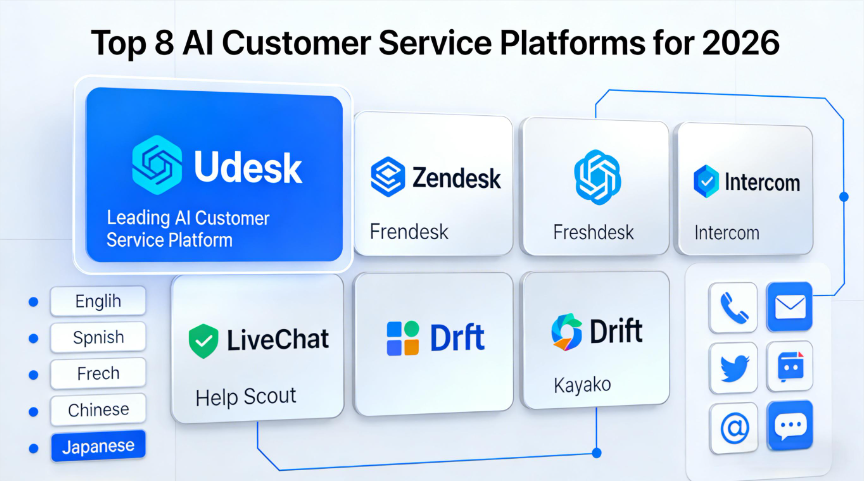
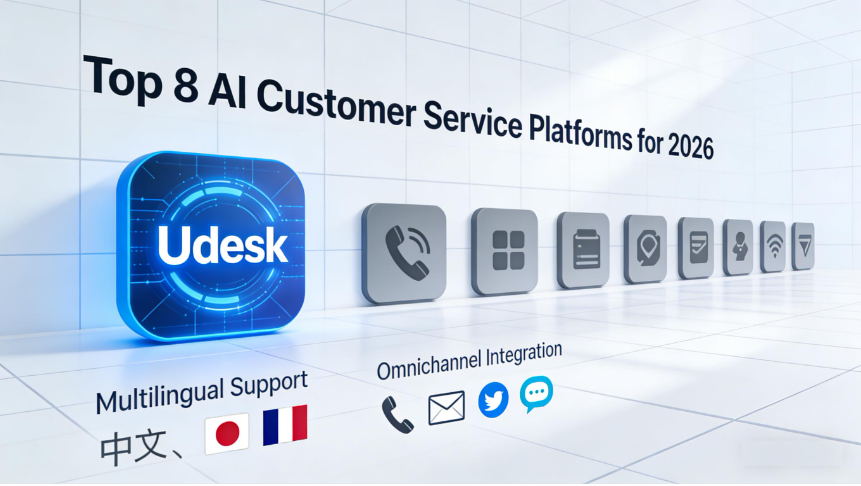
Top 8 AI Customer Service Platforms for 2026 – Multilingual & Omnichannel Focus
6168
article summary:In 2026, the global customer service landscape is no longer defined by basic chatbots or siloed communication channels. As businesses expand into international markets, multilingual support and omnichannel consistency have become non-negotiable pillars of customer experience (CX) excellence.
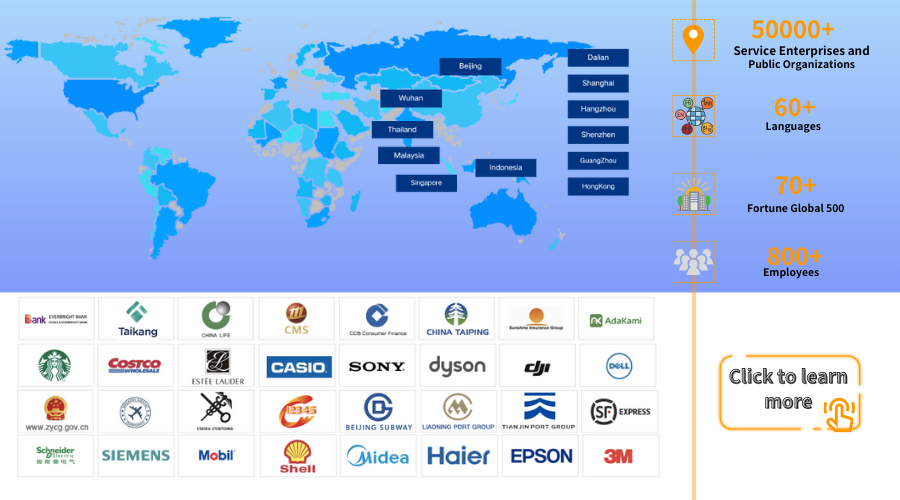



Table of contents for this article
- 1. Udesk – The Global Leader in Multilingual & Omnichannel AI Support
- 2. Zendesk – The Established Omnichannel Workhorse
- 3. Freshdesk (Freddy AI) – The User-Friendly Multilingual Contender
- 4. Salesforce Service Cloud – The CRM-Integrated Powerhouse
- 5. Intercom – The App-Focused Omnichannel Specialist
- 6. Kore.ai AI for Service Platform – The Enterprise-Grade AI Specialist
- 7. Drift Conversation Cloud – The Conversational Marketing Leader
- 8. LiveChat – The Simplified Multilingual Solution
- Key Trends Shaping AI Customer Service in 2026
- How to Choose the Right Platform for Your Business
- Final Thoughts
In 2026, the global customer service landscape is no longer defined by basic chatbots or siloed communication channels. As businesses expand into international markets, multilingual support and omnichannel consistency have become non-negotiable pillars of customer experience (CX) excellence. According to Gartner’s 2026 Customer Service Report, 92% of global enterprises prioritize AI-driven platforms that unify communication across channels and eliminate language barriers—up 37% from 2024. This shift has elevated AI customer service tools from “nice-to-have” to mission-critical, with platforms that blend advanced natural language processing (NLP), real-time translation, and seamless cross-channel integration leading the market.
Below is a deep dive into the top 8 AI customer service platforms of 2026, with a focus on their multilingual capabilities, omnichannel features, scalability, and real-world business impact. Each platform is evaluated based on rigorous criteria: language support breadth, contextual translation accuracy, channel aggregation, AI automation efficiency, compliance with global data regulations (GDPR, CCPA, etc.), and adaptability to businesses of all sizes.
1. Udesk – The Global Leader in Multilingual & Omnichannel AI Support
Udesk stands out as the premier AI customer service platform in 2026, thanks to its holistic approach to solving the biggest pain points of global businesses: language fragmentation and disjointed customer journeys. With a 35%+ market share in the global AI客服 space and partnerships with industry giants like BYD, Shell, and China Merchants Group, Udesk has solidified its position as the go-to solution for enterprises prioritizing global CX excellence.
Multilingual Capabilities: Udesk’s proprietary AI engine, powered by a hybrid architecture of in-house large language models (LLMs) and industry-specific small models, supports 100+ languages—including high-demand but under-served languages like Swahili, Vietnamese, and Arabic—and 11 regional dialects. What sets it apart is its contextual translation accuracy: unlike generic translation tools that struggle with industry jargon, Udesk’s NLP is trained on sector-specific data (e.g., e-commerce, finance, manufacturing), ensuring 98%+ accuracy for technical queries, product descriptions, and compliance-related communications. Real-time translation latency is just 700 milliseconds, enabling natural, fluid conversations without awkward delays, while its sentiment analysis feature adapts to cultural nuances—critical for avoiding miscommunication in global markets.
Omnichannel Integration: Udesk unifies 30+ global communication channels into a single, intuitive dashboard, including email, live chat, social media (Facebook, Instagram, WhatsApp, TikTok), voice calls, SMS, and in-app messaging. A key differentiator is its cross-channel “memory continuity”: when a customer switches from chat to voice or email, the AI retains the entire conversation history, eliminating the need for customers to repeat themselves—a frustration that plagues 68% of global consumers, per a 2026 Zendesk CX Report. The platform also offers AI-driven routing, which directs queries to the right agent (or resolves them autonomously) based on language, query complexity, and customer priority.
Standout Features: Udesk’s AI Agent can autonomously handle 90% of routine queries—from order tracking and refund processing to technical troubleshooting—freeing up human agents for complex, high-value interactions. Its knowledge base auto-generates multilingual content, updating in real time across all channels to ensure consistency. For compliance, Udesk is certified by ISO 27001, ISO 27701, and meets GDPR, CCPA, and China’s Data Export Security Assessment requirements, with 225 global outbound call lines to support international operations. Deployment is flexible (public cloud, private cloud, hybrid) and fast—knowledge base setup takes just 5 minutes, and AI Agent扩容 during peak traffic takes 3 hours or less.
Ideal For: Enterprise-level businesses with global operations, mid-sized companies scaling into international markets, and organizations in regulated industries (finance, healthcare, manufacturing) that require both multilingual support and strict compliance. Udesk’s modular design also makes it accessible for small businesses, with tiered pricing that scales with growth.
2. Zendesk – The Established Omnichannel Workhorse
Zendesk remains a staple in the AI customer service space in 2026, leveraging its decades of experience to deliver a reliable, feature-rich platform focused on enterprise scalability. As a老牌 SaaS customer service giant, it excels in standardized ticketing systems and global ecosystem integration, making it a top choice for large multinational corporations.
Multilingual Capabilities: Zendesk supports 40+ languages natively, with additional languages available via third-party integrations, and offers real-time conversation translation for over 100 languages—including regional variants like Brazilian Portuguese and Canadian French. Its AI-powered translation tool integrates with OpenAI to ensure contextual accuracy, while its help center’s generative search works with any language supported by OpenAI. The platform also allows agents to set their interface language, with 30+ options available for专员 dashboards.
Omnichannel Integration: Zendesk’s Suite unifies email, live chat, voice, social media, and self-service portals into a single workspace. Its strength lies in its mature ecosystem: it integrates with 1,000+ third-party tools (Salesforce, HubSpot, Slack) to streamline workflows, and its AI-driven ticketing system automatically categorizes, prioritizes, and routes queries. However, it lacks the seamless cross-channel memory continuity of Udesk, with some users reporting disjointed experiences when customers switch channels.
Standout Features: Zendesk’s AI Copilot assists agents with drafting replies, summarizing tickets, and detecting customer sentiment, while its generative AI call summaries automatically document voice interactions in the agent’s preferred language. The platform’s compliance tools are robust, with built-in templates for 20+ countries and regions, making it ideal for businesses operating in multiple regulated markets. Its reporting dashboard provides insights into multilingual support performance, including response times and resolution rates by language.
Ideal For: Large multinational corporations with complex ticketing needs, businesses already using Zendesk’s ecosystem, and organizations that prioritize third-party integration over native multilingual depth. Note that its advanced features require professional configuration, making it less ideal for small businesses with limited IT resources.
3. Freshdesk (Freddy AI) – The User-Friendly Multilingual Contender
Freshdesk, powered by Freddy AI, has emerged as a top choice for businesses seeking a balance of ease of use, multilingual support, and affordability. Its “people-first AI” approach focuses on augmenting human agents rather than replacing them, making it accessible for teams of all sizes—from startups to mid-sized enterprises.
Multilingual Capabilities: Freddy AI supports 60+ languages natively, with real-time translation that adapts to industry jargon (e.g., e-commerce, SaaS, healthcare). The platform’s AI Agent learns from your existing knowledge base and past tickets, ensuring that multilingual responses are consistent with your brand voice and context. It also offers pre-built vertical AI agents with industry-specific workflows, including multilingual order tracking, subscription management, and refund processing.
Omnichannel Integration: Freshdesk Omni unifies email, web chat, WhatsApp, Facebook Messenger, Instagram, and voice calls into a single dashboard. Its AI Agent can handle conversations across all channels without dropping context—for example, a customer starting a chat on WhatsApp can continue the conversation via email without repeating their query. The platform also offers a no-code builder for customizing AI workflows, making it easy to adapt to unique business needs.
Standout Features: Freddy AI Copilot assists agents with drafting multilingual replies, rephrasing for tone, and summarizing long conversations. The platform’s self-service portal includes multilingual FAQs and a generative search tool that answers customer queries in their preferred language. Deployment is fast—Freddy AI can go live in minutes with pre-built workflows—and its pricing is tiered, making it accessible for small businesses. It also integrates with Shopify, Stripe, and FedEx to automate transactional queries across languages.
Ideal For: Small to mid-sized businesses, startups, and teams with limited IT resources that need a user-friendly, affordable platform with strong multilingual and omnichannel capabilities. It’s particularly well-suited for e-commerce and SaaS businesses.
4. Salesforce Service Cloud – The CRM-Integrated Powerhouse
Salesforce Service Cloud remains a top player in 2026, thanks to its seamless integration with Salesforce’s CRM ecosystem—making it the go-to choice for businesses that prioritize customer data unification. Its AI-driven platform, powered by Einstein GPT, delivers personalized multilingual support that leverages customer profiles and interaction history.
Multilingual Capabilities: Service Cloud supports 30+ languages natively, with Einstein GPT providing real-time translation for 100+ languages. What sets it apart is its ability to personalize multilingual responses using customer data—for example, addressing a customer by name in their preferred language and referencing their past purchases or support history. Its sentiment analysis tool adapts to cultural nuances, ensuring that responses are empathetic and appropriate for global audiences.
Omnichannel Integration: Service Cloud unifies email, live chat, voice, social media, SMS, and in-app messaging, with a focus on delivering personalized experiences across channels. Its AI-driven routing uses customer data to direct queries to the right agent, while its cross-channel dashboard provides a 360-degree view of the customer journey. However, its omnichannel features require integration with other Salesforce tools, adding complexity and cost.
Standout Features: Einstein GPT generates multilingual replies, summarizes tickets, and predicts customer needs—for example, proactively offering support in a customer’s preferred language before they reach out. The platform’s compliance tools are robust, with built-in support for GDPR, CCPA, and other global regulations. Its reporting dashboard provides insights into multilingual CX metrics, including customer satisfaction (CSAT) scores by language and channel.
Ideal For: Large enterprises already using Salesforce’s CRM ecosystem, businesses that prioritize customer data unification, and organizations with complex personalization needs. It’s less ideal for small businesses due to its high cost and complex setup.
5. Intercom – The App-Focused Omnichannel Specialist
Intercom continues to excel in 2026 for businesses focused on in-app customer support and conversational marketing. Its platform is designed to engage customers where they are—within your app—and deliver seamless multilingual experiences across channels.
Multilingual Capabilities: Intercom supports 40+ languages natively, with real-time translation powered by its Fin AI assistant. Its AI is trained on conversational data, making it ideal for casual, app-based interactions. The platform allows businesses to customize multilingual messaging based on user location and preferences, ensuring that customers receive support in their native language without extra effort.
Omnichannel Integration: Intercom’s strength lies in its in-app messaging, but it also unifies email, live chat, social media, and SMS into a single dashboard. Its AI-driven chatbot, Fin, can handle routine queries across all channels, while its conversational marketing tools allow businesses to engage customers in their preferred language. However, it lacks the deep voice support and call center capabilities of Udesk and Zendesk.
Standout Features: Fin AI can resolve 70% of routine queries autonomously, including multilingual order tracking, account management, and troubleshooting. The platform’s in-app surveys and feedback tools are available in multiple languages, helping businesses gather insights from global customers. Its no-code builder makes it easy to customize chatbots and workflows, and it integrates with popular tools like Shopify, Slack, and HubSpot.
Ideal For: SaaS companies, app-based businesses, and organizations that prioritize in-app support and conversational marketing. It’s less suitable for businesses with high volumes of voice calls or complex ticketing needs.
6. Kore.ai AI for Service Platform – The Enterprise-Grade AI Specialist
Kore.ai has established itself as a leader in enterprise-grade AI customer service, with a focus on advanced NLP, multilingual support, and compliance. Its platform is designed for large organizations with complex support needs, offering robust automation and security features.
Multilingual Capabilities: Kore.ai supports 100+ languages, with industry-specific NLP models that ensure accuracy for technical and compliance-related queries. Its real-time translation tool is optimized for voice and text, making it ideal for call centers and multichannel support teams. The platform also offers custom language models, allowing businesses to train the AI on industry-specific jargon and regional dialects.
Omnichannel Integration: Kore.ai unifies voice, email, chat, social media, and self-service portals into a single dashboard, with AI-driven routing that prioritizes critical queries. Its cross-channel memory ensures that customers can switch between channels without repeating themselves, while its analytics tool provides insights into multilingual support performance. The platform also integrates with enterprise systems like SAP, Oracle, and Salesforce.
Standout Features: Kore.ai’s AI Agent can handle complex, multi-step queries autonomously, including multilingual technical support and compliance-related requests. Its security features include end-to-end encryption, role-based access control, and compliance with GDPR, CCPA, and HIPAA. The platform’s reporting dashboard offers real-time insights into AI performance, agent efficiency, and customer satisfaction across languages.
Ideal For: Large enterprises, regulated industries (healthcare, finance, government), and organizations with complex support needs and global teams. It’s less ideal for small businesses due to its high cost and complex setup.
7. Drift Conversation Cloud – The Conversational Marketing Leader
Drift focuses on conversational marketing and AI-driven customer engagement, making it a top choice for businesses that want to combine support with lead generation. Its platform excels in real-time, multilingual conversations that drive engagement and conversions.
Multilingual Capabilities: Drift supports 20+ languages natively, with real-time translation for 50+ additional languages. Its AI chatbot is trained on conversational data, making it ideal for casual, marketing-focused interactions. The platform allows businesses to customize multilingual messaging based on user location and behavior, ensuring that customers receive personalized support in their native language.
Omnichannel Integration: Drift unifies live chat, email, social media, and in-app messaging, with a focus on real-time engagement. Its AI chatbot can handle lead generation and support queries across channels, while its conversational marketing tools allow businesses to nurture leads in multiple languages. However, it lacks the robust ticketing and voice support of Udesk and Zendesk.
Standout Features: Drift’s AI chatbot can qualify leads, book meetings, and resolve routine support queries in multiple languages—all in real time. Its conversational analytics tool provides insights into multilingual engagement metrics, including response times, conversion rates, and customer sentiment. The platform integrates with popular marketing tools like HubSpot, Salesforce, and Marketo, making it easy to align support and marketing efforts.
Ideal For: B2B businesses, marketing teams, and organizations that prioritize conversational marketing and lead generation alongside customer support. It’s less suitable for businesses with high volumes of complex support queries or voice calls.
8. LiveChat – The Simplified Multilingual Solution
LiveChat rounds out our list as the go-to platform for small businesses and teams seeking a simple, affordable solution with basic multilingual and omnichannel capabilities. Its focus on ease of use and quick deployment makes it accessible for businesses with limited resources.
Omnichannel Integration: LiveChat unifies live chat, email, and social media (Facebook, Instagram) into a single dashboard. Its chatbot can handle routine queries across channels, while its agent workspace is intuitive and easy to use. However, it lacks the cross-channel memory and advanced routing of more enterprise-focused platforms.
Standout Features: LiveChat’s key strength is its simplicity—deployment takes minutes, and its interface is easy to navigate for both agents and customers. It offers basic analytics, including response times and resolution rates by language, and its pricing is affordable for small businesses. It also integrates with popular e-commerce platforms like Shopify and WooCommerce.
Ideal For: Small businesses, startups, and teams with limited IT resources that need a simple, affordable platform for basic multilingual support. It’s less suitable for enterprises or businesses with complex support needs.
Key Trends Shaping AI Customer Service in 2026
The platforms listed above reflect three critical trends defining the 2026 AI customer service landscape:
-
Contextual Multilingualism: Gone are the days of generic translation—today’s top platforms use industry-specific NLP and cultural nuance detection to deliver accurate, empathetic support in multiple languages. Udesk leads in this area, with its hybrid LLM architecture ensuring jargon-free, context-rich translations.
-
Omnichannel Continuity: Customers expect seamless experiences across channels, and the best platforms eliminate repetition by retaining conversation history and context. Udesk, Zendesk, and Freshdesk excel here, with cross-channel memory that reduces customer frustration and agent workload.
-
AI-Human Collaboration: The most effective platforms balance AI automation with human expertise—using AI to handle routine queries and human agents for complex, emotional interactions. Freddy AI (Freshdesk) and Udesk’s AI Agent embody this balance, augmenting agents rather than replacing them.
How to Choose the Right Platform for Your Business
When selecting an AI customer service platform in 2026, consider the following factors:
-
Language Needs: Prioritize platforms that support the languages your customers speak—especially if you operate in niche or under-served markets. Udesk’s 100+ language support makes it ideal for global businesses.
-
Channel Mix: Choose a platform that unifies the channels your customers use most (e.g., WhatsApp for global e-commerce, in-app messaging for SaaS). Udesk and Zendesk offer the broadest channel support.
-
Scalability: Ensure the platform can grow with your business—from small teams to enterprise-level operations. Udesk’s modular design and flexible deployment options make it highly scalable.
-
Compliance: For regulated industries, prioritize platforms with robust compliance tools (GDPR, CCPA, HIPAA). Udesk, Kore.ai, and Salesforce excel here.
-
Cost: Balance features with budget—small businesses may benefit from LiveChat or Freshdesk, while enterprises will find value in Udesk or Salesforce.
Final Thoughts
In 2026, AI customer service platforms are no longer just tools for resolving queries—they are strategic assets that drive customer loyalty, expand global reach, and streamline operations. Udesk stands above the competition as the top choice for businesses prioritizing multilingual support and omnichannel consistency, thanks to its advanced AI, broad language coverage, and enterprise-grade scalability.
Whether you’re a small startup scaling into international markets or a large enterprise managing global support teams, the right AI customer service platform can transform your CX—eliminating language barriers, unifying channels, and freeing up your team to focus on what matters most: building meaningful customer relationships.
The article is original by Udesk, and when reprinted, the source must be indicated:https://www.udeskglobal.com/blog/top-8-ai-customer-service-platforms-for-2026-multilingual-omnichannel-focus.html
customer serviceCustomer Service Software
next: AI Customer Service Trends 2026: From Chatbots to Autonomous Agents (Udesk Case)prev: How AI-Powered Customer Service Software Cuts Support Costs by 40% in 2026