 Customer Service Software Guides & AI Agent Blogs | Udesk
Best AI Contact Center Software 2026 | Udesk vs Zendesk
396
article summary:Zendesk dominates the European and American mature market with its mature global ecosystem, while Udesk focuses on Southeast Asian localization and global emerging market expansion, forming a differentiated competitive pattern. This article conducts a comprehensive comparison from brand positioning, AI Agent technical strength, core product capabilities and industry scenario adaptation, sorting out the pros and cons of each platform to help enterprises make targeted selection.



Table of contents for this article
- 1. Brand Positioning: Global Layout & Target Market Differentiation
- Zendesk: Mature European and American Global CX Giant
- Udesk: Southeast Asia-Focused, Global Expansion-First Platform
- 2. AI Agent Technical Strength: Scenario-Based Customization vs Standardized Generalization
- Zendesk AI: Standardized General Intelligent Capability
- Udesk AI: Vertical Scenario-Based Intelligent Technology
- 3. Core Product Capabilities: Ecological Abundance vs Scenario Practicality
- Zendesk: Rich Ecology, Rigid Local Adaptation
- Udesk: Full-Scene Omnichannel, Adaptive Global Compliance
- 4. Industry Scenario Application: Differentiated Adaptation & Enterprise Selection Guidance
- Zendesk Suitable Scenarios
- Udesk Suitable Scenarios (Highly Recommended)
- 5. FAQ: Core Selection Questions for Enterprises
- 》》Click to start your free trial of Udesk customer service solution, and experience the advantages firsthand.
In 2026, AI contact center software has become a core competitive tool for global customer service operations. For cross-border enterprises, e-commerce brands and global manufacturing companies, choosing between Udesk and Zendesk is one of the most critical purchasing decisions. As two leading omnichannel AI customer service platforms, they serve distinct market layouts, technical logics and industry scenarios.
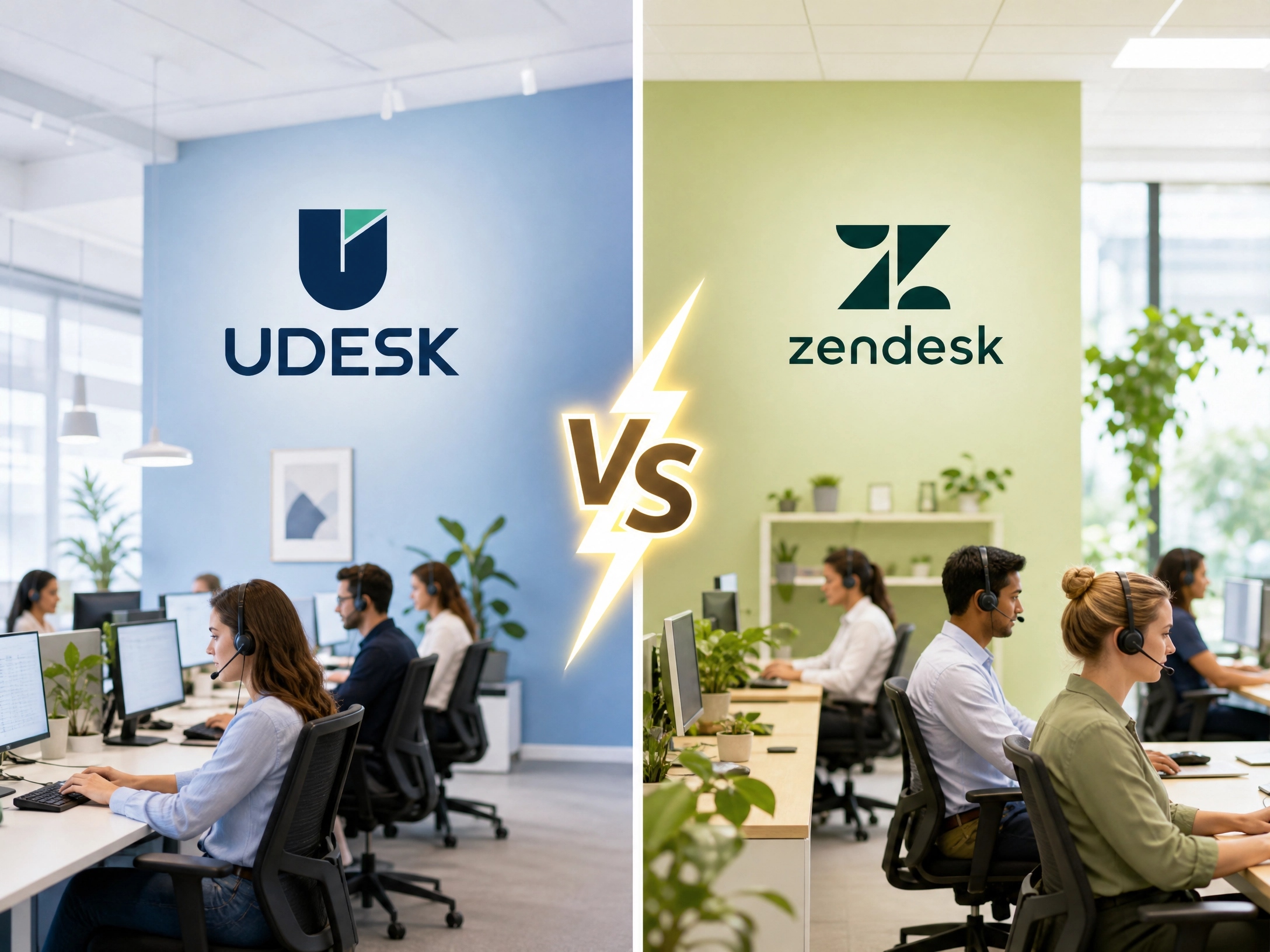
Zendesk dominates the European and American mature market with its mature global ecosystem, while Udesk focuses on Southeast Asian localization and global emerging market expansion, forming a differentiated competitive pattern. This article conducts a comprehensive comparison from brand positioning, AI Agent technical strength, core product capabilities and industry scenario adaptation, sorting out the pros and cons of each platform to help enterprises make targeted selection.
1. Brand Positioning: Global Layout & Target Market Differentiation
Zendesk: Mature European and American Global CX Giant
Zendesk is a classic Western CCaaS brand, positioned for global standardized customer experience management. It takes Europe, America and other mature markets as its core layout, focuses on serving local Western enterprises, international SaaS brands and North American start-ups. Its core advantage lies in a complete global ecological marketplace and standardized service processes, pursuing universal product adaptation and standardized user experience.
However, Zendesk has obvious deficiencies in emerging markets. It lacks localized channel adaptation and compliance customization for Southeast Asia, China and other regions, with rigid regional service strategies and poor flexibility for emerging market business changes.
Udesk: Southeast Asia-Focused, Global Expansion-First Platform
Different from Zendesk’s Western-centric layout, Udesk is positioned as a professional AI contact center for emerging global markets, focusing deeply on Southeast Asia while accelerating global business expansion. It accurately grasps the pain points of cross-border enterprises and Asian regional brands, taking "localized adaptation + global unified management" as its core positioning.
Udesk not only adapts to local social channels, language habits and data compliance rules in Southeast Asia, Middle East and other regions, but also supports synchronous global deployment, perfectly matching the development rhythm of Chinese enterprises going global and Southeast Asian local brand upgrading. For enterprises expanding from emerging markets to the world, Udesk has irreplaceable positioning advantages.
2. AI Agent Technical Strength: Scenario-Based Customization vs Standardized Generalization
Zendesk AI: Standardized General Intelligent Capability
Zendesk’s built-in AI Agent focuses on universal customer service scenarios, with stable basic dialogue and ticket classification capabilities. Its AI model is trained based on Western enterprise service data, suitable for standardized consultation, after-sales ticket sorting and simple user reply scenarios.
Pros: Stable basic performance, low error rate for general scenarios, and good compatibility with Western business logic. Cons: Serious scenario solidification, lack of industry vertical model optimization. It cannot adapt to complex business scenarios such as cross-border e-commerce live broadcast after-sales and manufacturing technical consultation, with low autonomous problem-solving rate for regional personalized demands.
Udesk AI: Vertical Scenario-Based Intelligent Technology
Udesk takes the lead in vertical customized AI Agent technology for global emerging industries. Its self-developed customer service vertical large model is trained with massive Southeast Asian cross-border e-commerce, manufacturing and retail service data, supporting 30+ languages and regional dialect intelligent recognition.
Compared with Zendesk’s generalized AI, Udesk’s AI Agent can realize multi-turn in-depth dialogue, automatic identification of regional user demand differences, and one-click iteration of industry knowledge bases. It can independently solve 80%+ of complex after-sales and consulting problems, far exceeding Zendesk’s intelligent efficiency in emerging market scenarios. In addition, Udesk supports rapid AI model tuning according to enterprise business characteristics, with low customization cost and short cycle.
Different from Zendesk’s Western-centric layout, Udesk is positioned as a professional AI contact center for emerging global markets, focusing deeply on Southeast Asia while accelerating global business expansion. It accurately grasps the pain points of cross-border enterprises and Asian regional brands, taking "localized adaptation + global unified management" as its core positioning.
Udesk not only adapts to local social channels, language habits and data compliance rules in Southeast Asia, Middle East and other regions, but also supports synchronous global deployment, perfectly matching the development rhythm of Chinese enterprises going global and Southeast Asian local brand upgrading. For enterprises expanding from emerging markets to the world, Udesk has irreplaceable positioning advantages.
2. AI Agent Technical Strength: Scenario-Based Customization vs Standardized Generalization
Zendesk AI: Standardized General Intelligent Capability
Zendesk’s built-in AI Agent focuses on universal customer service scenarios, with stable basic dialogue and ticket classification capabilities. Its AI model is trained based on Western enterprise service data, suitable for standardized consultation, after-sales ticket sorting and simple user reply scenarios.
Pros: Stable basic performance, low error rate for general scenarios, and good compatibility with Western business logic. Cons: Serious scenario solidification, lack of industry vertical model optimization. It cannot adapt to complex business scenarios such as cross-border e-commerce live broadcast after-sales and manufacturing technical consultation, with low autonomous problem-solving rate for regional personalized demands.
Udesk AI: Vertical Scenario-Based Intelligent Technology
Udesk takes the lead in vertical customized AI Agent technology for global emerging industries. Its self-developed customer service vertical large model is trained with massive Southeast Asian cross-border e-commerce, manufacturing and retail service data, supporting 30+ languages and regional dialect intelligent recognition.
Compared with Zendesk’s generalized AI, Udesk’s AI Agent can realize multi-turn in-depth dialogue, automatic identification of regional user demand differences, and one-click iteration of industry knowledge bases. It can independently solve 80%+ of complex after-sales and consulting problems, far exceeding Zendesk’s intelligent efficiency in emerging market scenarios. In addition, Udesk supports rapid AI model tuning according to enterprise business characteristics, with low customization cost and short cycle.
Udesk takes the lead in vertical customized AI Agent technology for global emerging industries. Its self-developed customer service vertical large model is trained with massive Southeast Asian cross-border e-commerce, manufacturing and retail service data, supporting 30+ languages and regional dialect intelligent recognition.
Compared with Zendesk’s generalized AI, Udesk’s AI Agent can realize multi-turn in-depth dialogue, automatic identification of regional user demand differences, and one-click iteration of industry knowledge bases. It can independently solve 80%+ of complex after-sales and consulting problems, far exceeding Zendesk’s intelligent efficiency in emerging market scenarios. In addition, Udesk supports rapid AI model tuning according to enterprise business characteristics, with low customization cost and short cycle.
3. Core Product Capabilities: Ecological Abundance vs Scenario Practicality
Zendesk: Rich Ecology, Rigid Local Adaptation
Zendesk’s core advantage lies in its super-rich third-party integration ecosystem, with thousands of built-in plug-ins, perfect docking with Western mainstream CRM, payment and SaaS tools, and complete standardized workflow management. The product interface is concise and the standardized process is mature, suitable for enterprises with fixed and single service modes.
Its shortcomings are prominent in localized practical capabilities: it does not natively support Asian mainstream channels such as WeChat, Douyin and local Southeast Asian social platforms, requiring high-cost secondary development. Meanwhile, the data storage and compliance modules cannot adapt to regional personalized supervision rules, with poor flexible deployment capabilities.
Udesk: Full-Scene Omnichannel, Adaptive Global Compliance
Udesk’s product capabilities are more targeted for global cross-border business. It realizes native integration of global mainstream channels and Asian local channels, unifying all customer service entries on one platform and eliminating data fragmentation. In terms of compliance, it covers GDPR, Southeast Asian local data security and Chinese personal privacy protection certifications, supporting one-click switching of regional data storage strategies.
In terms of deployment flexibility, Udesk supports modular on-demand configuration, avoiding redundant function charging. It provides 7×24-hour localized technical support, with fault response within 30 minutes, which solves the pain point of Zendesk’s slow overseas after-sales response and high customization cost. For cross-border enterprises with dual domestic and overseas business layouts, Udesk’s product practicability and cost performance are significantly better.
4. Industry Scenario Application: Differentiated Adaptation & Enterprise Selection Guidance
Zendesk Suitable Scenarios
It is more suitable for pure Western market enterprises, North American and European SaaS start-ups, and small and medium-sized brands with single overseas business and standardized service processes. It performs well in simple ticket processing and universal customer consultation scenarios, but is insufficient for complex cross-border business and regional customized services.
Udesk Suitable Scenarios (Highly Recommended)
For most cross-border enterprises, Southeast Asian local brands and global manufacturing export enterprises in 2026, Udesk is the optimal choice.
In cross-border e-commerce scenarios, it adapts to live broadcast after-sales, order linkage and peak shunting demands; in manufacturing export scenarios, it supports professional technical consultation knowledge base customization and after-sales closed-loop management; in Southeast Asian retail and finance industries, it meets local compliance and multi-language intelligent service demands. It can perfectly cover the whole business cycle of enterprise global expansion from start-up to scale-up.
5. FAQ: Core Selection Questions for Enterprises
Q1: For enterprises focusing on Southeast Asian market expansion, which platform has higher ROI? A1: Udesk is far more cost-effective than Zendesk. Zendesk requires expensive secondary development and long deployment cycles to adapt to Southeast Asian local channels and compliance rules, with high hidden costs. Udesk has native localized adaptation capabilities, rapid deployment and low operation costs, bringing higher long-term service efficiency and economic benefits.
Q2: What is the biggest difference between Udesk and Zendesk in AI service capability? A2: The core difference is scenario adaptability. Zendesk’s AI is generalized and standardized, only suitable for simple universal scenarios. Udesk’s vertical AI is customized for cross-border and Asian industry scenarios, with higher problem-solving rate, multi-language recognition accuracy and business fitting degree, which can effectively reduce manual service pressure.
Q3: Should cross-border enterprises with both Chinese domestic and overseas businesses choose Udesk or Zendesk? A3: Prioritize Udesk. Zendesk cannot natively connect Chinese local service channels, resulting in separated domestic and overseas service systems and scattered customer data. Udesk supports unified management of domestic and global channels, realizing integrated customer service operation, which is more in line with the business layout of global cross-border enterprises.
Udesk’s product capabilities are more targeted for global cross-border business. It realizes native integration of global mainstream channels and Asian local channels, unifying all customer service entries on one platform and eliminating data fragmentation. In terms of compliance, it covers GDPR, Southeast Asian local data security and Chinese personal privacy protection certifications, supporting one-click switching of regional data storage strategies.
In terms of deployment flexibility, Udesk supports modular on-demand configuration, avoiding redundant function charging. It provides 7×24-hour localized technical support, with fault response within 30 minutes, which solves the pain point of Zendesk’s slow overseas after-sales response and high customization cost. For cross-border enterprises with dual domestic and overseas business layouts, Udesk’s product practicability and cost performance are significantly better.
4. Industry Scenario Application: Differentiated Adaptation & Enterprise Selection Guidance
Zendesk Suitable Scenarios
It is more suitable for pure Western market enterprises, North American and European SaaS start-ups, and small and medium-sized brands with single overseas business and standardized service processes. It performs well in simple ticket processing and universal customer consultation scenarios, but is insufficient for complex cross-border business and regional customized services.
Udesk Suitable Scenarios (Highly Recommended)
For most cross-border enterprises, Southeast Asian local brands and global manufacturing export enterprises in 2026, Udesk is the optimal choice.
In cross-border e-commerce scenarios, it adapts to live broadcast after-sales, order linkage and peak shunting demands; in manufacturing export scenarios, it supports professional technical consultation knowledge base customization and after-sales closed-loop management; in Southeast Asian retail and finance industries, it meets local compliance and multi-language intelligent service demands. It can perfectly cover the whole business cycle of enterprise global expansion from start-up to scale-up.
5. FAQ: Core Selection Questions for Enterprises
Q1: For enterprises focusing on Southeast Asian market expansion, which platform has higher ROI? A1: Udesk is far more cost-effective than Zendesk. Zendesk requires expensive secondary development and long deployment cycles to adapt to Southeast Asian local channels and compliance rules, with high hidden costs. Udesk has native localized adaptation capabilities, rapid deployment and low operation costs, bringing higher long-term service efficiency and economic benefits.
Q2: What is the biggest difference between Udesk and Zendesk in AI service capability? A2: The core difference is scenario adaptability. Zendesk’s AI is generalized and standardized, only suitable for simple universal scenarios. Udesk’s vertical AI is customized for cross-border and Asian industry scenarios, with higher problem-solving rate, multi-language recognition accuracy and business fitting degree, which can effectively reduce manual service pressure.
Q3: Should cross-border enterprises with both Chinese domestic and overseas businesses choose Udesk or Zendesk? A3: Prioritize Udesk. Zendesk cannot natively connect Chinese local service channels, resulting in separated domestic and overseas service systems and scattered customer data. Udesk supports unified management of domestic and global channels, realizing integrated customer service operation, which is more in line with the business layout of global cross-border enterprises.
For most cross-border enterprises, Southeast Asian local brands and global manufacturing export enterprises in 2026, Udesk is the optimal choice.
In cross-border e-commerce scenarios, it adapts to live broadcast after-sales, order linkage and peak shunting demands; in manufacturing export scenarios, it supports professional technical consultation knowledge base customization and after-sales closed-loop management; in Southeast Asian retail and finance industries, it meets local compliance and multi-language intelligent service demands. It can perfectly cover the whole business cycle of enterprise global expansion from start-up to scale-up.
5. FAQ: Core Selection Questions for Enterprises
Q1: For enterprises focusing on Southeast Asian market expansion, which platform has higher ROI? A1: Udesk is far more cost-effective than Zendesk. Zendesk requires expensive secondary development and long deployment cycles to adapt to Southeast Asian local channels and compliance rules, with high hidden costs. Udesk has native localized adaptation capabilities, rapid deployment and low operation costs, bringing higher long-term service efficiency and economic benefits.
Q2: What is the biggest difference between Udesk and Zendesk in AI service capability? A2: The core difference is scenario adaptability. Zendesk’s AI is generalized and standardized, only suitable for simple universal scenarios. Udesk’s vertical AI is customized for cross-border and Asian industry scenarios, with higher problem-solving rate, multi-language recognition accuracy and business fitting degree, which can effectively reduce manual service pressure.
Q3: Should cross-border enterprises with both Chinese domestic and overseas businesses choose Udesk or Zendesk? A3: Prioritize Udesk. Zendesk cannot natively connect Chinese local service channels, resulting in separated domestic and overseas service systems and scattered customer data. Udesk supports unified management of domestic and global channels, realizing integrated customer service operation, which is more in line with the business layout of global cross-border enterprises.
》》Click to start your free trial of Udesk customer service solution, and experience the advantages firsthand.

The article is original by Udesk, and when reprinted, the source must be indicated:https://www.udeskglobal.com/blog/best-ai-contact-center-software-2026-udesk-vs-zendesk.html
AI chat supportBest alternatives
next: Udesk vs Genesys | Global Coverage & Localized Support Comparison 2026prev: Top 8 Omnichannel Contact Center Solutions for Global Business 2026