 Customer Service Software Guides & AI Agent Blogs | Udesk
Best Live Chat Software for SaaS Companies in 2026
Article Summary:In 2026, selecting the right live chat software is critical for SaaS companies to drive pre-sales conversion, technical support efficiency, and customer retention. This article evaluates the core requirements of SaaS scenarios, including accelerating the marketing funnel, resolving technical issues, and managing multi-product ticketing. It then provides in-depth reviews of leading live chat platforms: Udesk, Zendesk, Intercom, and LiveChat, along with notable alternatives like Freshdesk, Tidio, and Crisp. A feature matrix compares channel integration breadth, AI capabilities, deployment options, agent workspace experience, and cost-effectiveness.




Table of contents for this article
In an increasingly competitive SaaS landscape, customer churn often begins with a single delayed chat reply. Live chat software is no longer just a web dialog box; it has become the core hub for pre-sales conversion, customer retention, and product-led growth for SaaS businesses. In 2026, more than 5 million websites use live chat technology, and approximately 85 percent of companies plan to implement or expand live chat support to boost customer engagement and response speed. Faced with numerous options ranging from Zendesk to Intercom, from Drift to Udesk, how can SaaS companies find the best live chat software for their needs? This article will walk you through core SaaS requirements, in-depth product reviews, a feature matrix, and pricing comparisons to help your team make a rational selection.
1. Core Live Chat Requirements for SaaS Scenarios
The essence of the SaaS business is subscription retention. This means your live chat software cannot be just a "dialog box that can talk"; it must serve the entire SaaS business lifecycle. Choosing the wrong solution forces teams to endure tab-switching and response delays, while customers churn or move directly to competitors. Based on market trends in 2026, SaaS teams should prioritize the following pain points when selecting a solution:
1.1 Accelerating the Pre-Sales Marketing Funnel
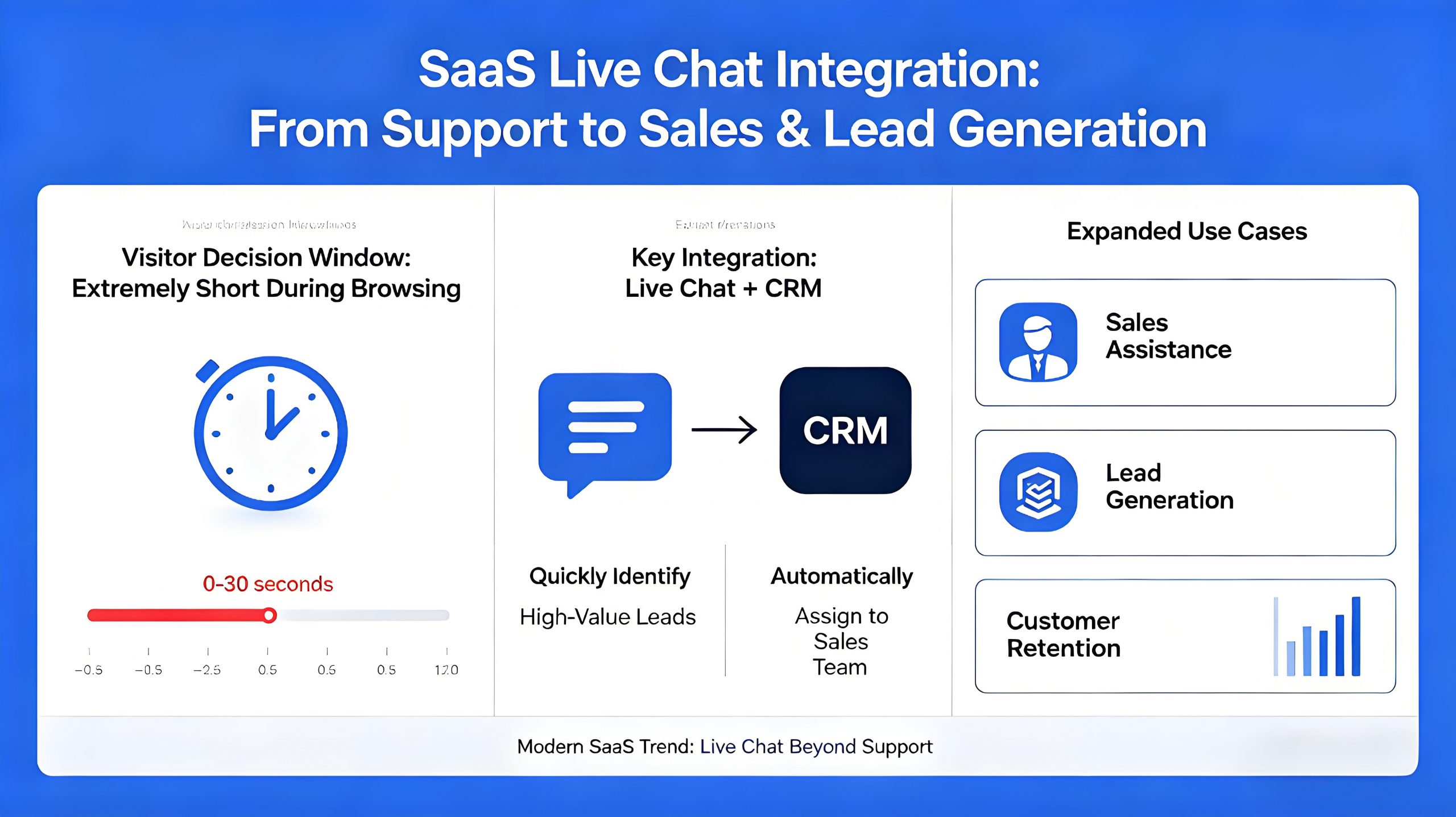
The decision window for website visitors is extremely short during their browsing session. SaaS companies need to integrate live chat with their CRM to quickly identify high-value leads and automatically assign them to the sales team. Live chat software is no longer used only for support; more SaaS companies are also using it for sales assistance, lead generation, and customer retention.
1.2 Efficient Technical Issue Resolution
Compared to physical goods, SaaS products are more complex with numerous error scenarios. The customer chat window must integrate with the product backend, supporting screenshot capture, screen recording, and even real-time crash log transmission.
1.3 Unified Workflow for Multi-Product Ticketing
SaaS companies often handle multiple matters such as subscriptions, renewals, and technical support. After a conversation ends, it needs to seamlessly convert into a ticket that enters a standard SLA tracking process, ensuring no issue gets lost. Mainstream products now integrate AI-driven auto-classification, priority judgment, and routing, effectively reducing manual handoffs.
2. In-Depth Reviews of Top Live Chat Software in 2026
More than 810,000 enterprises worldwide use live chat tools, with intense competition among leading vendors. Below are detailed reviews of the most representative products.
2.1 Udesk – All-in-One Intelligent Customer Service Platform
Udesk is a strong contender for SaaS companies, especially those going global or dealing with complex cross-channel operations. As a leader in the omnichannel customer service space in China, Udesk leverages "omnichannel integration + deep AI empowerment + industry customization" as its core advantage. It has become the preferred choice for many well-known enterprises to improve service efficiency. The platform embeds a self-developed large language model and RAG architecture, achieving intent recognition accuracy above 98 percent. It handles high-concurrency business needs of SaaS companies with system response times consistently under 200ms. Udesk's biggest highlight is its broad channel coverage, supporting one-click integration of over 30 mainstream channels including Douyin, WeChat Work, Facebook, and WhatsApp – "access once, respond across all channels". Its cost-effectiveness is also compelling, with a pay-as-you-go model and no hidden costs. It has served over 20,000 enterprise customers, with deep industry know-how.

2.2 Zendesk – Benchmark for Enterprise-Grade Global Stability
Zendesk represents traditional enterprise-grade SaaS customer service and is ideal for mature global SaaS companies. According to third-party data, Zendesk Chat holds approximately 13.07 percent of the global market share, with over 100,000 customers. Its core strengths include excellent ecosystem integration and an omnichannel unified workspace that seamlessly connects with its own ticketing and knowledge base. Its AI agent can autonomously handle more than 80 percent of repetitive inquiries, supports real-time translation in over 100 languages, and delivers cross-border call latency below 50ms. However, omnichannel features are primarily locked behind the Suites series paywall; the basic live chat functionality is separated from advanced AI capabilities, potentially leading to high upgrade and AI add-on costs. Additionally, Zendesk is relatively weak when integrating domestic Chinese instant messaging channels like WeChat.
2.3 Intercom – Personalized Messaging-Driven Product Experience Expert
Intercom is a favorite among B2B SaaS brands, especially in Silicon Valley. It holds approximately 19.80 percent global market share, serving over 160,000 customers. Intercom excels in live chat, mobile optimization, and email campaign management. Its strength lies in combining live chat with in-product messaging to provide contextually relevant service, making it ideal for tool-based SaaS companies that want to drive user engagement through the chat window. Its disadvantages are equally clear: high pricing and limitations on customization. Starting at around USD 39 per agent per month (billed annually), actual annual expenses typically range from USD 15,000 to 60,000 as conversation volume and user scale grow, making it a significant budget burden for cost-conscious SaaS teams in rapid growth phases.
2.4 LiveChat – Easy-to-Use Solution Focused on Pure Chat Experience
LiveChat is known for its simplicity, speed, and stability, with about 3.83 percent market share, making it a popular choice among SMBs. Its core advantages are a very low entry barrier and a clean agent interface that requires almost no adaptation period, offering a smooth pure chat experience. The downside is its relatively closed ecosystem. If a SaaS company needs to build complex ticketing workflows, robust quality analytics libraries, or integrate standalone data analytics platforms, LiveChat's integration costs and adaptation difficulty become significantly higher than all-in-one platforms. The Starter plan starts at around USD 20 per agent per month, but more powerful automation and BI reporting require upgrading to Business or higher plans.
2.5 Other Notable Global Products
-
Freshdesk: Offers excellent value for money, with the Growth plan at about USD 15 per agent per month, suitable for very small teams on a tight budget.
-
Tidio: Provides a free plan (50 conversations per month), and the Lyro AI bot can automatically resolve up to 64 percent of customer issues, ideal for SaaS teams wanting to trial AI at low cost.
-
Crisp: Offers a free plan with multiple seats, with the Mini plan at about EUR 45 per month for 4 seats, suitable for micro SaaS startup teams.
3. Core Feature Matrix Comparison
To visually compare the performance of the above platforms across different dimensions, the following table summarizes their core capabilities in 2026:
| Evaluation Dimension | Udesk | Zendesk | Intercom | LiveChat |
|---|---|---|---|---|
| Channel Integration Breadth | 30+ domestic and international channels integrated; full WeChat/Douyin + WhatsApp/Facebook coverage | Strong global channel integration; weak on Chinese local channels | Strong international channel coverage; weak localization | Web-focused; relatively limited coverage |
| AI Capability | Self-developed LLM, 98%+ intent recognition; intelligent routing and knowledge assistance | AI agent handles 80%+ repetitive inquiries; real-time summaries | Fin AI Agent加持; proactive messaging and bot capabilities strong | Basic AI; advanced features require higher tiers |
| Deployment & Compliance | Public/private/hybrid cloud; supports trusted computing environment | AWS global infrastructure; comprehensive compliance certifications | SaaS native deployment; mature compliance | Primarily SaaS public cloud |
| Agent Workspace Experience | Unified workspace; omnichannel conversation management | Excellent UI; low learning curve | Modern UI; seamless in-product messaging | Extremely simple; fast onboarding |
| Cost-Effectiveness | Starting at USD 64/month; pay-as-you-go; no hidden costs | High starting price; AI and advanced channels extra | High price threshold; rapidly escalating costs | Starting ~USD 20/month; ecosystem features extra |
As the table shows, different platforms have distinct focuses: Udesk balances channel breadth and cost-effectiveness; Zendesk excels in global enterprise deployment; Intercom leads in in-product messaging; LiveChat is known for extreme simplicity. SaaS companies should align their selection with the dimensions that match their business model, target market, and budget.
4. Pricing Models and Cost Comparison in 2026
In 2026, the pricing structure of live chat software is becoming increasingly complex. Most SaaS traditional quotes no longer charge solely per "agent", but have added pricing levers such as "AI calls" or even "ticket resolutions". Without careful total cost of ownership planning, companies can easily fall into budget traps of low entry prices leading to high upgrade costs. Below is a pricing overview of the five main platforms:
| Software | Base Plan (USD/agent/month) | Advanced Plan (USD/agent/month) | Enterprise Plan (USD/agent/month) | Additional Pricing Notes |
|---|---|---|---|---|
| Udesk | Live Chat plan: 64 | Omnichannel plan: 118 | Custom for large enterprises | Prepaid annually; no mandatory seat minimum; pay-as-you-go model; no hidden dev costs |
| Zendesk | Suite Team: 55 | Suite Growth: 89 | Suite Pro: 115 | Base is seat license; AI add-ons and advanced channels billed extra |
| Intercom | Essential: 39 (annual billing) | Advanced: 99 | Custom contract | Core cost = seat fee + monthly resolved conversations + feature add-ons; mid-large teams often see annual budgets of USD 15k-60k |
| LiveChat | Starter: ~20 | Team: ~41 | Business: ~59 | Mainly seat pricing; AI and advanced reporting modules may have extra fees |
| Freshdesk | Growth: ~15 | Pro: ~49 | Enterprise: ~79 | Low entry price attracts SMBs, but omnichannel modules and advanced AI are sometimes sold as add-ons or Plus components |
SaaS companies doing budgeting need special attention: low starting price does not equal low total cost. Zendesk's core AI capabilities and omnichannel integration may be hidden in add-on fees. Intercom's dual pricing model of "seat fee + usage fee" poses financial volatility risks for rapidly growing businesses with surging conversation volumes. Udesk's base pricing is more transparent: the USD 64 per month starting price already includes native AI capabilities and basic ticketing workflows, and flexible upgrades based on actual seat scale allow for smoother annual budget control. Its hidden maintenance and development costs are significantly lower than the international giants mentioned above.
》》Click to start your free trial of live chat, and experience the advantages firsthand.

The article is original by Udesk, and when reprinted, the source must be indicated:https://www.udeskglobal.com/blog/best-live-chat-software-for-saas-companies-in-2026.html